
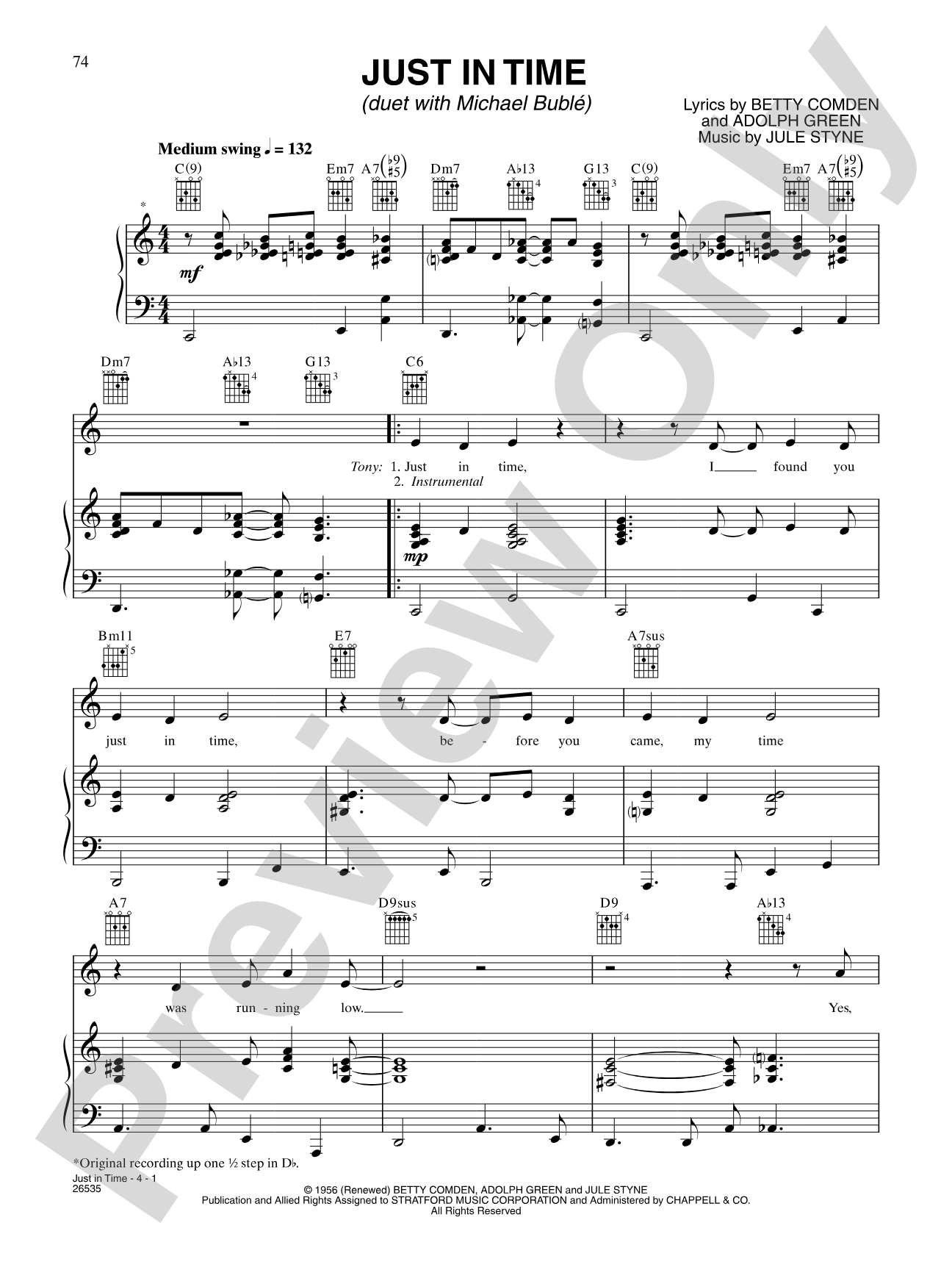

Just In Time: Piano/Vocal/Chords
Tony Bennett
Item: 00-PSP-000139
$4.99
One moment…
Related Items
Lullaby Of Broadway (From "Gold Diggers Of 1935"): Lead Sheet |
$4.99
|
View | |
Are You Havin' Any Fun? (from "Geoger White's Scandals"): Piano/Vocal/Chords |
$4.99
|
View | |
How Do You Keep The Music Playing? (from "Best Friends"): Piano/Vocal/Chords |
$5.99
|
View | |
I Wanna Be Around: Piano/Vocal/Chords |
$4.99
|
View | |
If I Ruled The World (from "Pickwick"): Piano/Vocal/Chords |
$4.99
|
View | |
Lullaby Of Broadway (from "Gold Diggers of 1935"): Piano/Vocal/Chords |
$9.99
|
View | |
Put On A Happy Face (from "Bye, Bye, Birdie"): Piano/Vocal/Chords |
$4.99
|
View | |
Rags To Riches: Piano/Vocal/Chords |
$4.99
|
View | |
The Boulevard Of Broken Dreams (from "Moulin Rouge"): Piano/Vocal/Chords |
$5.99
|
View | |
The Good Life: Piano/Vocal/Chords |
$4.99
|
View |
Description
Alfred is pleased to release the album-matching folio for Tony Bennett's Duets -- An American Classic. Duets -- An American Classic features Tony Bennett singing classic songs with some of the most famous vocalists in the world. This book provides the lyrics along with piano and chord arrangement for all the songs on the record. Titles: Lullaby of Broadway (w/the Dixie Chicks) * Smile (w/Barbara Streisand) * Put on a Happy Face (w/James Taylor) * The Very Thought of You (w/Paul McCartney) * The Shadow of Your Smile (w/Juanes) * Rags to Riches (w/Elton John) * The Good Life (w/Billy Joel) * Cold, Cold Heart (w/Tim McGraw) * The Best is Yet to Come (w/Diana Krall) * For Once in My Life (w/Stevie Wonder) * Are You Havin' Any Fun? (w/Elvis Costello) * Because of You (w/k.d. lang) * Just in Time (w/Michael Bublé) * The Boulevard of Broken Dreams (w/Sting) * I Wanna Be Around (w/Bono) * Sing, You Sinners (w/John Legend) * I Left My Heart in San Francisco * How Do You Keep the Music Playing? (w/George Michael) * If I Ruled The World (w/Celine Dion).


Just In Time: Piano/Vocal/Chords isn't in MakeMusic Cloud just yet...but it could be. Let us know you'd like to see it, and you'll help shape what comes next. In the meantime, start a free trial and dive into thousands of interactive titles your students can play along with today.
Request This Title
Tell us you want it.
Start Your Free Trial
Explore everything that's ready to play right now.
Sample Audio
No sample audio found.
Sample Video
No sample videos found.
Additional Details
Publisher:
Alfred Music
Page Count:
104
SKU:
00-PSP-000139
More about this title
About the Artist: Tony Bennett
Tony Bennett is a legendary jazz and popular standards vocalist whose career spans more than seven decades. Born Anthony Dominick Benedetto in 1926, Bennett became one of the most celebrated interpreters of the American songbook, known for his impeccable phrasing, emotional depth, and commitment to musical excellence across generations.
Why we love this
This folio captures Bennett's artistry at its finest, pairing timeless standards with contemporary vocalists in arrangements that honor both the songs' original spirit and modern sensibilities. For pianists accompanying singers or leading jazz ensembles, the collection offers 19 essential standards with authentic chord changes and lyrics, making it an invaluable resource for understanding how to voice these classics in a contemporary context. The roster of duet partners represents multiple musical worlds, showing how the Great American Songbook bridges jazz, pop, country, and soul.
What to expect
Opening this book feels like stepping into a master class in vocal artistry and arrangement craft. Each song carries the warmth and wisdom that defines Bennett's interpretive approach, grounded in melodies that have endured for decades yet feel immediate and personal.
Who it's for
This folio serves pianists who accompany vocalists in jazz and standards-based settings, music directors preparing singers for recitals or ensemble performances, and solo pianists exploring the American songbook through its most celebrated interpretations. It's equally valuable for jazz pianists studying contemporary arrangement approaches and for music teachers using authentic materials to deepen students' understanding of how standards evolve.
How to get the most out of it
- Study how Bennett approaches phrasing on the original recordings; his economy of vibrato and rhythmic placement are distinctive features that shape the melody line even when you're playing accompaniment.
- Pay attention to the chord voicings provided, as they reflect arrangements designed for modern listeners while maintaining jazz harmony standards; experiment with comping techniques that support the vocalist without overwhelming the lyric.
- Balance the richness of the piano sound with space for the vocal line; these standards thrive on clarity and the interplay between accompaniment and melody rather than constant full texture.
How to use it
Integrate individual selections into recital programs or jazz ensemble concerts, pairing them with contemporary vocalists to mirror the duet concept on the album. Use the collection to build a standards-focused concert or workshop where singers explore how classic melodies translate across musical genres, or assign selections as study materials for piano students accompanying singers in lessons and performances.
Skills your students will build
- Reading piano/vocal/chord notation and interpreting chord symbols in jazz and standards contexts
- Accompanying vocalists with sensitive, supportive comping rather than overbearing full arrangements
- Understanding harmonic movement in standards-based songwriting and recognizing common progressions across multiple pieces
- Phrasing coordination between accompanist and vocalist, including rhythmic flexibility and space management