
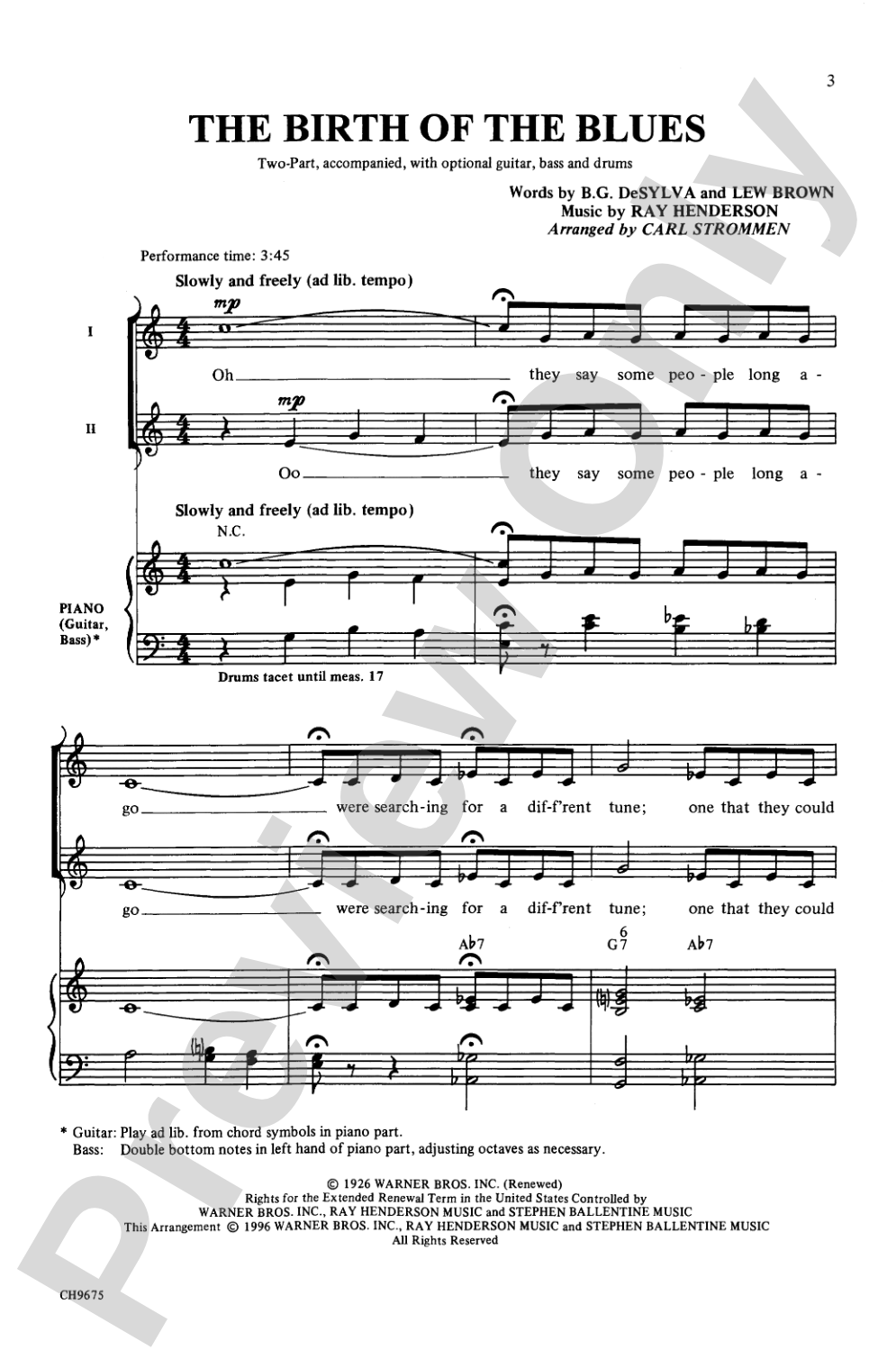
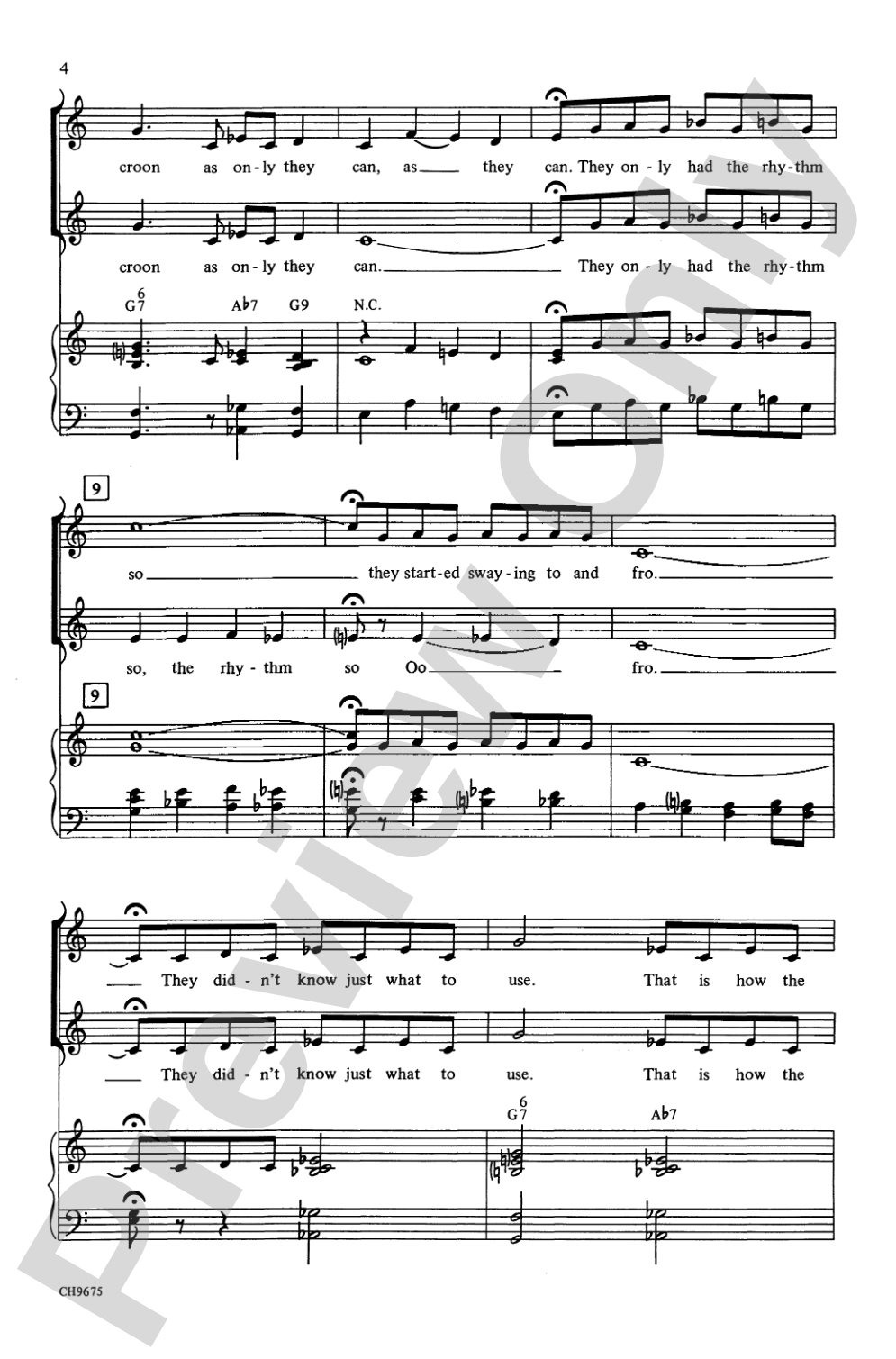

The Birth of the Blues: 2-Part Choral Octavo
Arr. Carl Strommen
Level: Moderate
Item: 00-PO-0004713
$2.25
Minimum order quantity: 20 copies
One moment…
Related Items
The Birth of the Blues: SATB Choral Octavo |
$2.25
|
View | |
The Birth of the Blues: 3-Part Mixed Choral Octavo |
$2.25
|
View | |
The Birth of the Blues: SATB Choral Octavo |
$2.25
|
View | |
The Birth of the Blues: 3-Part Mixed Choral Octavo |
$2.25
|
View | |
The Birth of the Blues: Choral Octavo SoundTrax CD |
$22.95
|
View |
Description
This Broadway hit of 1926, from the great songwriting team of DeSylva, Brown and Henderson, has also been featured in numerous Hollywood motion pictures. Carl's creative arrangement captures all the jazzy nuances to maintain the original feel that has helped to make this tune a blockbuster among Broadway standards. Programming possibilities abound!


The Birth of the Blues: 2-Part Choral Octavo isn't in MakeMusic Cloud just yet...but it could be. Let us know you'd like to see it, and you'll help shape what comes next. In the meantime, start a free trial and dive into thousands of interactive titles your students can play along with today.
Request This Title
Tell us you want it.
Start Your Free Trial
Explore everything that's ready to play right now.
Sample Audio
No sample audio found.
Sample Video
No sample videos found.
Additional Details
Series:
Alfred Archive Edition: Pop Choral Series
Publisher:
Alfred Music
Page Count:
12
SKU:
00-PO-0004713
More about this title
About the Arranger: Carl Strommen

Carl Strommen's work spans band, orchestra, jazz ensemble, and choral repertoire, establishing him as one of the most frequently performed arrangers across concert halls, broadcast media, and film productions worldwide. His consistent excellence has earned him the annual ASCAP Standard Writers Award throughout his career. A City College of New York graduate, Strommen teaches orchestration and composition as an adjunct professor at C.W. Post Campus of Long Island University while maintaining an active schedule as both a clinician and commissioned composer.
Clinicians and directors regularly seek out Strommen arrangements for their musicality and practical scoring. His work demonstrates deep knowledge of ensemble capabilities at every level, from accessible school settings to professional venues.
Why we love this
Strommen's arrangement preserves the swing and swagger of this 1926 standard without overcomplicating the voicing, making it genuinely singable for developing choirs. The jazz language feels authentic rather than cartoonish, and the two-part writing creates space for clear part independence while keeping rehearsal time reasonable. It's a piece that sounds far more sophisticated than its moderate difficulty suggests.
What to expect
The arrangement swings with a relaxed sophistication, evoking the energy of 1920s Broadway while remaining fresh and accessible. There's a warmth to the voicing that invites singers to lean into the phrasing and enjoy the storytelling at the heart of the song.
Who it's for
This octavo works well for middle school and early high school choirs seeking authentic popular song material that engages singers without demanding extensive vocal maturity. It suits programs looking to program a genuine jazz-inflected standard alongside more contemporary pop or classical selections.
How to get the most out of it
- Shape the phrasing with attention to the song's lyrical lines; let the natural Broadway melodicism guide your interpretation rather than driving rhythmically.
- Balance the two parts so neither overwhelms the other, especially during the head voice moments typical of jazz-influenced writing.
- Articulate the syncopated rhythms cleanly without rushing; the "bluesy" feel depends on relaxed precision rather than aggressive attack.
- If using the recorded accompaniment, rehearse several times without it first so singers own their parts and blend before matching the track.
How to use it
Pair this with other standards from Strommen's arrangements or use it as a bridge between classical and contemporary pop on a concert focused on American musical theater. It also serves well as a confidence builder mid-season when your ensemble is ready for something with real character but still developing secure technique.
Skills your students will build
- Reading syncopated rhythms in a jazz context
- Balancing two independent vocal lines with clear part definition
- Shaping phrases with lyrical sensitivity within a rhythmic framework
- Performing swing articulation and jazz-influenced diction