
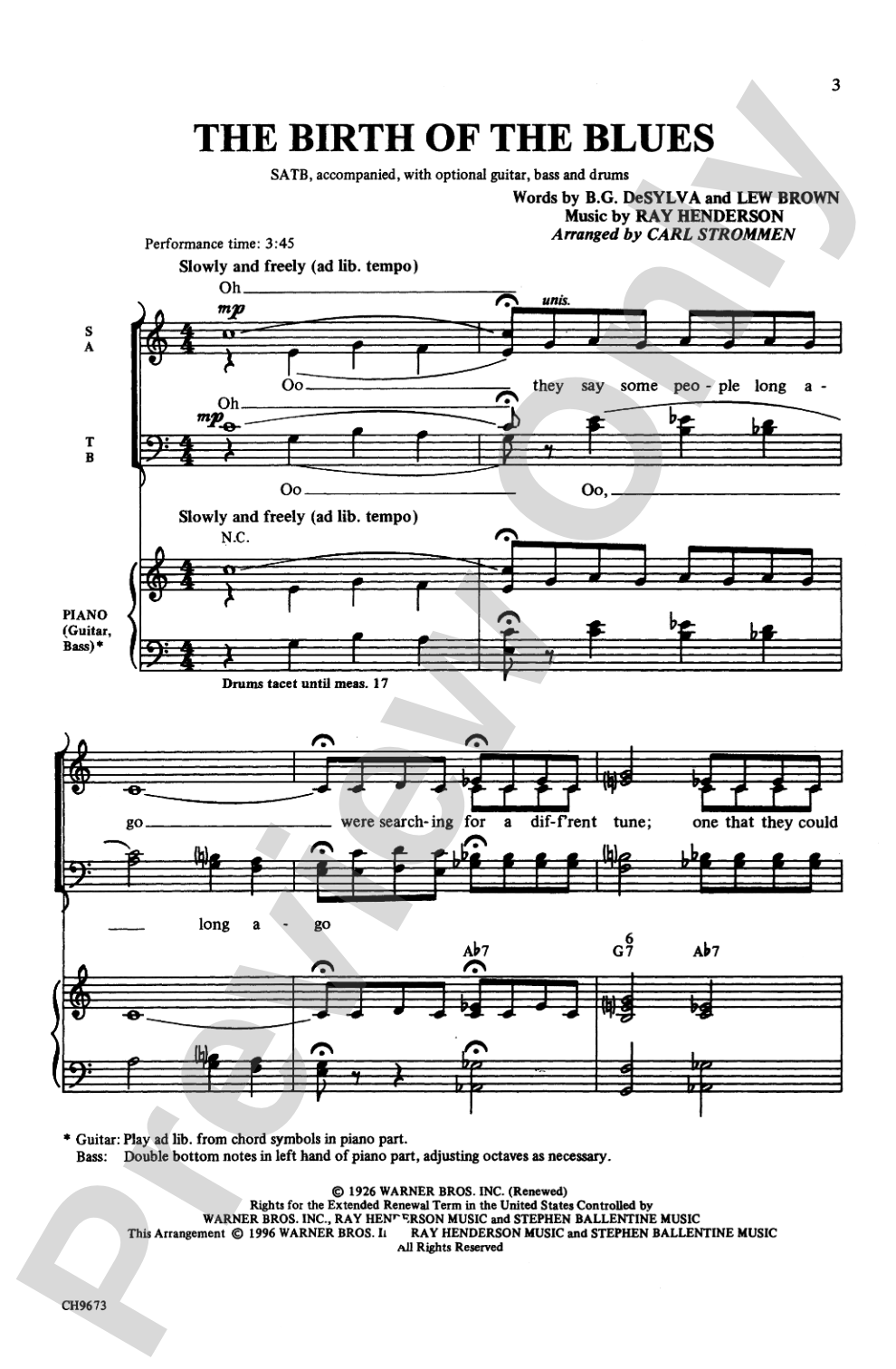
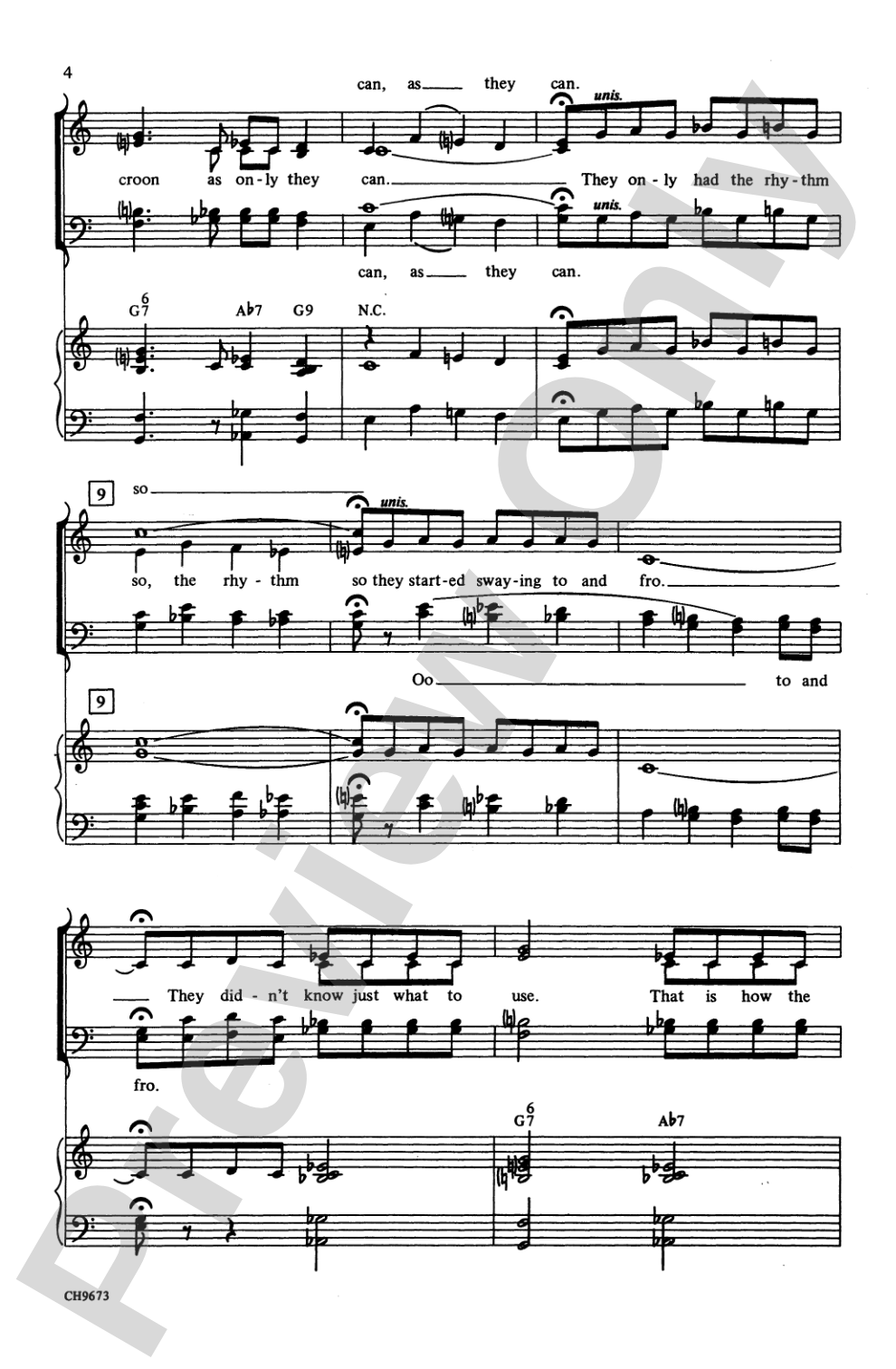

The Birth of the Blues: SATB Choral Octavo
Arr. Carl Strommen
Level: Moderate
Item: 00-PO-0002515
$2.25
Minimum order quantity: 20 copies
One moment…
Related Items
The Birth of the Blues: 3-Part Mixed Choral Octavo |
$2.25
|
View | |
The Birth of the Blues: 2-Part Choral Octavo |
$2.25
|
View | |
The Birth of the Blues: SATB Choral Octavo |
$2.25
|
View | |
The Birth of the Blues: 3-Part Mixed Choral Octavo |
$2.25
|
View | |
The Birth of the Blues: Choral Octavo SoundTrax CD |
$22.95
|
View |
Description
This Broadway hit of 1926, from the great songwriting team of DeSylva, Brown and Henderson, has also been featured in numerous Hollywood motion pictures. Carl's creative arrangement captures all the jazzy nuances to maintain the original feel that has helped to make this tune a blockbuster among Broadway standards. Programming possibilities abound!


The Birth of the Blues: SATB Choral Octavo isn't in MakeMusic Cloud just yet...but it could be. Let us know you'd like to see it, and you'll help shape what comes next. In the meantime, start a free trial and dive into thousands of interactive titles your students can play along with today.
Request This Title
Tell us you want it.
Start Your Free Trial
Explore everything that's ready to play right now.
Sample Audio
No sample audio found.
Sample Video
No sample videos found.
Additional Details
Series:
Alfred Archive Edition: Alfred Pop Choral Series
Publisher:
Alfred Music
Page Count:
12
SKU:
00-PO-0002515
More about this title
About the Arranger: Carl Strommen
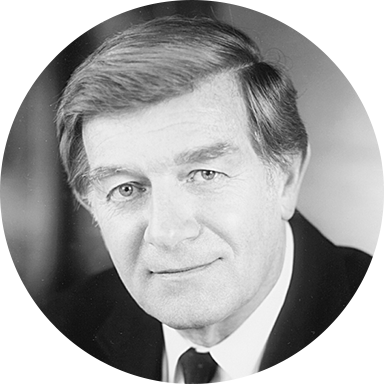
Carl Strommen's arrangements and compositions span band, orchestra, jazz ensemble, and vocal music, making him one of the most widely performed creators in these genres. His work regularly appears in concert halls, on television, and in film, and he remains a sought-after clinician and commission composer who has earned multiple ASCAP Standard Writers Awards throughout his career.
Strommen holds a degree from the City College of New York and has served on the faculty at C.W. Post Campus of Long Island University, where he teaches orchestration and composition. He maintains deep roots in both the academic and professional music communities.
Why we love this
Strommen's arrangement preserves the jazzy character and infectious energy of this 1926 standard while keeping the voicing accessible for intermediate choirs. The arrangement honors the Broadway tradition without overwhelming singers, and the recorded accompaniment option makes this perfect for festival season or concert programming where a polished, swinging sound matters.
What to expect
Sophisticated without pretension. The piece has the swagger and smoothness of a 1920s jazz standard, with harmonic warmth and a melody that sits naturally in the voice. It feels like stepping into a supper club where the band knows exactly what they're doing.
Who it's for
Intermediate choirs (high school, college, adult ensembles) seeking a Broadway standard that's stylistically authentic yet manageable at Grade 3. This works equally well for directors building a mixed-voice repertoire or planning a concert that spans American musical theater.
How to get the most out of it
- Lean into the swing feel. This isn't a straight rhythmic piece; the jazz articulation and phrasing make the difference between a dutiful reading and a performance that sparkles.
- Balance the parts so the melody sings through without the lower voices getting swallowed. Strommen's voicing is lean and clear, which rewards careful attention to blend.
- If using the recorded accompaniment, rehearse with it early and often so your singers internalize the groove rather than fighting against it.
How to use it
Program this as part of a Broadway or American standards set, where it can anchor a set of lighter, swinging pieces. It also works as a standalone crowd-pleaser in pops or gala concerts, and its festival-friendly length makes it ideal for a spring or fall festival season.
Skills your students will build
- Jazz-inflected phrasing and rhythmic interpretation
- Swing articulation and style authenticity
- SATB blend and balance in four-part writing
- Working with recorded accompaniment
- Interpretation of period vocal style (1920s Broadway)