
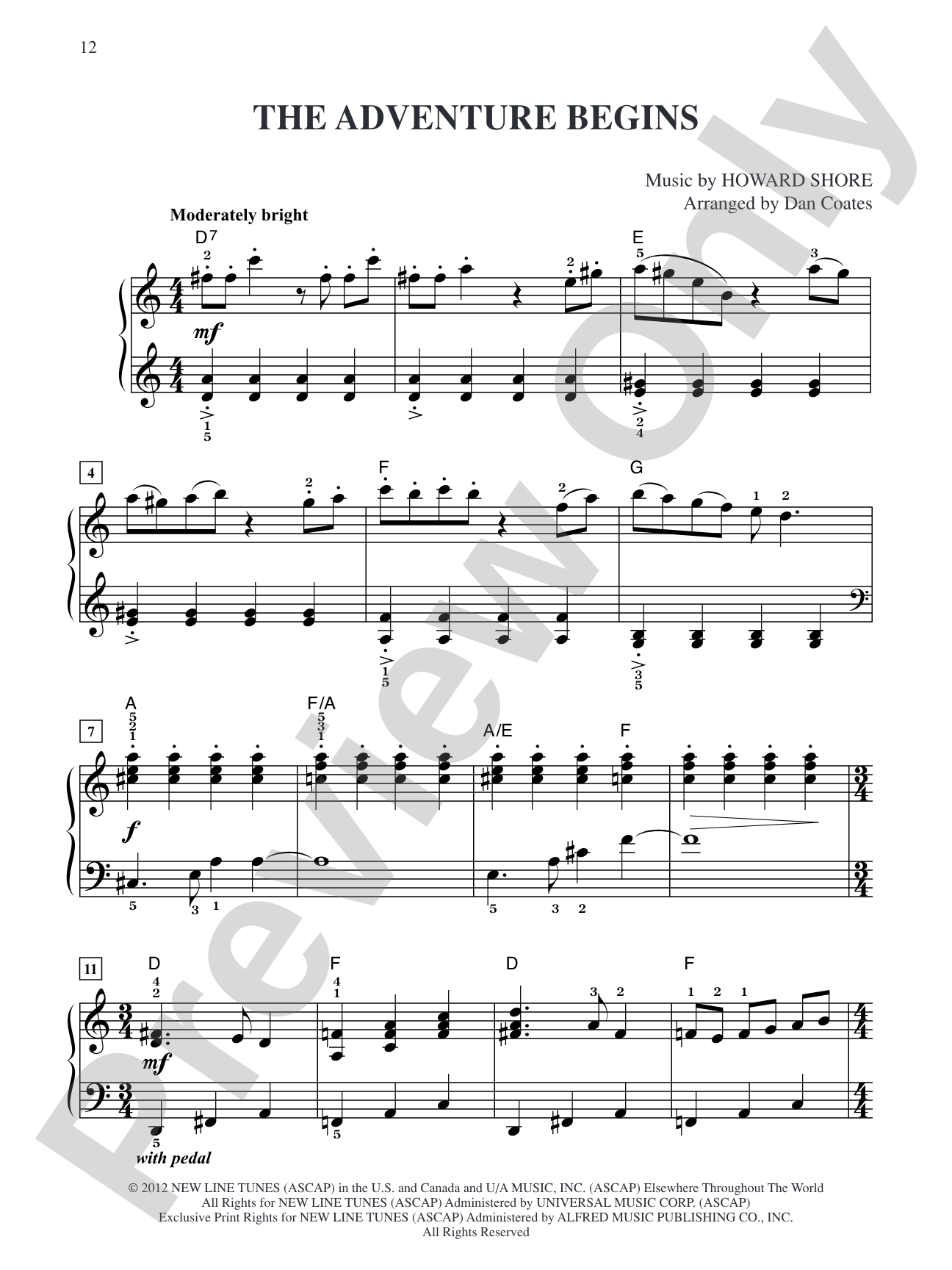

The Adventure Begins (from The Hobbit: An Unexpected Journey): Easy Piano
Sheet Music Selections from the Motion Picture
Music composed by Howard Shore / arr. Dan Coates
Level: Easy Piano
Item: 00-PS-0015895
$4.99
One moment…
Related Items
An Unexpected Party (from The Hobbit: An Unexpected Journey): Easy Piano |
$5.99
|
View | |
Misty Mountains (from The Hobbit: An Unexpected Journey): Easy Piano |
$4.99
|
View | |
Dreaming of Bag End (from The Hobbit: An Unexpected Journey): Easy Piano |
$4.99
|
View | |
Song of the Lonely Mountain (from The Hobbit: An Unexpected Journey): Easy Piano |
$4.99
|
View | |
A Very Respectable Hobbit (from The Hobbit: An Unexpected Journey): Easy Piano |
$5.99
|
View | |
Erebor (from The Hobbit: An Unexpected Journey): Easy Piano |
$4.99
|
View | |
The Dwarf Lords (from The Hobbit: An Unexpected Journey): Easy Piano |
$4.99
|
View | |
The Hobbit: An Unexpected Journey: Piano Book |
$15.99
|
View |
Description
Play selections from Howard Shore's brilliant score to The Hobbit: An Unexpected Journey! The eight arrangements in this collection are notably easier to play than those in the separately published piano/vocal edition. For The Hobbit, Howard Shore masterfully expands upon the musical palette of Middle-earth, blending familiar motifs from the The Lord of the Rings trilogy with an exciting array of memorable new themes. In addition to the piano arrangements, this beautifully produced souvenir folio features an array of colorful photos from the film. Titles: An Unexpected Party * Misty Mountains * The Adventure Begins * Song of the Lonely Mountain * Dreaming of Bag End * A Very Respectable Hobbit * Erebor * The Dwarf Lords.


The Adventure Begins (from The Hobbit: An Unexpected Journey): Easy Piano isn't in MakeMusic Cloud just yet...but it could be. Let us know you'd like to see it, and you'll help shape what comes next. In the meantime, start a free trial and dive into thousands of interactive titles your students can play along with today.
Request This Title
Tell us you want it.
Start Your Free Trial
Explore everything that's ready to play right now.
Sample Audio
No sample audio found.
Sample Video
No sample videos found.
Additional Details
Publisher:
Alfred Music
Page Count:
36
SKU:
00-PS-0015895
More about this title
About the Composer: Howard Shore
Howard Shore is a composer whose film scores have shaped modern cinema for over four decades. His work on the Lord of the Rings trilogy established him as a master of orchestral storytelling, and his ability to create thematic richness within massive ensemble contexts has made him indispensable to large-scale fantasy projects.
For The Hobbit trilogy, Shore returned to Middle-earth with a compositional approach that honored the musical language he had established while creating fresh material that captured the lighter tone and adventure of Bilbo's journey. His understanding of how motifs can carry meaning across entire film narratives makes his work particularly valuable for music students learning how leitmotif functions in dramatic storytelling.
Why we love this
These arrangements capture the sweep and character of Shore's orchestral writing without requiring virtuosic technique. Dan Coates has preserved the melodic integrity and harmonic color of the score while making it accessible to pianists still building their facility, which means students can experience genuine film music composition rather than simplified versions stripped of their musical content.
What to expect
These pieces capture the sense of stepping into a vast, fantastical world. Whether navigating the comforting nostalgia of the Shire or the grand, mountain-dwelling pride of the dwarves, the music balances intimacy with epic scope. There's a quality of discovery throughout, as though each piece invites the pianist to explore a new corner of Middle-earth.
Who it's for
Pianists at the early-intermediate level who want to play music that sounds and feels substantial without the technical demands of the original film score. This collection works equally well for students looking for repertoire that connects film and concert music, and for teachers seeking material that motivates students through familiar and beloved melodies.
How to get the most out of it
- Pay attention to tempo and pacing in the slower pieces like Dreaming of Bag End. Shore's film music often works through sustained harmonic movement, so resist the urge to rush passages with wider spacing or longer note values.
- Listen to the film versions of these pieces before you learn them. Knowing how the melody sits in the original orchestration will help you shape the piano line with the right color and articulation.
- Use pedal deliberately in pieces like Misty Mountains and Erebor to enhance the atmospheric quality, but change it frequently enough to keep harmonies clear. These arrangements rely on harmonic resonance to capture the film's sense of wonder.
- Think of yourself as conducting an orchestra through these pieces rather than playing notes on a keyboard. The phrasing, dynamics, and tempo flexibility Shore uses in the film score translate directly to how a pianist should approach these arrangements.
How to use it
Feature a single arrangement as a palette cleanser between contrasting pieces in a student recital, or program several selections together to create a mini-suite that showcases how film composers use thematic development. These pieces also work well in community or school concert settings where audiences connect with the film, making them valuable bridges between classical and contemporary music.
Skills your students will build
- Sustaining musical phrasing across passages with varied harmonic rhythm
- Pedal control and selective use for harmonic color without muddiness
- Interpreting leitmotif and character through melodic emphasis and accompaniment texture
- Understanding how film scores balance lyrical melody with harmonic sophistication
- Tempo flexibility and rubato within a structured harmonic framework