
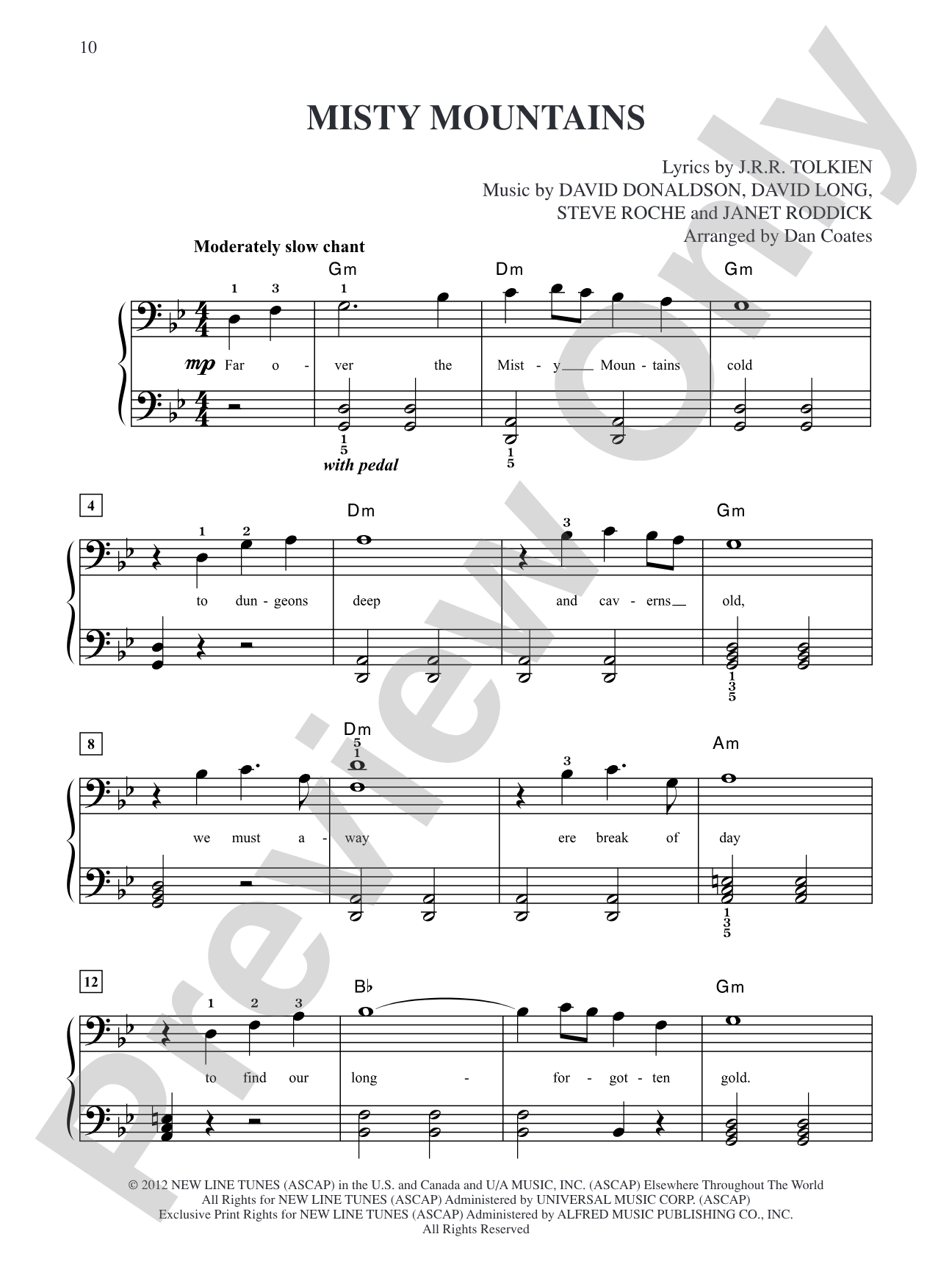

Misty Mountains (from The Hobbit: An Unexpected Journey): Easy Piano
Sheet Music Selections from the Motion Picture
Music composed by Howard Shore / arr. Dan Coates
Level: Easy Piano
Item: 00-PS-0015894
$4.99
One moment…
Related Items
An Unexpected Party (from The Hobbit: An Unexpected Journey): Easy Piano |
$5.99
|
View | |
The Adventure Begins (from The Hobbit: An Unexpected Journey): Easy Piano |
$4.99
|
View | |
Dreaming of Bag End (from The Hobbit: An Unexpected Journey): Easy Piano |
$4.99
|
View | |
Song of the Lonely Mountain (from The Hobbit: An Unexpected Journey): Easy Piano |
$4.99
|
View | |
A Very Respectable Hobbit (from The Hobbit: An Unexpected Journey): Easy Piano |
$5.99
|
View | |
Erebor (from The Hobbit: An Unexpected Journey): Easy Piano |
$4.99
|
View | |
The Dwarf Lords (from The Hobbit: An Unexpected Journey): Easy Piano |
$4.99
|
View | |
The Hobbit: An Unexpected Journey: Piano Book |
$15.99
|
View |
Description
Play selections from Howard Shore's brilliant score to The Hobbit: An Unexpected Journey! The eight arrangements in this collection are notably easier to play than those in the separately published piano/vocal edition. For The Hobbit, Howard Shore masterfully expands upon the musical palette of Middle-earth, blending familiar motifs from the The Lord of the Rings trilogy with an exciting array of memorable new themes. In addition to the piano arrangements, this beautifully produced souvenir folio features an array of colorful photos from the film. Titles: An Unexpected Party * Misty Mountains * The Adventure Begins * Song of the Lonely Mountain * Dreaming of Bag End * A Very Respectable Hobbit * Erebor * The Dwarf Lords.


Misty Mountains (from The Hobbit: An Unexpected Journey): Easy Piano isn't in MakeMusic Cloud just yet...but it could be. Let us know you'd like to see it, and you'll help shape what comes next. In the meantime, start a free trial and dive into thousands of interactive titles your students can play along with today.
Request This Title
Tell us you want it.
Start Your Free Trial
Explore everything that's ready to play right now.
Sample Audio
No sample audio found.
Sample Video
No sample videos found.
Additional Details
Publisher:
Alfred Music
Page Count:
36
SKU:
00-PS-0015894
More about this title
Why we love this
Dan Coates has stripped away the technical demands without sacrificing the sweeping character of Shore's themes, making these arrangements genuinely playable for intermediate pianists who love film music. The collection balances iconic moments like the Misty Mountains song with atmospheric underscore cues, so you get both singable melodies and the cinematic depth that makes Hobbit music so distinctive. Your students will recognize every title instantly, which means they'll stay motivated through the technical work.
What to expect
Coates captures the mythic, adventurous spirit of Middle-earth without demanding leaps across the keyboard or complex rhythmic figures. You'll find yourself in misty, contemplative moments that feel cinematic and dreamlike, then shift into more energetic sequences that capture the thrill of the journey. The writing favors singable melodies and clear harmonic movement, so the music flows naturally under your fingers.
Who it's for
Pianists at the early-intermediate level who want to play recognizable film music without the technical barriers of more advanced arrangements. Students preparing recitals will appreciate having eight distinct pieces at a consistent, manageable difficulty level. Anyone teaching piano who needs accessible repertoire tied to popular culture will find immediate student engagement here.
How to get the most out of it
- Let the sustained chords in the left hand establish the film's epic scope; resist the urge to rush through these foundational passages, as they set the emotional tone for each piece.
- Pay close attention to dynamic markings around key melodic moments. Shore's orchestral writing translates to piano through careful shaping of phrase endings and strategic use of softer dynamics before climactic passages.
- Balance the melodic line against accompaniment textures by listening for which voice carries the primary theme in each section. Some pieces layer multiple motifs, and clarity comes from choosing which one to highlight.
- Approach tempo changes gradually rather than abruptly. These arrangements often shift between reflective passages and action-driven sections, so transitions work best when they feel natural rather than mechanical.
How to use it
These arrangements work beautifully in a student recital featuring a film music theme or a multi-composer program. You might also use individual pieces as supplementary material in a piano method curriculum, pairing them with technical studies at a similar level. A student performing multiple pieces from this collection creates a cohesive concert segment that showcases different moods within a single score.
Skills your students will build
- Sustaining long melodic lines across hand position changes
- Balancing melody and accompaniment in multi-voice textures
- Reading and executing dynamic contrast (pp to ff across an eight-page arrangement)
- Interpreting tempo and style markings specific to film music scoring
- Pedal technique for atmospheric, sustained chord passages
- Maintaining rhythmic clarity in pieces that blend orchestral textures onto a single keyboard