
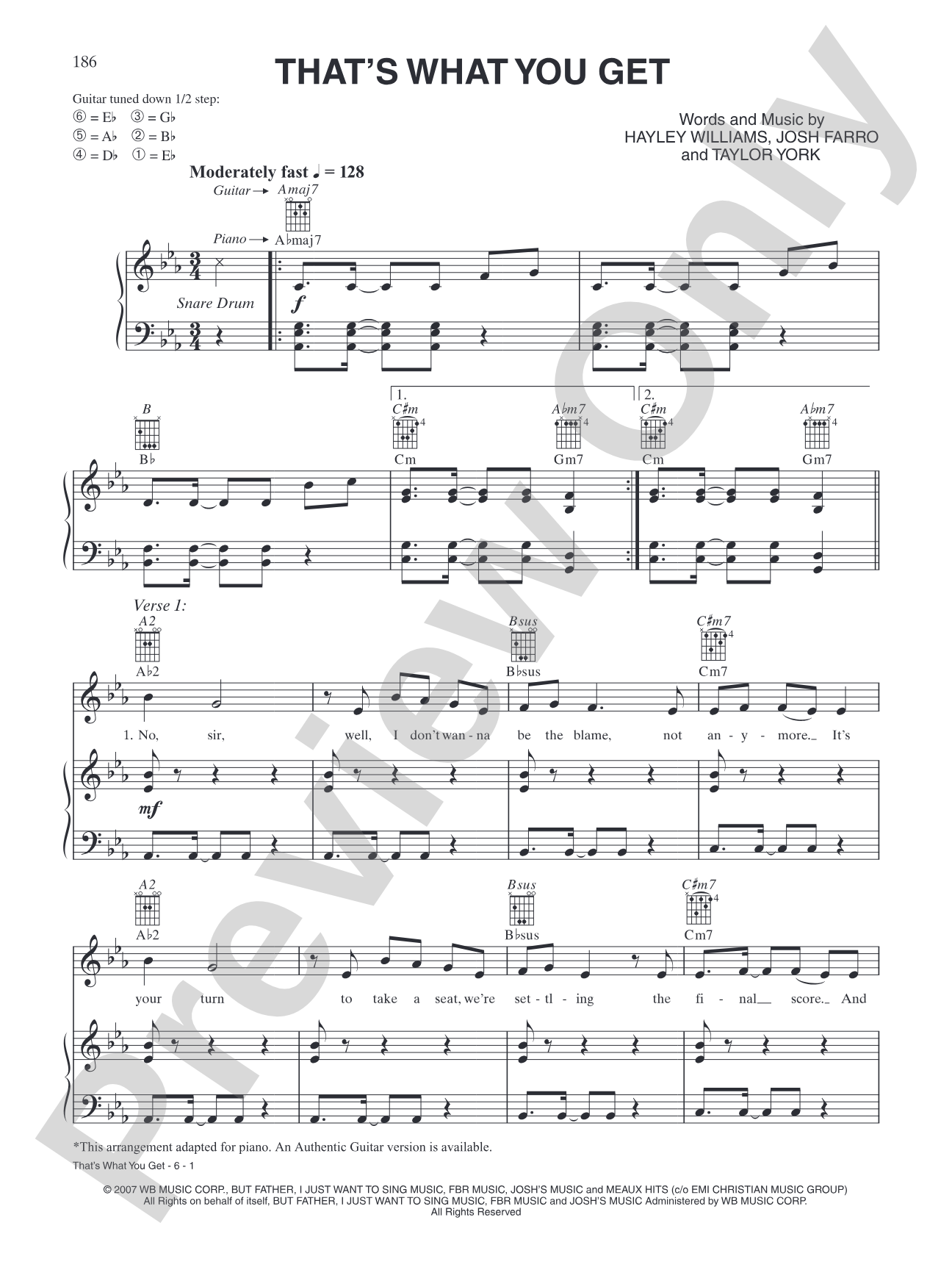
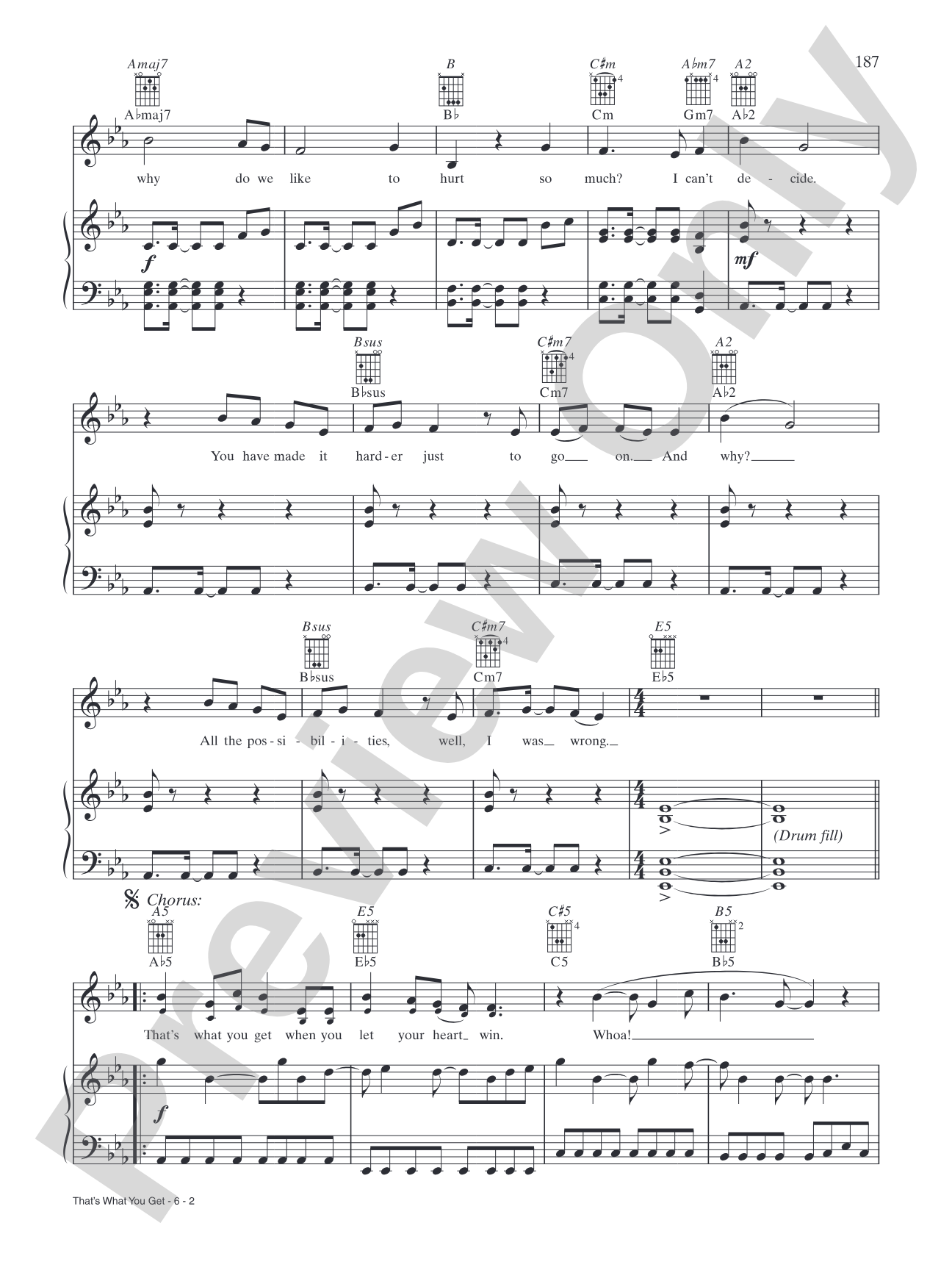

That's What You Get: Piano/Vocal/Chords
Songs That Made the Year!
Item: 00-PS-0010932
$5.99
One moment…
Related Items
Praying for Time: Piano/Vocal/Chords |
$4.99
|
View | |
Sorry: Piano/Vocal/Chords |
$4.99
|
View | |
Lost: Piano/Vocal/Chords |
$5.99
|
View | |
Psycho: Piano/Vocal/Chords |
$5.99
|
View | |
The Story: Piano/Vocal/Chords |
$5.99
|
View | |
4 Minutes: Piano/Vocal/Chords |
$5.99
|
View | |
Leavin': Piano/Vocal/Chords |
$4.99
|
View | |
Paralyzer: Piano/Vocal/Chords |
$5.99
|
View | |
Whatever it Takes: Piano/Vocal/Chords |
$5.99
|
View | |
Porcelain Doll: Piano/Vocal/Chords |
$5.99
|
View |
Description
Titles: 4 Minutes (Madonna and Justin Timberlake) * All Summer Long (Kid Rock) * Almost Lover (A Fine Frenzy) * A-Punk (Vampire Weekend) * Auld Lang Syne (Mairi Campbell and Dave Francis) * Crush (David Archuleta) * Do You Believe Me Now (Jimmy Wayne) * Don't Stop the Music (Rihanna) * Everything (Michael Bublé) * Falling Slowly (from Once) (Glen Hansard and Marketa Irglova) * Goodbye Philadelphia (Peter Cincotti) * Halo 3 Theme: One Final Effort (Martin O'Donnell and Michael Salvatori) * Hey There Delilah (Plain White T's) * Home (Blake Shelton) * Hot N Cold (Katy Perry) * I Kissed a Girl (Katy Perry) * In Love with a Girl (Gavin DeGraw) * In My Arms (Plumb) * Just Got Started Lovin' You (James Otto) * Last Name (Carrie Underwood) * Leavin' (Jesse McCartney) * Lost (Michael Bublé) * New Soul (Yael Naïm) * One Step at a Time (Jordin Sparks) * Our Time Now (Plain White T's) * Paralyzer (Finger Eleven) * Porcelain Doll (Megan McCauley) * Praying for Time (Carrie Underwood) * Psycho (Puddle of Mudd) * Sorry (Buckcherry) * The Story (Brandi Carlile) * That's What You Get (Paramore) * What About Now (Daughtry) * Whatever It Takes (Lifehouse).


That's What You Get: Piano/Vocal/Chords isn't in MakeMusic Cloud just yet...but it could be. Let us know you'd like to see it, and you'll help shape what comes next. In the meantime, start a free trial and dive into thousands of interactive titles your students can play along with today.
Request This Title
Tell us you want it.
Start Your Free Trial
Explore everything that's ready to play right now.
Sample Audio
No sample audio found.
Sample Video
No sample videos found.
Additional Details
Series:
Sheet Music Playlist
Publisher:
Alfred Music
Page Count:
208
SKU:
00-PS-0010932
More about this title
About the Composer: Hayley Williams
Hayley Williams is the lead vocalist and primary songwriter for Paramore, the alternative rock band that emerged in the mid-2000s. Her songwriting voice blends introspective lyrics with driving melodies and dynamic arrangements that appeal across age groups and skill levels. Williams has written some of the most recognizable pop-rock songs of the past two decades, making her work highly relevant for contemporary music education and student engagement.
Why we love this
This collection captures 35 hits spanning pop, rock, country, and alternative styles from the 2000s, giving pianists and vocalists immediate access to songs they already know and care about. The mix of contemporary standards (Michael Bublé, Rihanna, Katy Perry) alongside indie and alternative tracks (Plain White T's, Vampire Weekend, Paramore) means students encounter genuinely diverse musical styles in one affordable download. The chord notations make it accessible for accompanists and singers working together, whether in a studio setting, rehearsal room, or private lesson.
What to expect
These songs live in the space between raw pop production and singer-songwriter vulnerability. You'll move from upbeat dance tracks and arena-ready anthems to quieter, acoustic-leaning ballads, all of which carry genuine emotional weight despite their accessibility. The piano/vocal/chord format lets you strip songs down to their core or build them back up, depending on what the moment calls for.
Who it's for
This folio works for pianists accompanying singers in lessons or recitals, vocalists learning contemporary repertoire across multiple genres, and accompaniment students building facility with pop and rock arrangements. It is also valuable for music teachers and directors seeking current, recognizable material to engage students who might not connect with classical or traditional repertoire.
How to get the most out of it
- Anchor your chord voicings to the recorded versions whenever possible; these arrangements assume familiarity with the original productions, so matching that rhythmic feel in your left hand matters as much as the melody line.
- For songs with multiple vocal ranges represented (like Michael Bublé and Carrie Underwood tracks), transpose thoughtfully rather than forcing a single key; piano/vocal/chord charts are designed for flexible key centers.
- Balance lyric clarity with rhythmic pocket; many of these songs sit in a pop sensibility where the groove and lyrics are equally important, so avoid over-interpreting traditional piano dynamics.
How to use it
Stock this in your studio library for accompanying vocalists at recitals, or use individual songs as teaching tools for rhythm, jazz comping, and voice-leading in ensemble settings. The breadth of styles makes it useful for curriculum building across levels; students learning accompanimental skills can work through multiple genres in one resource.
Skills your students will build
- reading and voicing jazz-influenced chord symbols in contemporary contexts
- adapting melodic lines and accompaniment patterns across different key centers
- balancing lyrical phrasing with rhythmic groove in pop and rock styles
- sight-reading chord charts and lead-sheet notation
- understanding song form and arrangement in commercial production (verse-chorus-bridge, production dynamics)