
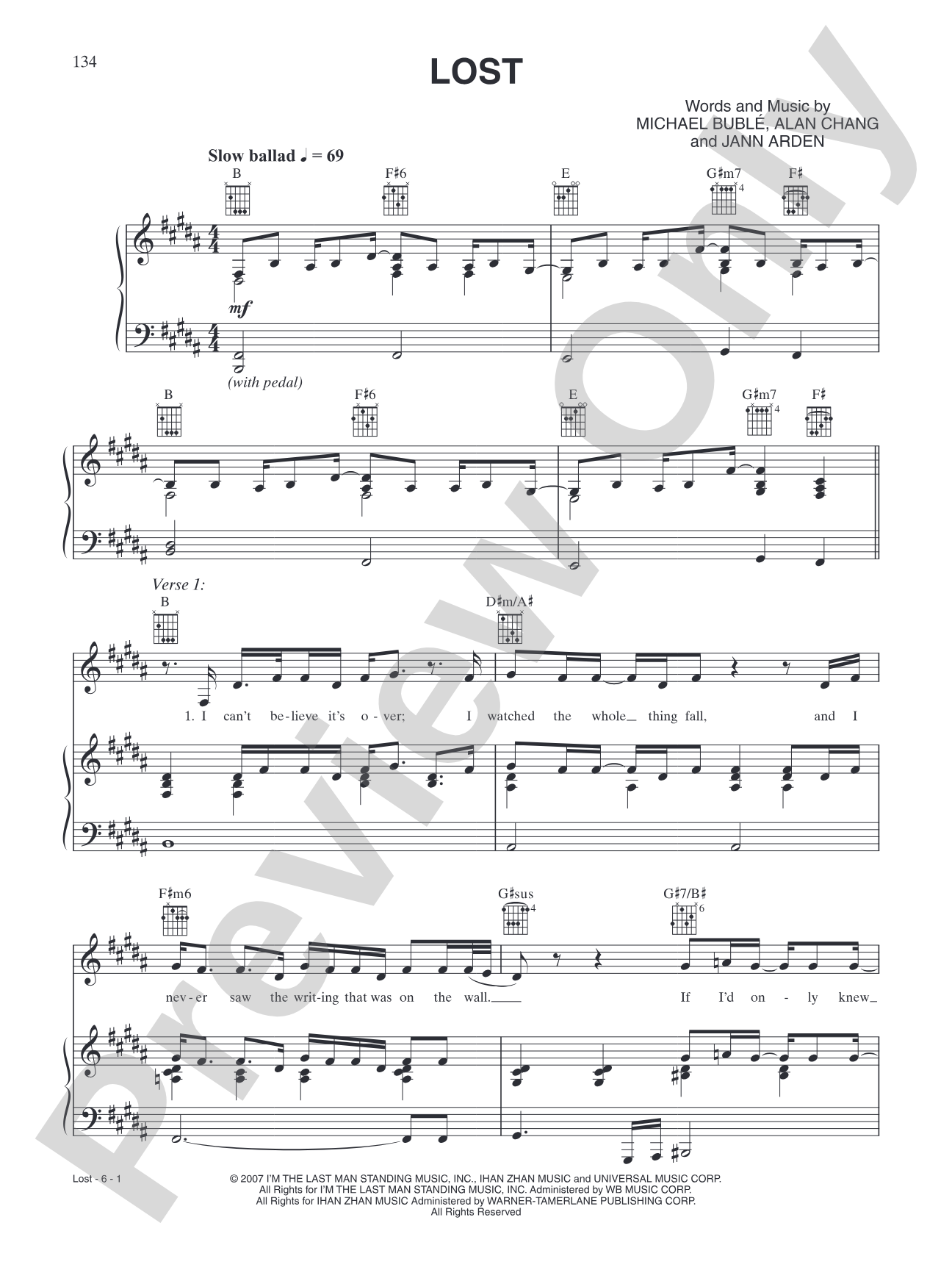
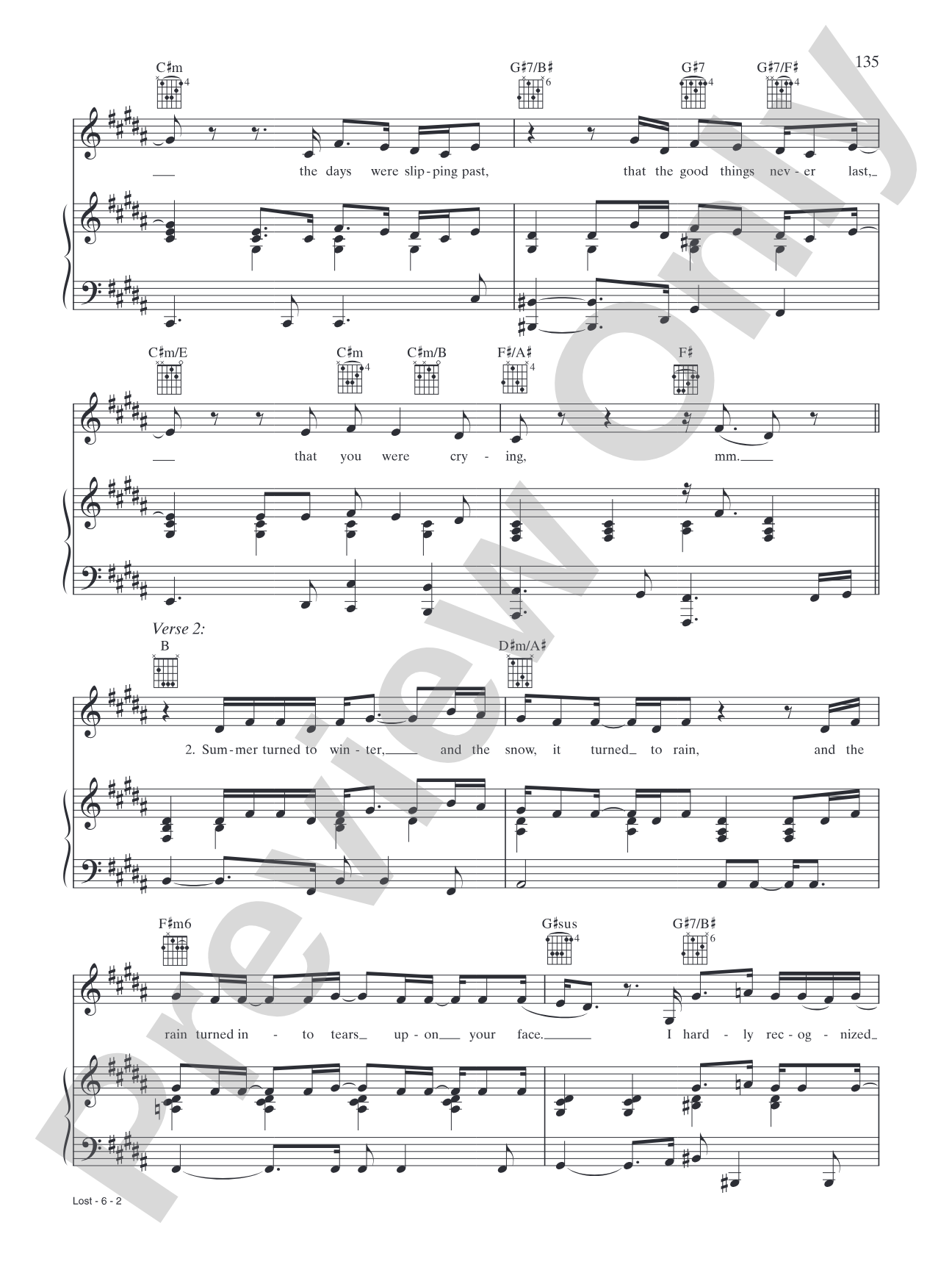

Lost: Piano/Vocal/Chords
Songs That Made the Year!
Item: 00-PS-0010931
$5.99
One moment…
Related Items
Praying for Time: Piano/Vocal/Chords |
$4.99
|
View | |
Sorry: Piano/Vocal/Chords |
$4.99
|
View | |
That's What You Get: Piano/Vocal/Chords |
$5.99
|
View | |
Psycho: Piano/Vocal/Chords |
$5.99
|
View | |
The Story: Piano/Vocal/Chords |
$5.99
|
View | |
4 Minutes: Piano/Vocal/Chords |
$5.99
|
View | |
Leavin': Piano/Vocal/Chords |
$4.99
|
View | |
Paralyzer: Piano/Vocal/Chords |
$5.99
|
View | |
Whatever it Takes: Piano/Vocal/Chords |
$5.99
|
View | |
Porcelain Doll: Piano/Vocal/Chords |
$5.99
|
View |
Description
Titles: 4 Minutes (Madonna and Justin Timberlake) * All Summer Long (Kid Rock) * Almost Lover (A Fine Frenzy) * A-Punk (Vampire Weekend) * Auld Lang Syne (Mairi Campbell and Dave Francis) * Crush (David Archuleta) * Do You Believe Me Now (Jimmy Wayne) * Don't Stop the Music (Rihanna) * Everything (Michael Bublé) * Falling Slowly (from Once) (Glen Hansard and Marketa Irglova) * Goodbye Philadelphia (Peter Cincotti) * Halo 3 Theme: One Final Effort (Martin O'Donnell and Michael Salvatori) * Hey There Delilah (Plain White T's) * Home (Blake Shelton) * Hot N Cold (Katy Perry) * I Kissed a Girl (Katy Perry) * In Love with a Girl (Gavin DeGraw) * In My Arms (Plumb) * Just Got Started Lovin' You (James Otto) * Last Name (Carrie Underwood) * Leavin' (Jesse McCartney) * Lost (Michael Bublé) * New Soul (Yael Naïm) * One Step at a Time (Jordin Sparks) * Our Time Now (Plain White T's) * Paralyzer (Finger Eleven) * Porcelain Doll (Megan McCauley) * Praying for Time (Carrie Underwood) * Psycho (Puddle of Mudd) * Sorry (Buckcherry) * The Story (Brandi Carlile) * That's What You Get (Paramore) * What About Now (Daughtry) * Whatever It Takes (Lifehouse).


Lost: Piano/Vocal/Chords isn't in MakeMusic Cloud just yet...but it could be. Let us know you'd like to see it, and you'll help shape what comes next. In the meantime, start a free trial and dive into thousands of interactive titles your students can play along with today.
Request This Title
Tell us you want it.
Start Your Free Trial
Explore everything that's ready to play right now.
Sample Audio
No sample audio found.
Sample Video
No sample videos found.
Additional Details
Series:
Sheet Music Playlist
Publisher:
Alfred Music
Page Count:
208
SKU:
00-PS-0010931
More about this title
About the Composer: Michael Bublé
Michael Bublé is a Canadian singer and composer known for his interpretations of jazz and pop standards, as well as contemporary material that bridges classical sensibility with modern accessibility. His work spans recording, performance, and composition, making him a significant figure in popular music education contexts where students encounter stylistically diverse repertoire.
Why we love this
This collection captures the exact moment when pop and rock dominated student listening habits (circa 2008), making it an authentic entry point for singers and pianists who want to engage repertoire from their own musical world. The mix of indie rock, contemporary pop, and country hits alongside a few jazz-inflected pieces like "Everything" and "Falling Slowly" means you're not choosing between accessibility and musical substance. Teachers consistently report that students sight-read more eagerly when the songs matter to them.
What to expect
The collection spans a wide emotional landscape, from the wistful intimacy of "Hey There Delilah" and "Falling Slowly" to the propulsive energy of "Hot N Cold" and "Paralyzer." You'll encounter melancholy ballads, upbeat pop anthems, and rock songs with genuine grit, creating a sense of genuine artistic choice rather than a manufactured compilation.
Who it's for
Pianists and singers preparing repertoire for recitals, auditions, or casual performance who want songs that feel genuinely contemporary rather than arranged for pedagogical purposes. This works equally well for vocal students building a working setlist and pianists seeking accessible pop and rock arrangements that maintain musical credibility.
How to get the most out of it
- Pay close attention to the chord symbols and voicings, especially in songs like "Everything" where the piano arranging carries harmonic sophistication beyond what the melody alone suggests.
- Treat the rhythm notation as a guide for placement rather than a prescription; many of these songs benefit from slight rubato or swing that works naturally with the song's original recorded version.
- Build dynamics gradually across verses and choruses rather than performing at a static volume level; contemporary pop songs rely on production depth that translates to vocal and piano shaping.
- Anchor your interpretation by listening to the original recordings, which contain production details and phrasing choices that sheet notation cannot fully capture.
How to use it
Program individual selections from this collection alongside classical or musical theater repertoire to reflect the full range of a student's musical interests during a recital. The diversity means you can build a coherent program that moves between styles, or use specific songs as warm-up or encores that reconnect the audience with contemporary music outside the concert hall.
Skills your students will build
- Reading chord charts and realizing lead sheet notation with flexibility
- Interpreting contemporary vocal phrasing and rhythmic nuance from written music
- Balancing melody-driven accompaniment with harmonic voice-leading
- Adapting published arrangements to match original recorded versions
- Building interpretive choices across different pop, rock, and indie genres