
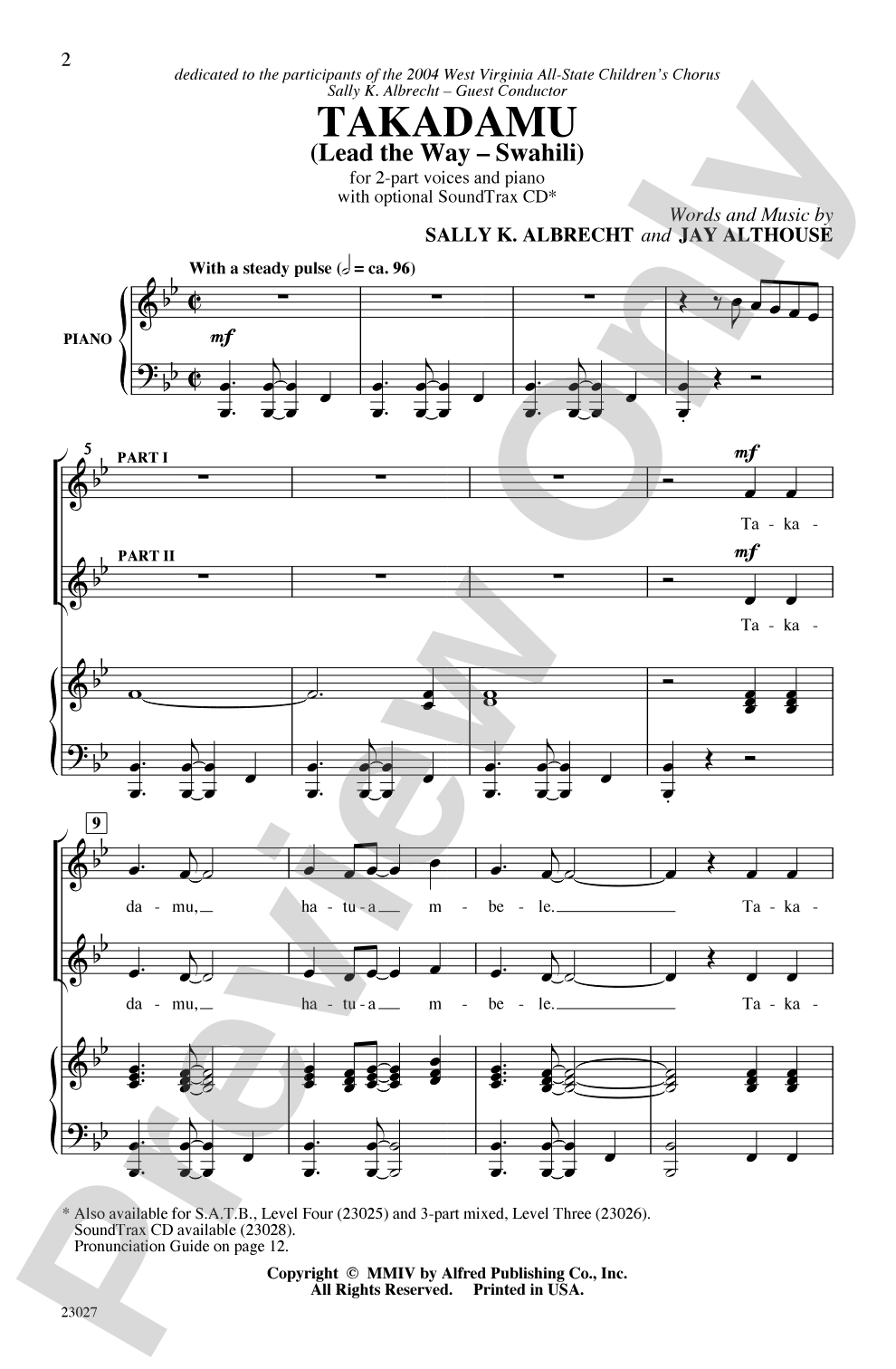
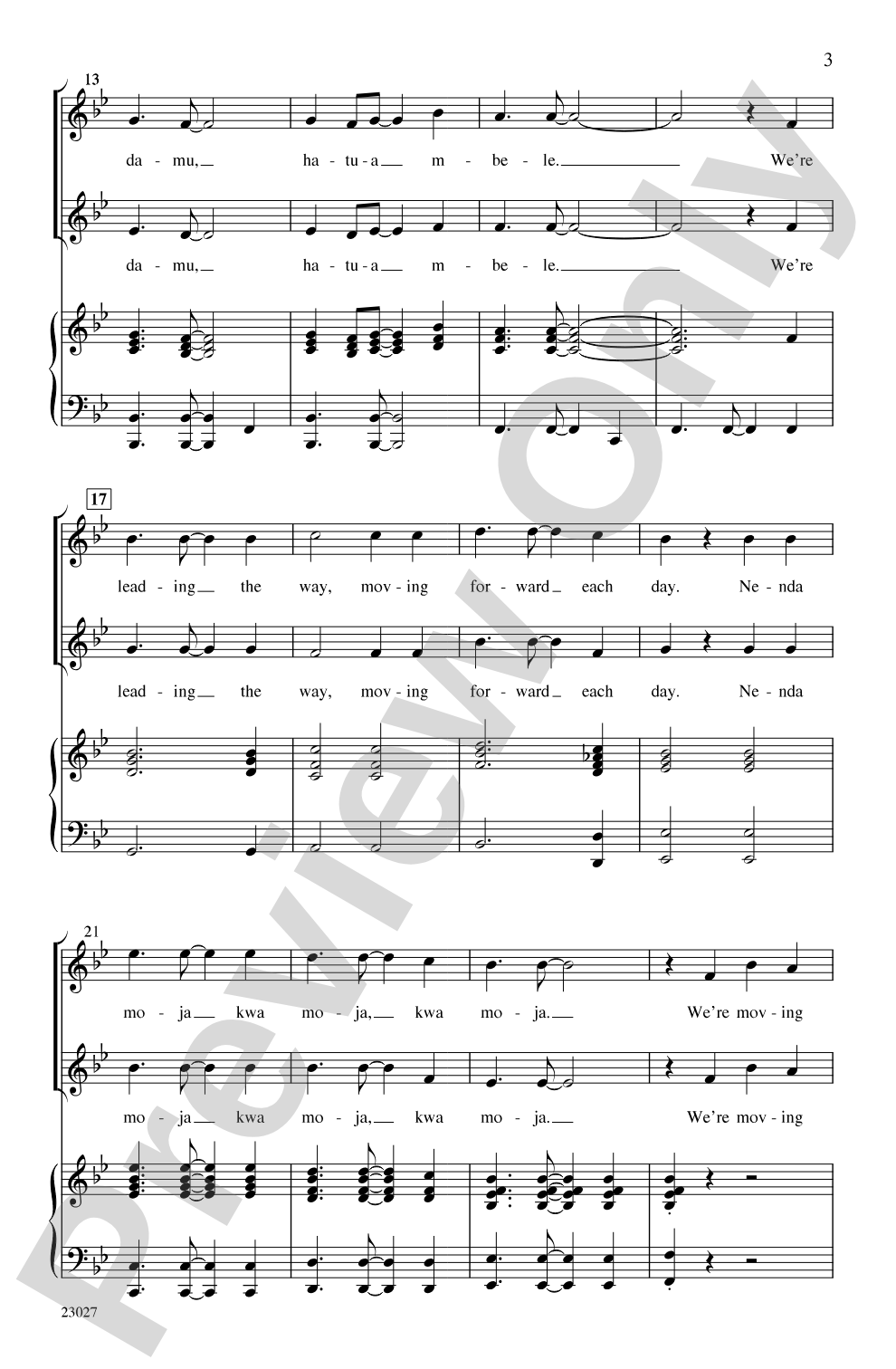

Takadamu: 2-Part Choral Octavo
(Lead the Way -- Swahili)
Music by Sally K. Albrecht and Jay Althouse
Item: 00-PO-0007743
$1.65
Minimum order quantity: 20 copies
Pickup currently not available
Description
Five easy Swahili phrases are followed by their English equivalents in this pulsating piece which teaches the importance of traveling life's road "step by step." The rhythms are infectious and the harmonies are traditional. A phonetic pronunciation guide and literal translation are included in the publication, and the optional SoundTrax CD sounds authentic, with real African instruments. Featured on the new staging DVD/Video "On the Stage!" (DVD #23037, Video #23129).


Takadamu: 2-Part Choral Octavo isn't in MakeMusic Cloud just yet...but it could be. Let us know you'd like to see it, and you'll help shape what comes next. In the meantime, start a free trial and dive into thousands of interactive titles your students can play along with today.
Request This Title
Tell us you want it.
Start Your Free Trial
Explore everything that's ready to play right now.
Sample Audio
1
Audio File
--:--
0:00
0:00
Sample Video
No sample videos found.
Additional Details
Series:
Alfred Choral Designs
Publisher:
Alfred Music
Page Count:
12
SKU:
00-PO-0007743
More about this title
About the Composer: Sally K. Albrecht
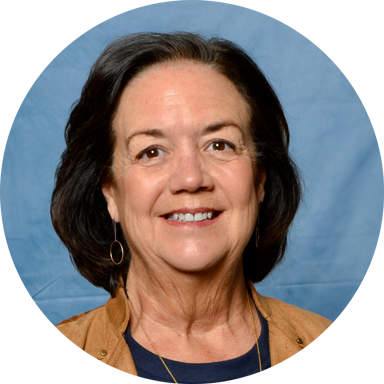
Sally K. Albrecht brings three decades of experience as a choral composer, conductor, and clinician to her work, with particular expertise in integrating movement into choral performance. Her catalog includes over 600 published choral works and 75 songbooks and musicals, earning her consistent recognition through the ASCAP Special Music Award since 1987. She has led honor choirs at major venues including Lincoln Center, Carnegie Hall, and The Kennedy Center, and served as Director of School Choral, Vocal, and Elementary Publications for Alfred Music.
Educated at Rollins College (B.A. in Music and Theater, 1976) and the University of Miami (M.A. in Drama, 1977; M.M. in Accompanying, 1979), Albrecht has taught at Oakland University, Jersey City State College, and Meredith College. She holds the Distinguished Alumna Award from both the University of Miami Frost School of Music and Rollins College, where she serves on the Board of Trustees. She and her husband, composer Jay Althouse, reside in Wake Forest, North Carolina.
Why we love this
Albrecht and Althouse capture something essential here: a simple idea wrapped in genuine cultural authenticity. The phonetic pronunciation guide removes barriers for teachers uncertain about Swahili, while the African instrumentation on the optional recording grounds the piece in real sound rather than approximation. The message itself, moving through life one step at a time, lands differently when sung in another language, giving students both a linguistic gateway and a meditation on perseverance.
What to expect
Energetic and grounded at once. The Swahili phrases move with rhythmic confidence while the traditional harmonies feel warm and inclusive. There's an invitation in the piece, to lean into unfamiliar sounds and discover that the message of steady progress is understood everywhere.
Who it's for
This piece works especially well for middle school and high school choirs seeking accessible yet culturally meaningful repertoire. Singers benefit from the straightforward 2-part writing, which removes technical barriers while the engaging text and movement options keep energy high and engagement real.
How to get the most out of it
- Lean into the pulse without rigidity. These infectious rhythms thrive on forward motion, so shape phrases around the beat rather than fighting against it.
- Coordinate movement with the recorded accompaniment from the start of rehearsal, even at half-tempo. Staging becomes part of the musical learning, not an afterthought.
- Use the phonetic pronunciation guide actively in early rehearsals so singers develop confidence with the Swahili phrases before worrying about blend or dynamics.
- Build awareness of how the harmonies complement the English text and Swahili phrases; this supports singers in understanding the dual-language message about life's journey.
How to use it
This piece shines in winter concerts celebrating cultural diversity or in programming around Kwanzaa. Its brevity, accessibility, and strong thematic message about journey and perseverance also make it a natural choice for graduation or brotherhood/peace themed programs where authentic world music carries real meaning.
Skills your students will build
- Reading and performing Swahili pronunciation accurately
- Sustaining rhythmic precision in syncopated, call-and-response textures
- Coordinating movement with ensemble singing
- Blending 2-part harmonies grounded in African harmonic traditions
- Understanding how musical and textual meaning work together across languages