
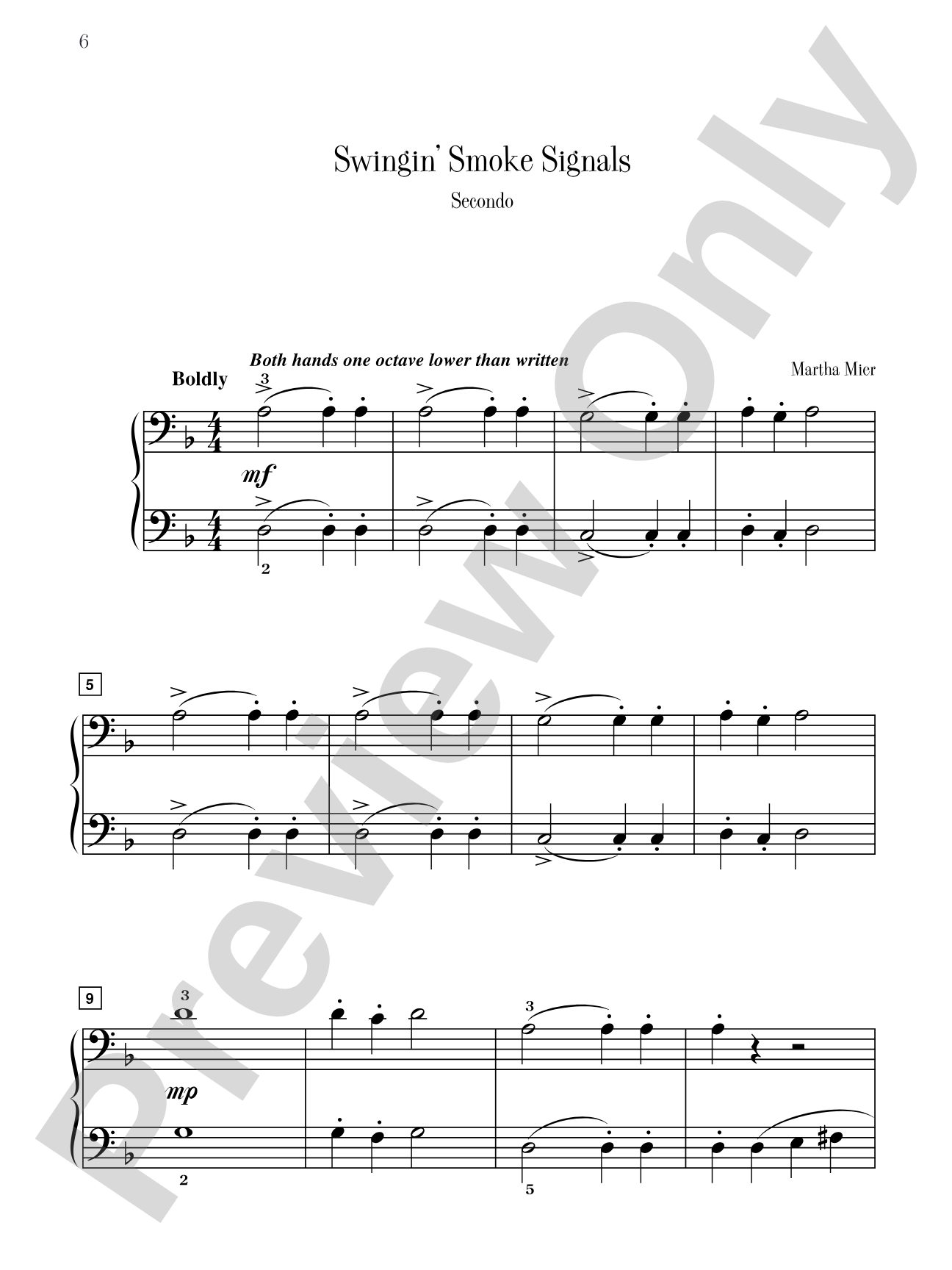

Swingin' Smoke Signals - Piano Duet (1 Piano, 4 Hands): Piano Duet (1 Piano, 4 Hands)
6 Exciting Duets for Late Elementary to Early Intermediate Pianists
By Martha Mier
Level: Late Elementary / Early Intermediate
Item: 00-PS-0017675
$4.99
Pickup currently not available
Related Items
Billy Goat Rag - Piano Duet (1 Piano, 4 Hands): Piano Duet (1 Piano, 4 Hands) |
$4.99
|
View | |
Celebration March - Piano Duet (1 Piano, 4 Hands): Piano Duet (1 Piano, 4 Hands) |
$4.99
|
View | |
Four O'Clock Tea - Piano Duet (1 Piano, 4 Hands): Piano Duet (1 Piano, 4 Hands) |
$4.99
|
View | |
The Royal Procession - Piano Duet (1 Piano, 4 Hands): Piano Duet (1 Piano, 4 Hands) |
$6.95
|
View | |
Terrific Tunes for Two, Book 2: Piano Duet (1 Piano, 4 Hands) Book |
$6.95
|
View |
Description
Playing duets with friends or family members is an exciting and fun aspect of piano study. The duets in Terrific Tunes for Two will encourage students to play with imagination. Both the primo and secondo parts are written at an equal level of difficulty. Book 2 has six duets for late elementary to early intermediate pianists and correlates with Alfred's Basic Piano Level 2-3. A Federation Festivals 2020-2024 selection.


Discover MakeMusic Cloud: thousands of interactive titles your students can play along with today.
Sample Audio
1
Swingin Smoke Signals
--:--
2
The Royal Procession
--:--
Swingin Smoke Signals
0:00
0:00
Sample Video
No sample videos found.
Additional Details
Publisher:
Alfred Music
Page Count:
24
SKU:
00-PS-0017675
More about this title
About the Composer: Martha Mier

Martha Mier has shaped music education for generations through her prolific catalog of accessible, engaging piano literature. Since joining Alfred Music Publishing in 1989, she has become one of the most widely performed educational composers, with her Jazz, Rags & Blues and Romantic Impressions series reaching students in studios and classrooms worldwide. A Florida State University graduate and longtime piano studio owner, Mier brings both scholarly rigor and practical teaching experience to every piece she writes.
Her work as a clinician and adjudicator has taken her across the United States and internationally to Australia and New Zealand, where she has led workshops for teachers at the Music Teachers National Association Conference, the National Piano Teachers Institute, and the World Piano Pedagogy Conference. Certified through the Music Teachers National Association, the Florida State Music Teachers Association, and the National Guild of Piano Teachers, Mier remains active in church music and collaborative performance. Over two hundred of her educational publications have earned recognition from the National Federation of Music Clubs, and she served as co-author of Alfred's Premier Piano Course.
Why we love this
Mier writes duet parts with genuine equality, so neither pianist feels relegated to accompaniment. The straightforward rhythmic language and consistent texture make learning to balance sound and coordinate entries natural rather than labored, and students actually want to play these pieces again.
What to expect
Swingin' Smoke Signals radiates energy and movement, with jazz-inflected rhythms that feel modern without requiring complex harmonies or awkward hand positions. The piece captures the playfulness of swing idioms while staying firmly rooted in the late elementary world, making it feel simultaneously cool and genuinely achievable.
Who it's for
Late elementary to early intermediate pianists ready to experience the rewards of duet playing without the technical strain of unequal parts. Two students of similar level working toward the same Suzuki or Alfred level will find that both parts offer equally rewarding musical material.
How to get the most out of it
- Establish a steady pulse together before beginning; play a few measures of the accompaniment figure alone so both pianists feel the harmonic rhythm underneath the melody.
- Listen for the secondo's rhythmic foundation rather than watching hands. This trains ear-focused ensemble playing that transfers immediately to other chamber settings.
- Experiment with dynamic shading between the parts. Mier's orchestral sensibility means the primo can bring out a singing line while the secondo provides textural color rather than just support.
- Work out the section transitions as a team. Agreeing on where to breathe or shift weight helps the piece feel like one musical thought rather than two separate lines.
How to use it
Include it in a recital where you want to showcase chamber music alongside solos, or use it to open a spring concert with immediate energy and joy. Its federation selection status makes it an excellent choice for festival season, and the six duets in the book give you flexibility to build an all-duet program for a special event.
Skills your students will build
- Ensemble listening and responding to a partner's tempo
- Balancing multiple melodic and harmonic layers at the keyboard
- Coordinating attacks and releases in two-hand units across an extended range
- Understanding jazz rhythmic vocabulary (swing eighth notes, syncopation)
- Reading equal-difficulty parts without role hierarchy or accompanying anxiety