
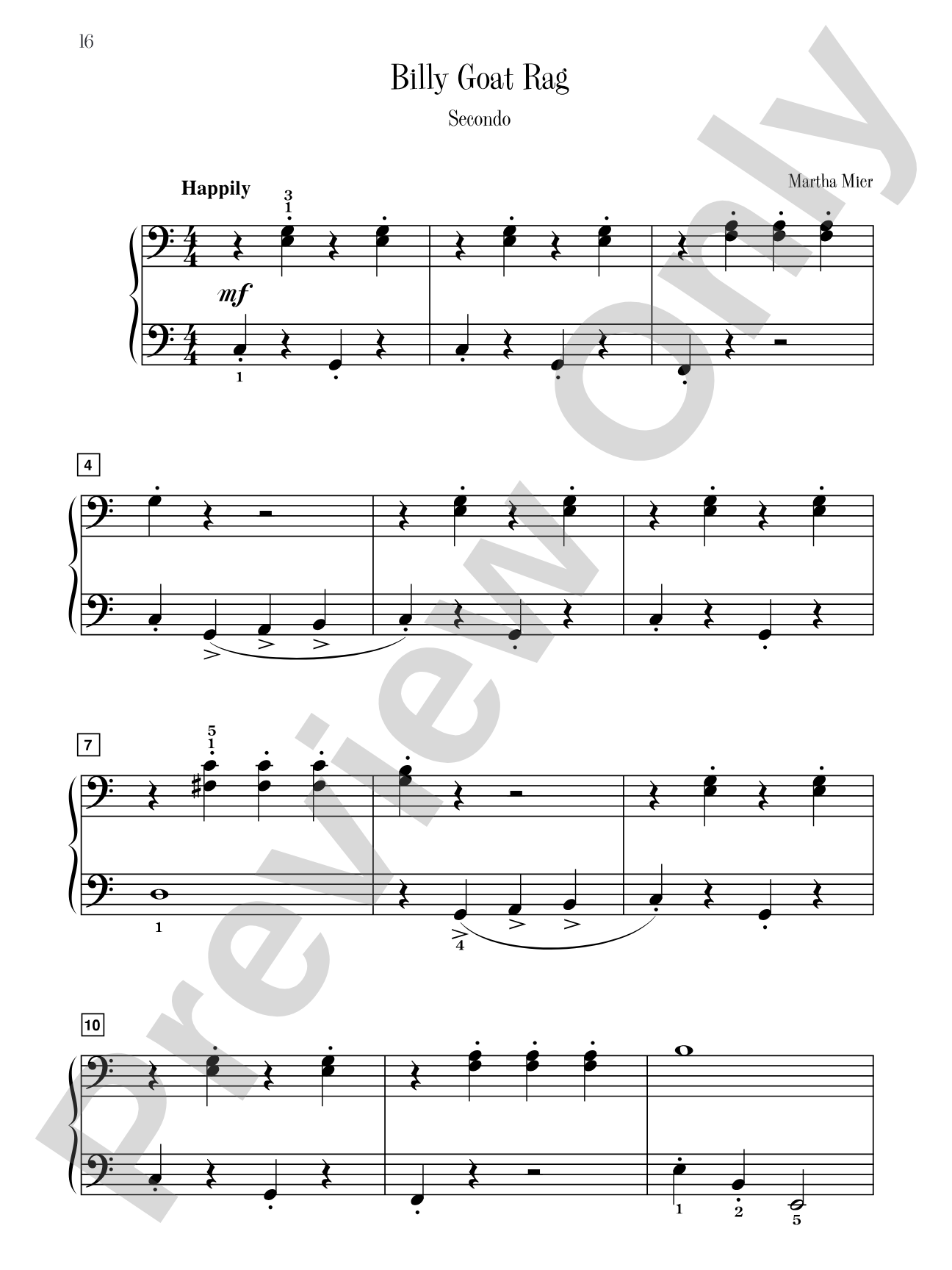

Billy Goat Rag - Piano Duet (1 Piano, 4 Hands): Piano Duet (1 Piano, 4 Hands)
6 Exciting Duets for Late Elementary to Early Intermediate Pianists
By Martha Mier
Level: Late Elementary / Early Intermediate
Item: 00-PS-0017672
$4.99
Pickup currently not available
Related Items
Celebration March - Piano Duet (1 Piano, 4 Hands): Piano Duet (1 Piano, 4 Hands) |
$4.99
|
View | |
Four O'Clock Tea - Piano Duet (1 Piano, 4 Hands): Piano Duet (1 Piano, 4 Hands) |
$4.99
|
View | |
Swingin' Smoke Signals - Piano Duet (1 Piano, 4 Hands): Piano Duet (1 Piano, 4 Hands) |
$4.99
|
View | |
The Royal Procession - Piano Duet (1 Piano, 4 Hands): Piano Duet (1 Piano, 4 Hands) |
$6.95
|
View | |
Terrific Tunes for Two, Book 2: Piano Duet (1 Piano, 4 Hands) Book |
$6.95
|
View |
Description
Playing duets with friends or family members is an exciting and fun aspect of piano study. The duets in Terrific Tunes for Two will encourage students to play with imagination. Both the primo and secondo parts are written at an equal level of difficulty. Book 2 has six duets for late elementary to early intermediate pianists and correlates with Alfred's Basic Piano Level 2-3. A Federation Festivals 2020-2024 selection.


Discover MakeMusic Cloud: thousands of interactive titles your students can play along with today.
Sample Audio
1
Swingin Smoke Signals
--:--
2
The Royal Procession
--:--
Swingin Smoke Signals
0:00
0:00
Sample Video
No sample videos found.
Additional Details
Publisher:
Alfred Music
Page Count:
24
SKU:
00-PS-0017672
More about this title
About the Composer: Martha Mier

Martha Mier has shaped piano pedagogy for decades through her prolific output of accessible, engaging educational works. A Florida State University graduate and founding member of several professional music organizations, she opened her own piano studio and became known for her ability to write music that students genuinely want to play. Her compositions span jazz, blues, romantic styles, and classical forms, and she has served as a clinician and adjudicator across the United States, Australia, and New Zealand.
As a co-author of Alfred's Premier Piano Course and contributor to over 200 educational publications, Mier has built a legacy of supporting music teachers and their students. Her works appear regularly on National Federation of Music Clubs festival bulletins, and her commitment to the teaching profession remains active through her memberships in the Music Teachers National Association, Florida State Music Teachers Association, and National Guild of Piano Teachers.
Why we love this
Mier's duets balance playfulness with genuine musical substance. Both parts are equally voiced and interesting, which means neither pianist feels like they're accompanying the other. The ragtime character gives students a rhythmic and stylistic context they might not encounter elsewhere in their early repertoire, making duet time feel like genuine musical collaboration rather than a practice chore.
What to expect
Playful and rhythmically alive, with the syncopated swagger of classic ragtime. The piece bounces and sways; it invites the performers to lean into the groove without requiring virtuosity. There's something both lighthearted and sophisticated about it, as if the pianists are sharing a musical joke that happens to be genuinely well-crafted.
Who it's for
Late elementary to early intermediate pianists who are ready to explore ensemble playing and want a piece with genuine stylistic character. This duet works especially well for studio teachers looking to engage students who might be losing interest in traditional etudes or early romantic pieces, and for students preparing for festivals or informal performances with a friend or sibling.
How to get the most out of it
- Establish the pulse together before starting. Rags depend on rhythmic precision and forward momentum, so a clear, steady tempo from both players creates the foundation for everything else.
- Listen actively to the other part while playing your own line. The interplay between primo and secondo drives the piece's energy, so constant awareness of balance keeps the music cohesive.
- Exaggerate the character of the syncopation without losing control. Ragtime thrives on rhythmic playfulness, but clarity of articulation prevents muddiness when both hands are working.
- Shape the phrases as a single unit rather than two separate parts. Even though you're reading different music, thinking of the duet as one piece helps with dynamics, tempo flexibility, and overall musicality.
How to use it
Feature this duet in a recital or studio showcase where you want to highlight collaborative work and introduce audiences to styles beyond the classical canon. It pairs naturally with other pieces in the Terrific Tunes for Two collection if your students are working through that book, or it can stand alone as a memorable bridge piece in a program of contrasting solo works. The upbeat energy makes it ideal for a concert that includes mixed levels, as it gives early intermediate students a moment to shine without requiring the virtuosity of more advanced repertoire.
Skills your students will build
- Rhythmic accuracy in syncopated patterns specific to ragtime style
- Listening and ensemble coordination with another pianist
- Independence between both hands while maintaining awareness of a second player's part
- Stylistic interpretation of early 20th century American music
- Reading multiple staves simultaneously and tracking a non-melodic accompaniment part