
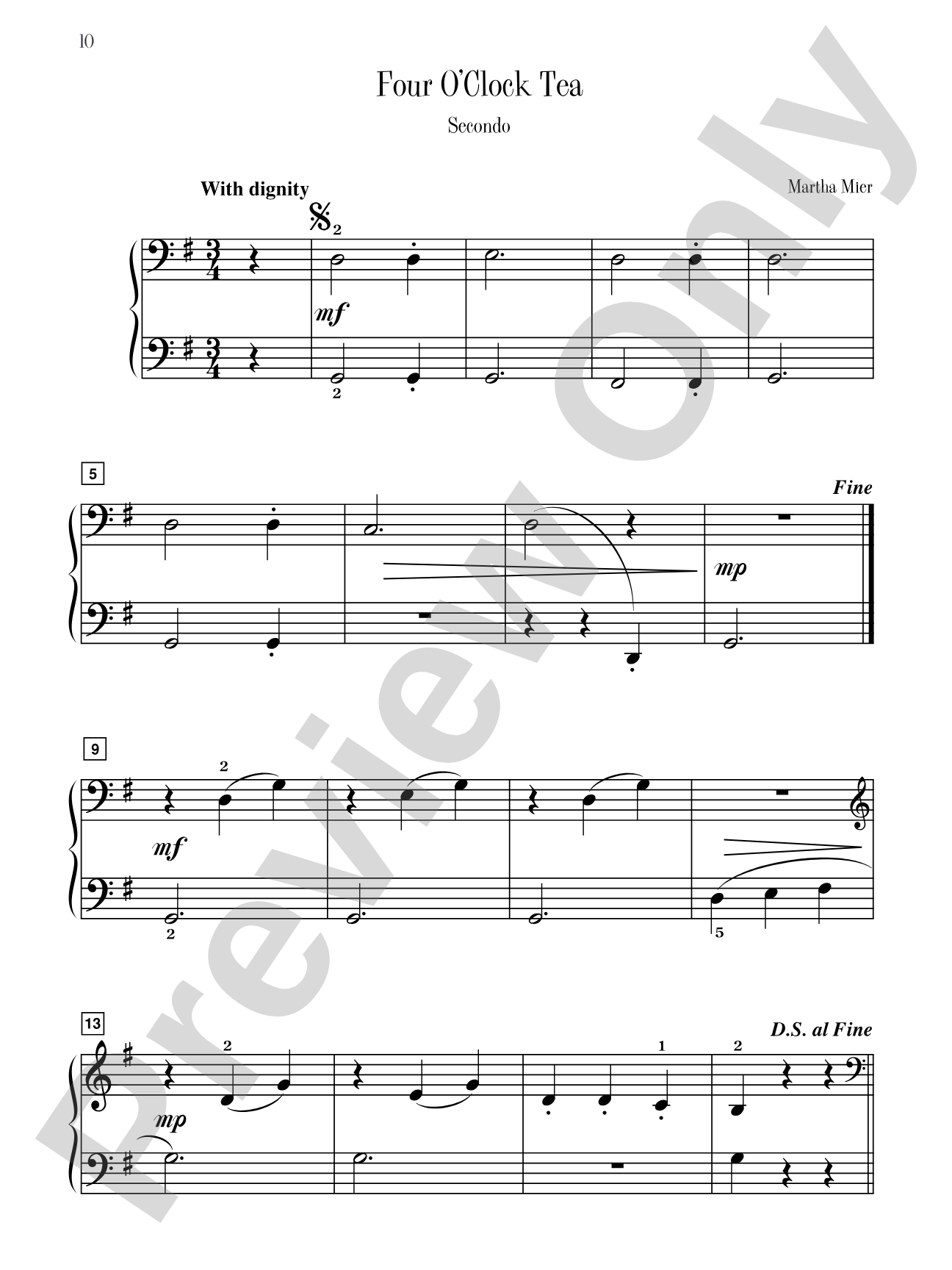

Four O'Clock Tea - Piano Duet (1 Piano, 4 Hands): Piano Duet (1 Piano, 4 Hands)
6 Exciting Duets for Late Elementary to Early Intermediate Pianists
By Martha Mier
Level: Late Elementary / Early Intermediate
Item: 00-PS-0017674
$4.99
Pickup currently not available
Related Items
Billy Goat Rag - Piano Duet (1 Piano, 4 Hands): Piano Duet (1 Piano, 4 Hands) |
$4.99
|
View | |
Celebration March - Piano Duet (1 Piano, 4 Hands): Piano Duet (1 Piano, 4 Hands) |
$4.99
|
View | |
Swingin' Smoke Signals - Piano Duet (1 Piano, 4 Hands): Piano Duet (1 Piano, 4 Hands) |
$4.99
|
View | |
The Royal Procession - Piano Duet (1 Piano, 4 Hands): Piano Duet (1 Piano, 4 Hands) |
$6.95
|
View | |
Terrific Tunes for Two, Book 2: Piano Duet (1 Piano, 4 Hands) Book |
$6.95
|
View |
Description
Playing duets with friends or family members is an exciting and fun aspect of piano study. The duets in Terrific Tunes for Two will encourage students to play with imagination. Both the primo and secondo parts are written at an equal level of difficulty. Book 2 has six duets for late elementary to early intermediate pianists and correlates with Alfred's Basic Piano Level 2-3. A Federation Festivals 2020-2024 selection.


Discover MakeMusic Cloud: thousands of interactive titles your students can play along with today.
Sample Audio
1
Swingin Smoke Signals
--:--
2
The Royal Procession
--:--
Swingin Smoke Signals
0:00
0:00
Sample Video
No sample videos found.
Additional Details
Publisher:
Alfred Music
Page Count:
24
SKU:
00-PS-0017674
More about this title
About the Composer: Martha Mier

Martha Mier has shaped piano pedagogy for over three decades as a prolific composer whose works span jazz, impressionistic, and classical idioms. Since joining Alfred Music Publishing in 1989, she has written more than 200 educational publications that reach students across all proficiency levels. Her pieces appear regularly on National Federation of Music Clubs festival lists, and she continues to influence music education through clinician work, adjudication, and membership in the Music Teachers National Association, the Florida State Music Teachers Association, and the National Guild of Piano Teachers.
Mier's background includes ownership of a private piano studio in Lake City, Florida, active involvement in church music and collaborative piano work, and training from Florida State University. Her commitment to both composition and pedagogy makes her uniquely positioned to write duets that challenge students appropriately while remaining genuinely engaging to play.
Why we love this
Mier writes duets where both hands matter equally. The primo and secondo parts carry comparable technical demands and musical interest, which keeps the partner engaged rather than subordinate. Students actually want to return to these pieces week after week because the melodies are memorable and the harmonic language feels fresh without being overwhelming.
What to expect
These duets capture the warmth and playfulness of afternoon social time. Melodies are lyrical and memorable, harmonies land comfortably under the hands, and the four-hand texture creates genuine dialogue rather than one player accompanying another. The musical character feels unhurried and genuinely collaborative.
Who it's for
Late elementary to early intermediate pianists ready to experience ensemble playing on a single instrument. This collection works well for students progressing through Alfred's Basic Piano Level 2-3 or for those seeking motivated duet literature that rewards consistent practice.
How to get the most out of it
- Balance the melodic line between primo and secondo by listening carefully to which part carries the primary tune in each passage. Neither player should automatically dominate.
- Establish a steady tempo before beginning, then maintain it through transitions and key changes. Use a light foot-tap if needed to keep both players anchored.
- Shape the dynamic contrasts as a unit. When the primo swells, the secondo should support by mirroring the intensity rather than playing mechanically.
- Practice hands separately first, then hands together, then combine with your partner. The coordination required is as important as playing the notes accurately.
How to use it
Program a duet in a studio recital to showcase ensemble preparation and shared musicianship. A duet also works well as a performance requirement that motivates intermediate students to maintain steady practice with a peer, or as a special item in a student-and-teacher concert context.
Skills your students will build
- Listening and responding to a partner's tempo and phrasing in real time
- Maintaining independent rhythmic accuracy while coordinating with another player
- Reading and executing equal technical demands across primo and secondo parts
- Shaping musical phrases collaboratively across a four-hand texture
- Sustaining focus through longer ensemble works