

Sutoku In: SATB Choral Octavo
Words by Emperor Sutoku, music by Ruth Morris Gray
Item: 00-PO-0008401
$2.50
Minimum order quantity: 20 copies
Pickup currently not available
Related Items
Sutoku In: SoundTrax Digital Audio Download |
$29.98
|
View | |
Sutoku In: 3-Part Mixed Choral Octavo |
$2.05
|
View | |
Sutoku In: 2-Part Choral Octavo |
$2.05
|
View | |
Sutoku In: SATB Choral Octavo |
$2.50
|
View | |
Sutoku In: 3-Part Mixed Choral Octavo |
$2.05
|
View | |
Sutoku In: 2-Part Choral Octavo |
$2.05
|
View | |
Sutoku In: Choral SoundTrax CD |
$29.99
|
View |
Description
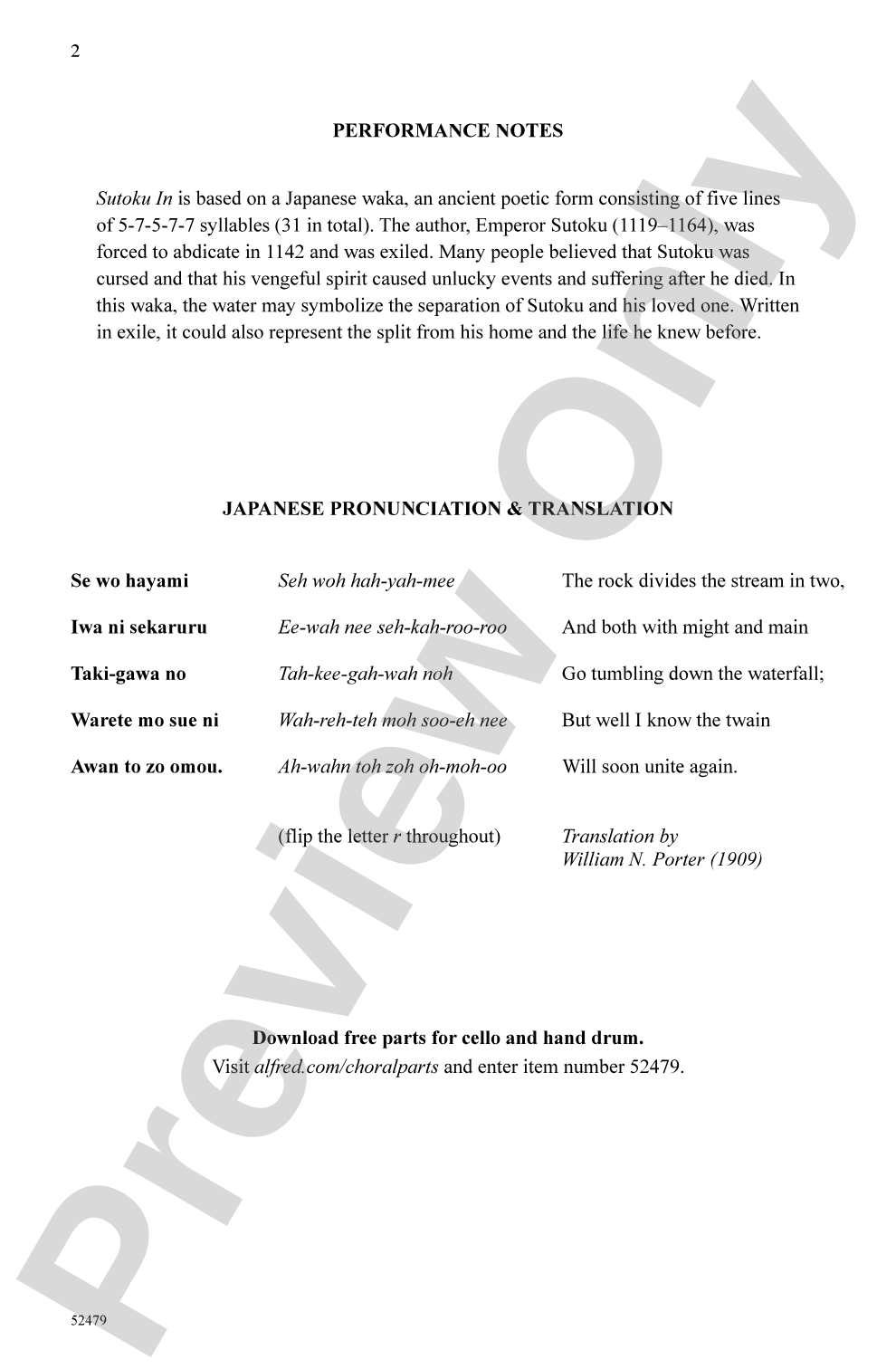
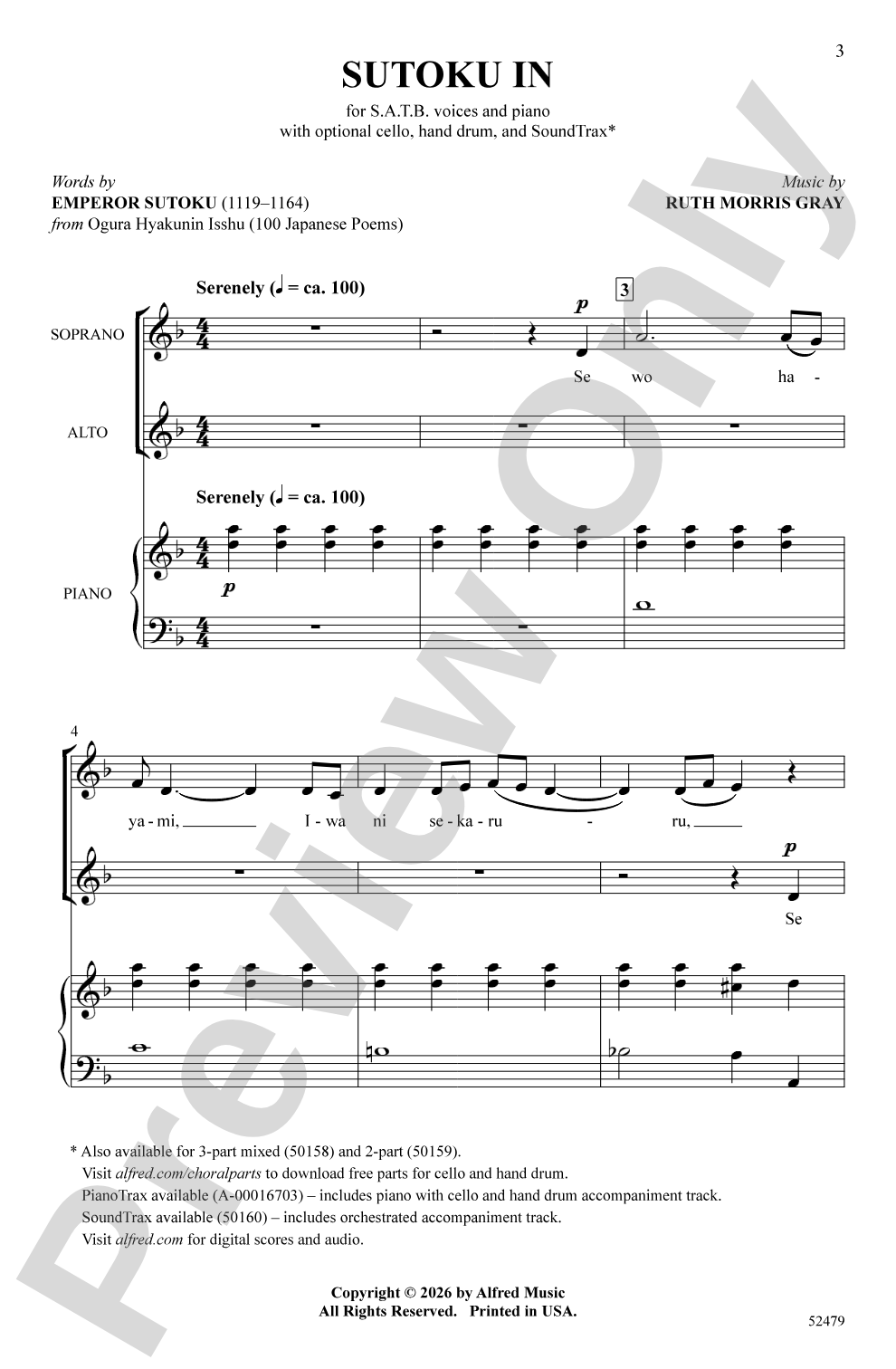
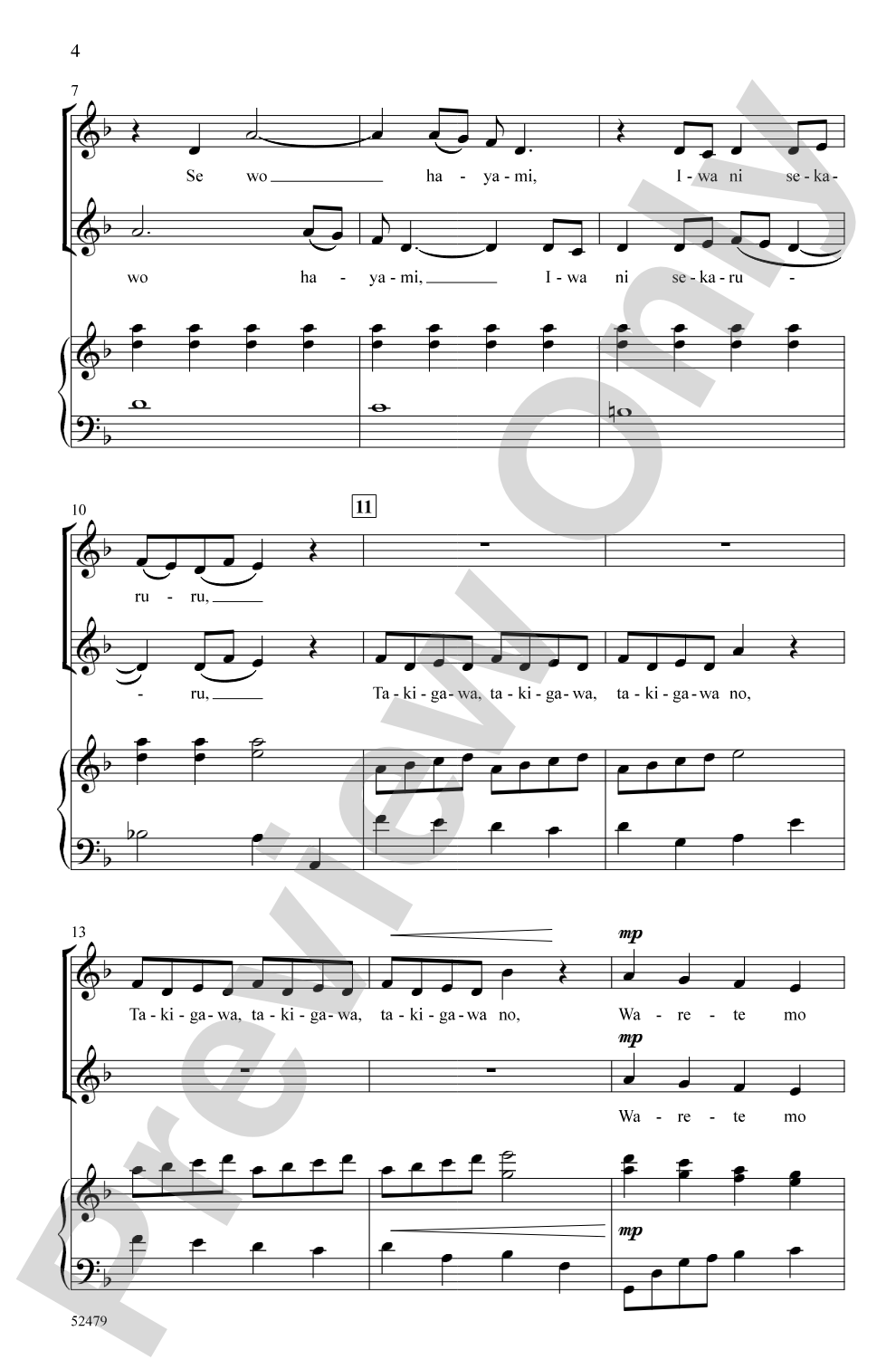
The text of this multicultural feature is a waka (an ancient Japanese poetic form) written by 12th-century ruler Emperor Sutoku. Ruth Morris Gray's original music highlights the poem's depth and explores its theme of separation. Crafted with two minor-key melodies (one sung in Japanese, the other in English) that artfully intertwine at the pinnacle moment. A pronunciation guide is included in the publication.


Discover MakeMusic Cloud: thousands of interactive titles your students can play along with today.
Sample Audio
1
Audio File
--:--
0:00
0:00
Sample Video
Additional Details
Series:
Alfred Choral Designs
Page Count:
12
SKU:
00-PO-0008401
More about this title
About the Composer: Ruth Morris Gray

Ruth Morris Gray directs choirs at Rosemead High School in Rosemead, California, where she has shaped singers and composers since 2004. Her output spans over 100 published choral works, each reflecting her dual training in piano performance and composition from Biola University, paired with advanced study in composition at UC Santa Barbara. Gray holds her teaching credential from California State University, Northridge, and balances her life in music with travel, swimming, reading, and cycling alongside her husband, Douglas.
Why we love this
Gray's setting gives genuine musical weight to Emperor Sutoku's waka without relying on exoticism or surface-level color. The dual melodic lines in Japanese and English that converge at the emotional center demand real attention from singers and listeners alike, making this a concert piece that stays in people's minds long after the final chord.
What to expect
The minor tonality and intricate interweaving of melodies create an intimate, contemplative soundscape grounded in the theme of separation and distance. The piece unfolds with restraint until the moment the two melodies meet, where harmonic clarity and emotional release arrive together.
Who it's for
Choirs seeking repertoire that engages both artistic ambition and cultural learning. Strong sight-readers will navigate the piece most smoothly, though any SATB ensemble committed to detailed textual and harmonic work can bring it to life.
How to get the most out of it
- Spend rehearsal time on the Japanese text using the provided pronunciation guide. Accuracy here shapes the piece's authenticity and gives singers ownership of the language.
- Shape each of the two minor melodies with its own character before intertwining them. Treating them as distinct voices first makes their convergence more striking.
- Use the recorded accompaniment in early rehearsals to lock the harmonic language, then gradually pull it back so the choir can feel the harmonic weight without relying on it.
How to use it
Position this as a concert or festival centerpiece where programming depth matters. Its multicultural foundation makes it ideal for diversity-focused concerts or as a pairing alongside other world music repertoire that treats cultural texts seriously.
Skills your students will build
- Singing in Japanese with accurate pronunciation and natural phrasing
- Reading and performing two distinct melodic lines that interact across SATB texture
- Understanding harmonic function in minor keys
- Connecting poetic meaning to musical structure and form
- Balancing textural clarity when multiple independent lines occur simultaneously