

Sutoku In: 2-Part Choral Octavo
Words by Emperor Sutoku, music by Ruth Morris Gray
Item: 00-PO-0007031
$2.05
Minimum order quantity: 20 copies
Pickup currently not available
Description
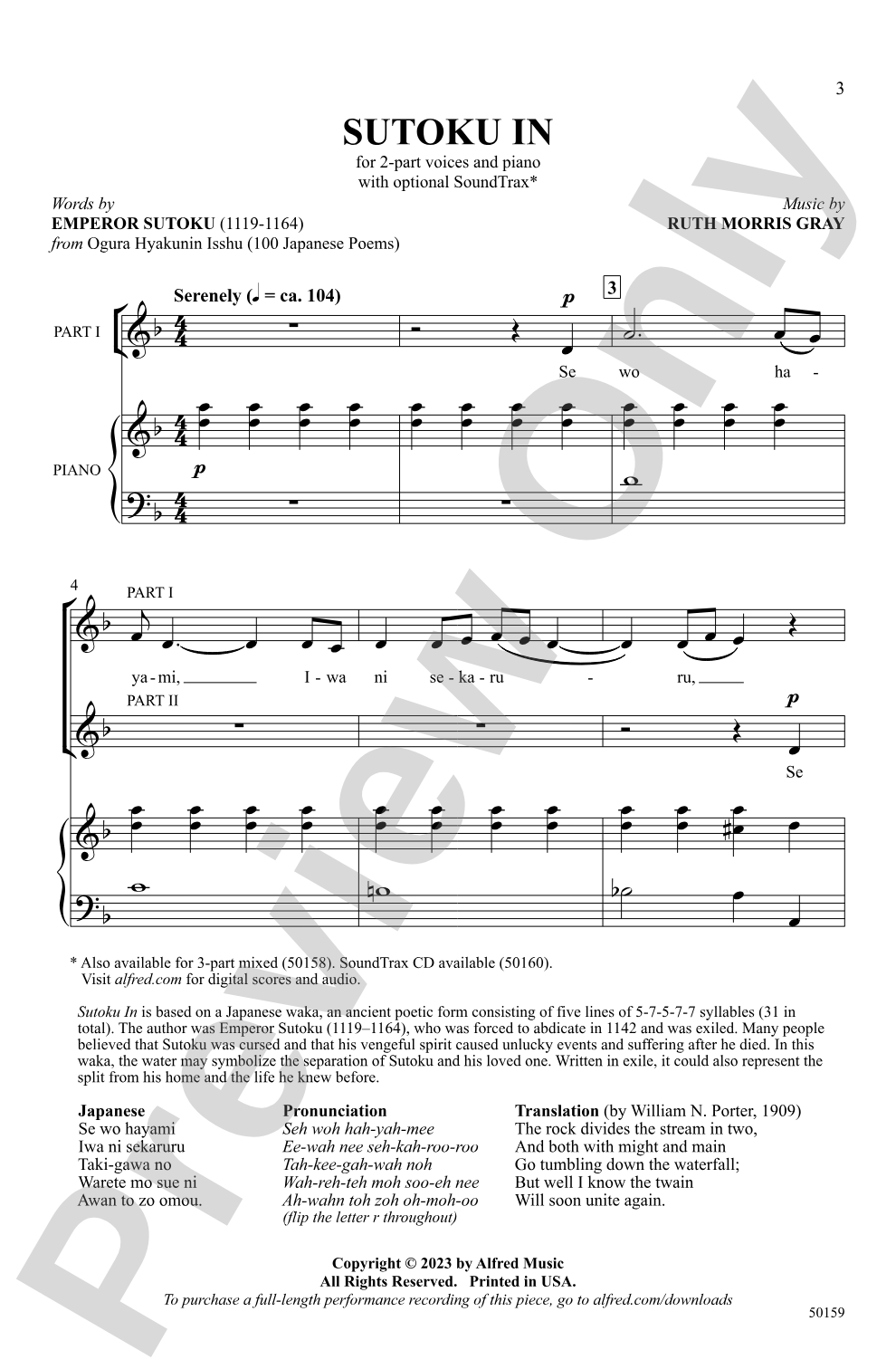
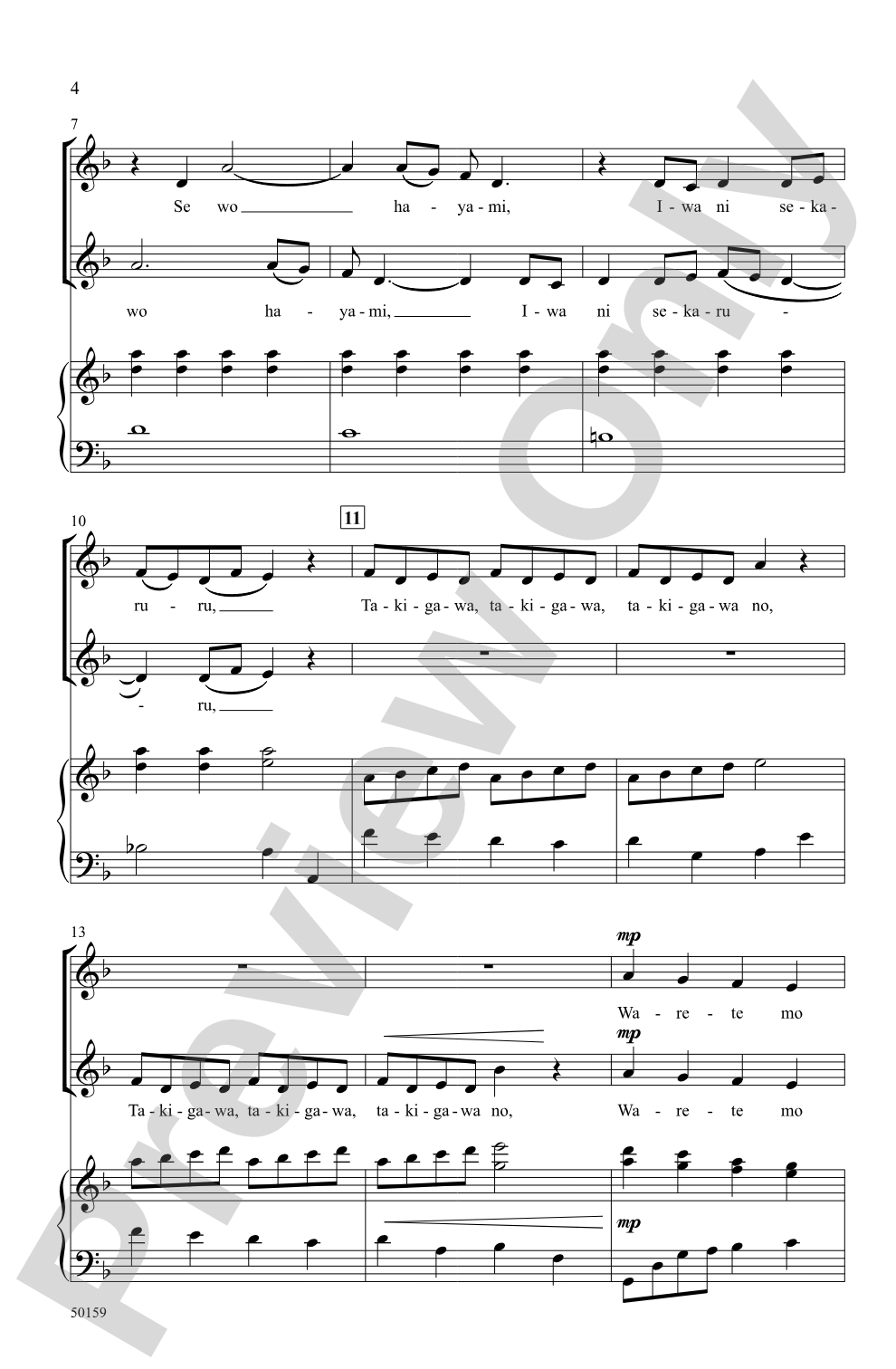
The text of this multicultural feature is a waka (an ancient Japanese poetic form) written by 12th-century ruler Emperor Sutoku. Ruth Morris Gray's original music highlights the poem's depth and explores its theme of separation. Crafted with two minor-key melodies (one sung in Japanese, the other in English) that artfully intertwine at the pinnacle moment. A pronunciation guide is included in the publication.


Discover MakeMusic Cloud: thousands of interactive titles your students can play along with today.
Sample Audio
1
Audio File
--:--
0:00
0:00
Sample Video
Additional Details
Series:
Alfred Choral Designs
Publisher:
Alfred Music
Page Count:
12
SKU:
00-PO-0007031
More about this title
About the Composer: Ruth Morris Gray

Ruth Morris Gray has directed choirs at Rosemead High School in California since 2004, where she also teaches piano. Her catalog of over 100 published choral compositions reflects her dual expertise in composition and pedagogy, drawing from training at Biola University (Bachelor of Music in Piano Performance and Composition) and UC Santa Barbara (Master of Arts in Music Composition).
Beyond the classroom and composition studio, Gray holds a California Single Subject Music Credential from Cal State Northridge. Her work as both educator and creative artist informs her ability to write music that challenges singers while remaining accessible to young voices.
Why we love this
Gray's setting captures the emotional restraint and longing embedded in Emperor Sutoku's 12th-century waka, using two minor-key melodies that mirror the poem's meditation on distance and separation. The interweaving of Japanese and English text creates an authentic multicultural moment that feels earned rather than superficial, giving singers genuine musical and linguistic engagement. For festivals and concert programming, this piece stands apart as both a substantial artistic statement and an accessible entry point into non-Western poetry for developing choirs.
What to expect
Introspective and spacious, with the quality of something overheard from a distance. The two intertwining melodies create a quiet conversation between languages, building toward a moment of connection that feels both inevitable and tender. The minor tonality grounds the piece in contemplation without heaviness.
Who it's for
Two-part choirs seeking repertoire that expands cultural literacy while maintaining musical substance. The piece suits intermediate to advancing singers ready to engage thoughtfully with non-English text and minor-key harmonic language.
How to get the most out of it
- Attend carefully to the pronunciation guide provided in the score. Japanese vowels are pure and sustained; establish these sounds in unison warm-ups before sectional work begins.
- Shape each melodic line with awareness of the moment when both parts converge at the climax. Build toward that meeting point across the entire arc of the piece.
- Balance the two melodies so neither dominates. Since they're written in different languages, clarity of text matters equally for both parts; neither should fade into accompaniment.
- If using the recorded accompaniment, rehearse without it first to ensure singers internalize the harmonic movement and can sustain their pitches independently.
How to use it
Program this as a bridge between secular and literary repertoire on a concert featuring world music or poetry-inspired pieces. Its 12-page length and two-part accessibility make it ideal for festivals where you want to present something substantial without overwhelming emerging singers. It also works well in the second half of a concert where you've already established vocal maturity and audience attention.
Skills your students will build
- Singing in Japanese with proper vowel production and sustained tone
- Reading and performing two independent minor-key melodies simultaneously
- Balancing blend when two melodic lines carry equal textual and musical weight
- Following harmonic motion in minor keys
- Interpreting poetry across languages and connecting text to musical phrase shape