
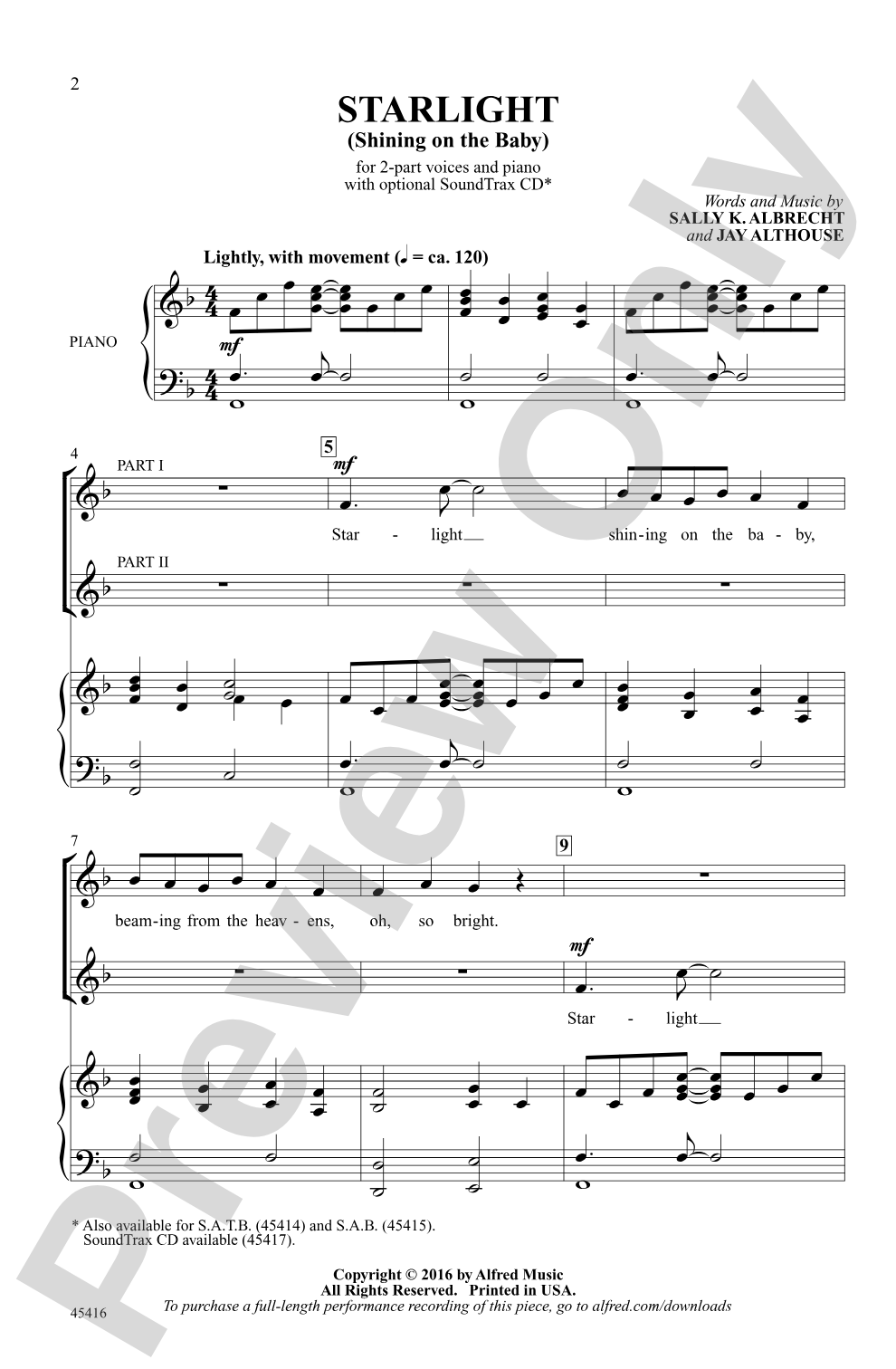
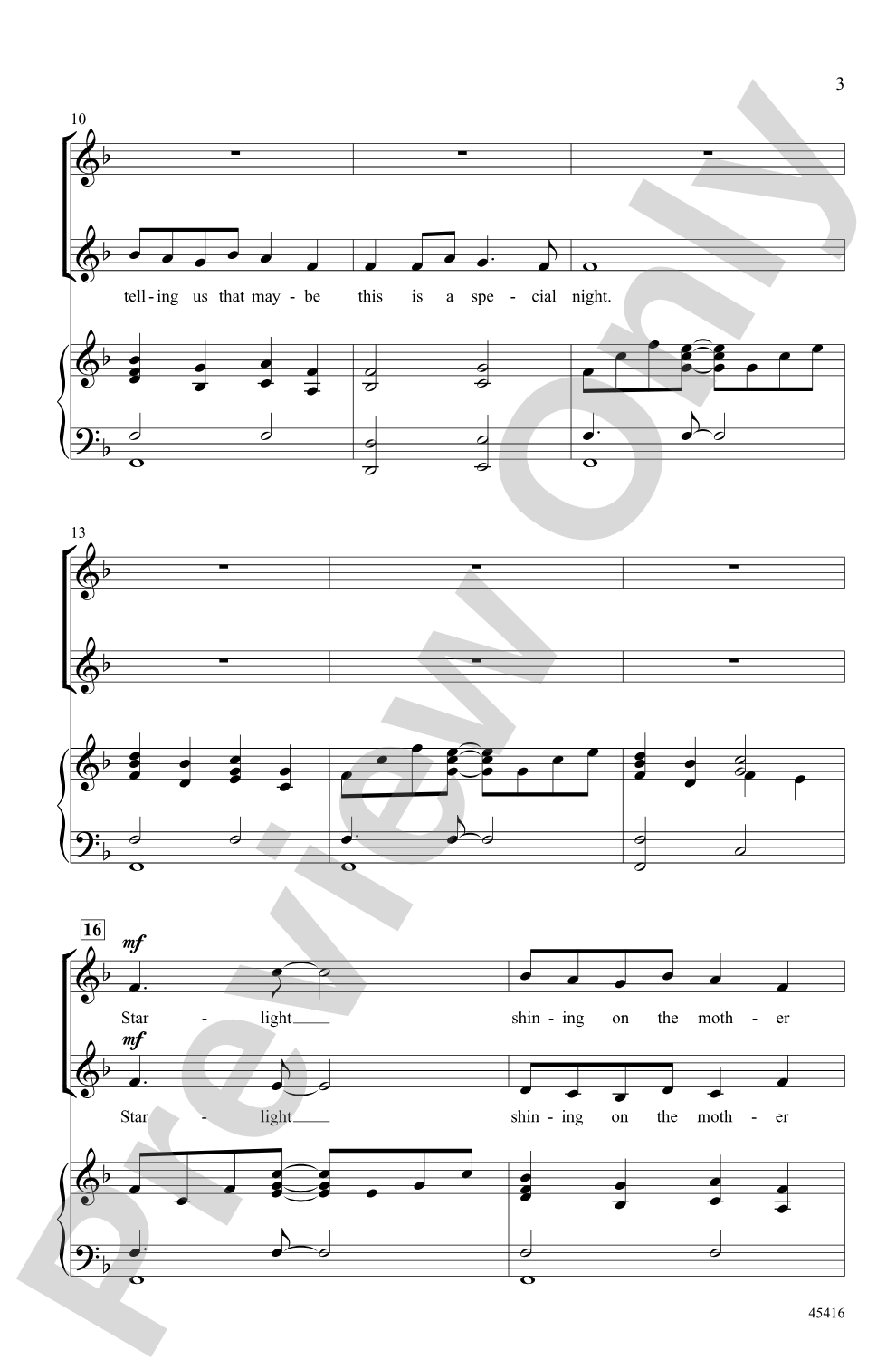

Starlight: 2-Part Choral Octavo
(Shining on the Baby)
Words and music by Sally K. Albrecht and Jay Althouse
Item: 00-PO-0003660
$1.90
Minimum order quantity: 20 copies
Pickup currently not available
Related Items
Starlight: SoundTrax Digital Audio Download |
$27.99
|
View | |
Starlight: SATB Choral Octavo |
$1.90
|
View | |
Starlight: SAB Choral Octavo |
$1.90
|
View | |
Starlight: SATB Choral Octavo |
$1.90
|
View | |
Starlight: SAB Choral Octavo |
$1.90
|
View | |
Starlight: 2-Part Choral Octavo |
$1.90
|
View | |
Starlight: Choral Octavo SoundTrax CD |
$27.99
|
View |
Description
A symbolic ascending fifth opens the main melodic idea in this bright original for Christmas. Taking inspiration from "Angels We Have Heard on High," the chorus moves in a new harmonic direction, while a brief bridge quotes the traditional carol. Simply stellar! Appropriate for both school and church.


Starlight: 2-Part Choral Octavo isn't in MakeMusic Cloud just yet...but it could be. Let us know you'd like to see it, and you'll help shape what comes next. In the meantime, start a free trial and dive into thousands of interactive titles your students can play along with today.
Request This Title
Tell us you want it.
Start Your Free Trial
Explore everything that's ready to play right now.
Sample Audio
1
Audio File
--:--
0:00
0:00
Sample Video
No sample videos found.
Additional Details
Series:
Alfred Choral Designs
Publisher:
Alfred Music
Page Count:
12
SKU:
00-PO-0003660
More about this title
About the Composer: Sally K. Albrecht

Sally K. Albrecht has shaped choral music education for over thirty years, first as Director of School Choral, Vocal, and Elementary Publications at Alfred Music and through her prolific output as a composer and arranger. Since 1987, she has received the ASCAP Special Music Award annually, with more than 600 choral works and 75 musicals and songbooks currently in publication. Her influence extends across the country through conducting appearances at prestigious venues including Lincoln Center, Carnegie Hall, and The Kennedy Center, where she has led honor choirs and festivals.
Albrecht's academic background spans music, drama, and accompanying, with degrees from Rollins College, the University of Miami, and teaching appointments at Oakland University, Jersey City State College, and Meredith College. She and her husband, composer and arranger Jay Althouse, live in North Carolina. In recent years, she has been recognized with the Distinguished Alumna Award from both the University of Miami Frost School of Music and Rollins College, where she serves on the Board of Trustees.
Why we love this
Albrecht and Althouse craft a piece that feels both fresh and deeply rooted in tradition. The harmonic sophistication elevates what could be a straightforward carol arrangement, while the 2-part voicing keeps it accessible for developing singers without sacrificing musical substance.
What to expect
Brightness and reverence coexist here. The symbolic ascending fifth and harmonic movement create forward momentum and modern sensibility, while the carol quotation and Christmas context ground the piece in timeless warmth. The overall effect is uplifting without being saccharine.
Who it's for
This piece suits developing choirs in both school and church settings, particularly those with mixed-age or mixed-ability singers. The 2-part voicing welcomes ensembles ranging from younger students to intergenerational community choirs seeking accessible yet artistically satisfying holiday repertoire.
How to get the most out of it
- Shape the opening ascending fifth with clarity and intention. This symbolic gesture sets the tone for everything that follows, so give it space and definition rather than rushing through it.
- When the piece moves into new harmonic territory away from the traditional carol, maintain vocal clarity through the chord changes. Blend matters here, but individual line integrity prevents the harmony from becoming muddy.
- The brief bridge quoting "Angels We Have Heard on High" offers a moment of recognition for your singers and audience. Let it land with warmth before returning to the original material.
How to use it
Pair this with other original Christmas compositions and traditional carols to create a balanced holiday concert. Its moderate length and accessibility make it ideal for mid-program placement, where it can lift the energy while offering a moment of harmonic sophistication that distinguishes your Christmas offerings from purely traditional programming.
Skills your students will build
- Following harmonic movement across chord changes in a tonal context
- Singing sustained melodic lines while maintaining ensemble blend
- Recognizing and interpreting symbolism in music (ascending fifth, carol quotation)
- Balancing individual line clarity with ensemble unity in 2-part writing