
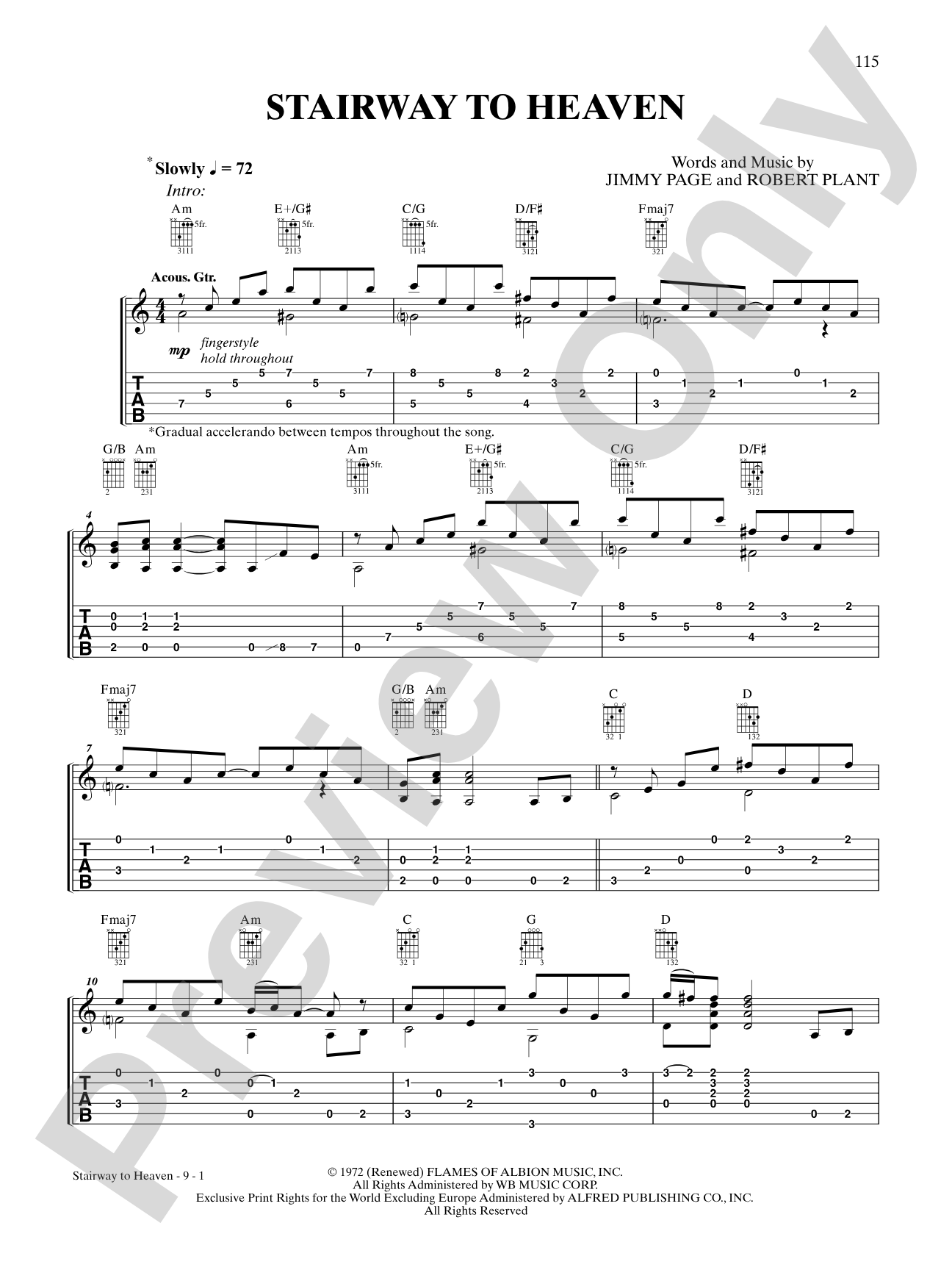
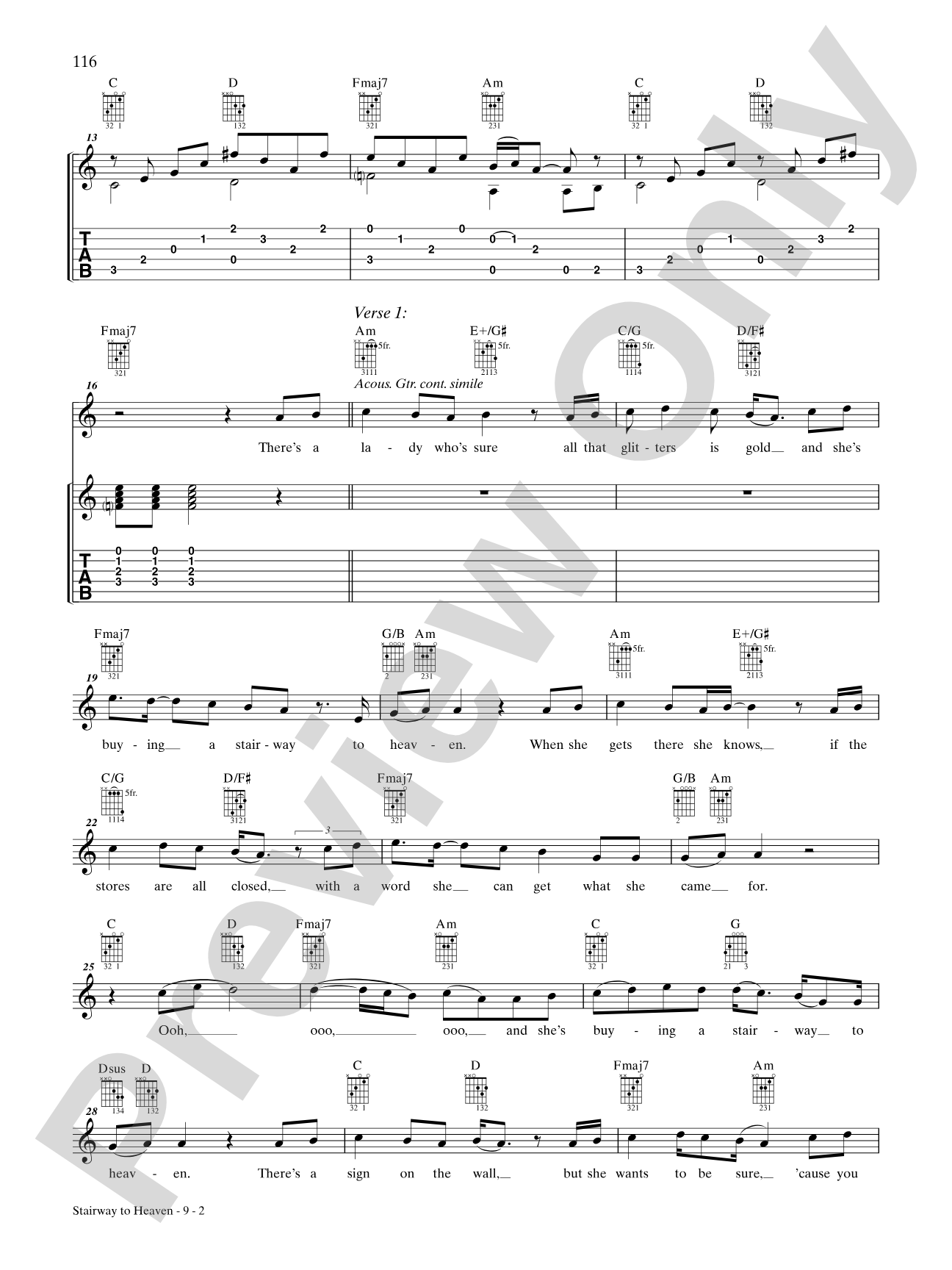

Stairway to Heaven: Guitar TAB
The Soft Side of Hard Rock
Item: 00-PS-0013824
$5.99
Pickup currently not available
Related Items
Thank You: Guitar TAB |
$5.99
|
View | |
Handy Man: Guitar TAB |
$4.99
|
View | |
If You Leave Me Now: Guitar TAB |
$4.99
|
View | |
I Don't Want to Miss a Thing (from "Armageddon"): Guitar TAB |
$4.99
|
View | |
Open Arms: Guitar TAB |
$4.99
|
View | |
Faithfully: Guitar TAB |
$5.99
|
View | |
When I See You Smile: Guitar TAB |
$4.99
|
View | |
My Immortal: Guitar TAB |
$4.99
|
View | |
Broken: Guitar TAB |
$5.99
|
View | |
One Thing: Guitar TAB |
$4.99
|
View | |
Wild Horses: Guitar TAB |
$4.99
|
View | |
With Arms Wide Open: Guitar TAB |
$4.99
|
View | |
Higher: Guitar TAB |
$5.99
|
View | |
Only the Lonely: Guitar TAB |
$4.99
|
View | |
Marry Me: Guitar TAB |
$4.99
|
View | |
Rock Ballads: Guitar Book |
$19.99
|
View |
Description
This book contains 26 of the greatest rock ballads ever committed to record, in notation and guitar TAB. Included are hits by Aerosmith, Bob Dylan, Journey, The Rolling Stones, Guns N' Roses, and more. Titles: Breathe (Pink Floyd) * Broken (Seether feat. Amy Lee) * Europa (Earth's Cry Heaven's Smile) (Santana) * Faithfully (Journey) * Fountain of Sorrow (Jackson Browne) * The Game of Love (Santana feat. Michelle Branch) * Handy Man (James Taylor) * Higher (Creed) * I Don't Want to Miss a Thing (Aerosmith) * If You Leave Me Now (Chicago) * Kiss from a Rose (Seal) * Knockin' on Heaven's Door (Bob Dylan) * The Load-Out (Jackson Browne) * Marry Me (Train) * My Immortal (Evanescence) * Nights in White Satin (The Moody Blues) * One Thing (Finger Eleven) * Only the Lonely (The Motels) * Open Arms (Journey) * Patience (Guns N' Roses) * Stairway to Heaven (Led Zeppelin) * Thank You (Led Zeppelin) * When I See You Smile (Bad English) * A Whiter Shade of Pale (Procol Harum) * Wild Horses (The Rolling Stones) * With Arms Wide Open (Creed).


Stairway to Heaven: Guitar TAB isn't in MakeMusic Cloud just yet...but it could be. Let us know you'd like to see it, and you'll help shape what comes next. In the meantime, start a free trial and dive into thousands of interactive titles your students can play along with today.
Request This Title
Tell us you want it.
Start Your Free Trial
Explore everything that's ready to play right now.
Sample Audio
No sample audio found.
Sample Video
No sample videos found.
Additional Details
Publisher:
Alfred Music
Page Count:
144
SKU:
00-PS-0013824
More about this title
About the Composer: Jimmy Page
Jimmy Page shaped modern rock guitar through his work as a session musician, producer, and founding member of Led Zeppelin. His innovative approach to arrangement, layering, and tone revolutionized how guitarists thought about the instrument's sonic possibilities.
Why we love this
This collection pairs one of rock's most essential compositions with 25 other ballads that defined emotional guitar playing across generations. The TAB notation makes these songs immediately accessible to intermediate players while the standard notation serves advancing musicians, and the stylistic range from Led Zeppelin to Evanescence models how ballads function across different eras of rock.
What to expect
These are songs built on restraint, dynamics, and emotional weight rather than speed or flash. You'll encounter fingerpicking patterns that require patience, sustained tones that demand good tone control, and arrangements that show how much impact comes from knowing when not to play.
Who it's for
Intermediate to advanced guitarists who want to expand their repertoire with songs that shaped rock ballad tradition. This collection also works well for students studying different eras of rock songwriting and arrangement, from classic rock through modern alternative and post-grunge.
How to get the most out of it
- Study the dynamics carefully in pieces like Stairway to Heaven and Patience, where restraint in the early sections sets up the power of later passages.
- Pay attention to how sustain and decay shape emotion in fingerpicked pieces like Thank You and Open Arms; tone matters more than speed.
- Use the mix of acoustic and electric arrangements in this collection to understand how the same song can work in different contexts.
- Work through the chord voicings in the standard notation alongside the TAB to build your understanding of how shapes relate to sound.
How to use it
Feature individual songs from this collection in student recitals to show range and maturity beyond pop or school repertoire. The breadth of styles makes it useful for themed concert programming around rock history, emotional storytelling through music, or the evolution of the power ballad.
Skills your students will build
- Reading guitar TAB and standard notation simultaneously
- Fingerpicking patterns across multiple song styles
- Dynamic control and phrasing in sustained passages
- Recognizing and executing different voicing types (barre chords, open positions, suspended harmonies)
- Interpreting dynamics and tempo marking to create emotional arc
- Transposing songs to accommodate vocal ranges or ensemble contexts