
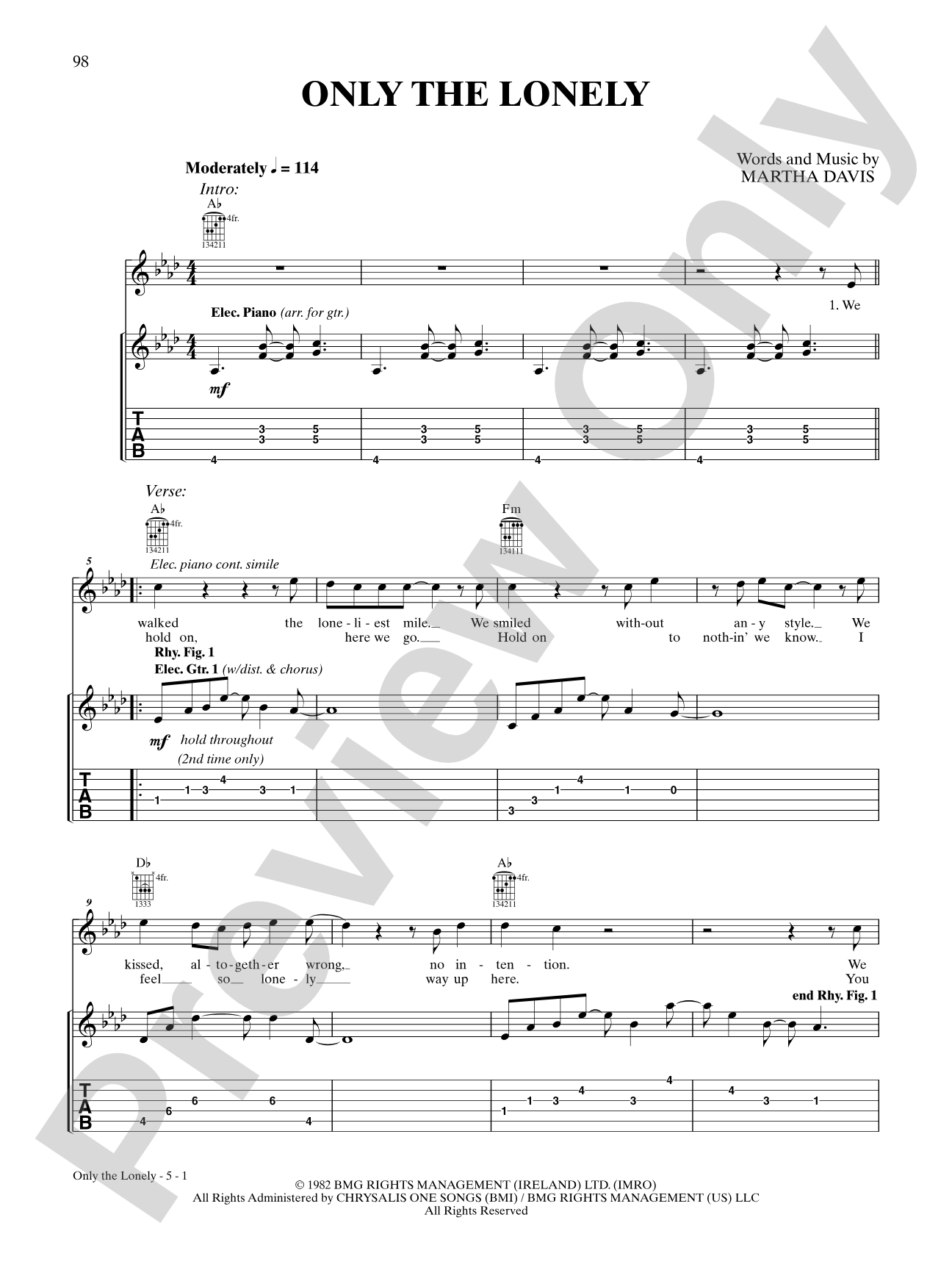

Only the Lonely: Guitar TAB
The Soft Side of Hard Rock
Item: 00-PS-0013839
$4.99
Pickup currently not available
Related Items
Thank You: Guitar TAB |
$5.99
|
View | |
Handy Man: Guitar TAB |
$4.99
|
View | |
If You Leave Me Now: Guitar TAB |
$4.99
|
View | |
I Don't Want to Miss a Thing (from "Armageddon"): Guitar TAB |
$4.99
|
View | |
Stairway to Heaven: Guitar TAB |
$5.99
|
View | |
Open Arms: Guitar TAB |
$4.99
|
View | |
Faithfully: Guitar TAB |
$5.99
|
View | |
When I See You Smile: Guitar TAB |
$4.99
|
View | |
My Immortal: Guitar TAB |
$4.99
|
View | |
Broken: Guitar TAB |
$5.99
|
View | |
One Thing: Guitar TAB |
$4.99
|
View | |
Wild Horses: Guitar TAB |
$4.99
|
View | |
With Arms Wide Open: Guitar TAB |
$4.99
|
View | |
Higher: Guitar TAB |
$5.99
|
View | |
Marry Me: Guitar TAB |
$4.99
|
View | |
Rock Ballads: Guitar Book |
$19.99
|
View |
Description
This book contains 26 of the greatest rock ballads ever committed to record, in notation and guitar TAB. Included are hits by Aerosmith, Bob Dylan, Journey, The Rolling Stones, Guns N' Roses, and more. Titles: Breathe (Pink Floyd) * Broken (Seether feat. Amy Lee) * Europa (Earth's Cry Heaven's Smile) (Santana) * Faithfully (Journey) * Fountain of Sorrow (Jackson Browne) * The Game of Love (Santana feat. Michelle Branch) * Handy Man (James Taylor) * Higher (Creed) * I Don't Want to Miss a Thing (Aerosmith) * If You Leave Me Now (Chicago) * Kiss from a Rose (Seal) * Knockin' on Heaven's Door (Bob Dylan) * The Load-Out (Jackson Browne) * Marry Me (Train) * My Immortal (Evanescence) * Nights in White Satin (The Moody Blues) * One Thing (Finger Eleven) * Only the Lonely (The Motels) * Open Arms (Journey) * Patience (Guns N' Roses) * Stairway to Heaven (Led Zeppelin) * Thank You (Led Zeppelin) * When I See You Smile (Bad English) * A Whiter Shade of Pale (Procol Harum) * Wild Horses (The Rolling Stones) * With Arms Wide Open (Creed).


Only the Lonely: Guitar TAB isn't in MakeMusic Cloud just yet...but it could be. Let us know you'd like to see it, and you'll help shape what comes next. In the meantime, start a free trial and dive into thousands of interactive titles your students can play along with today.
Request This Title
Tell us you want it.
Start Your Free Trial
Explore everything that's ready to play right now.
Sample Audio
No sample audio found.
Sample Video
No sample videos found.
Additional Details
Publisher:
Alfred Music
Page Count:
144
SKU:
00-PS-0013839
More about this title
About the Composer: Martha Davis
Martha Davis is best known as the lead vocalist and primary songwriter for The Motels, the new wave rock band that produced hits throughout the late 1970s and 1980s. Her gift for crafting memorable melodies and emotionally direct lyrics made her a distinctive voice in rock music. As a guitarist and bandleader, Davis understands what makes a rock ballad resonate both emotionally and musically, knowledge she brings to her arrangements.
Why we love this
This collection spans four decades of rock ballad repertoire, giving guitarists immediate access to songs that matter to them. The TAB notation paired with standard notation means students at different reading levels can work through the same material together, and the sheer range of artists keeps the book relevant to multiple generations of players.
What to expect
These 26 songs carry the weight of genuine emotion, from the hushed vulnerability of fingerpicked passages to the sustained power of full acoustic and electric arrangements. Playing through them feels less like technical study and more like connecting with songs that have resonated with audiences for decades.
Who it's for
Intermediate to advanced guitarists who want to build a repertoire of songs that appeal to listeners and showcase musicianship beyond technical display. This collection also works well for private teachers building a student's performance library or for guitarists preparing auditions and recitals.
How to get the most out of it
- Study the dynamics carefully. Rock ballads often build from intimate fingerpicked passages into fuller, strummed sections; these transitions require intentional volume control and tone shaping to land properly.
- Listen to the original recordings before drilling the TAB. These songs have distinctive rhythmic feels and phrasing that the notation alone won't fully capture; hearing how the artist shapes the melody informs your interpretation.
- Map out your hand positions before you play through a piece. Many of these arrangements use position shifts, and marking them on your copy prevents fumbling during performance.
- Pay attention to barre chord voicings. Several of these songs rely on specific chord colors and inversions that matter to the overall sound; substituting open chords will change the character significantly.
How to use it
Use selections from this collection as standalone recital pieces or pair complementary songs into a themed program (e.g., a Led Zeppelin evening, a Santana retrospective). The variety of tunings and styles means you can build a diverse setlist without straying from the ballad aesthetic.
Skills your students will build
- Reading TAB notation fluently alongside standard notation
- Interpreting dynamic shaping and phrasing in rock contexts
- Managing position shifts and hand transitions cleanly
- Distinguishing chord voicings and their harmonic colors
- Adapting fingerpicking patterns for longer sustain and resonance
- Matching articulation and tone to the original recorded performance