
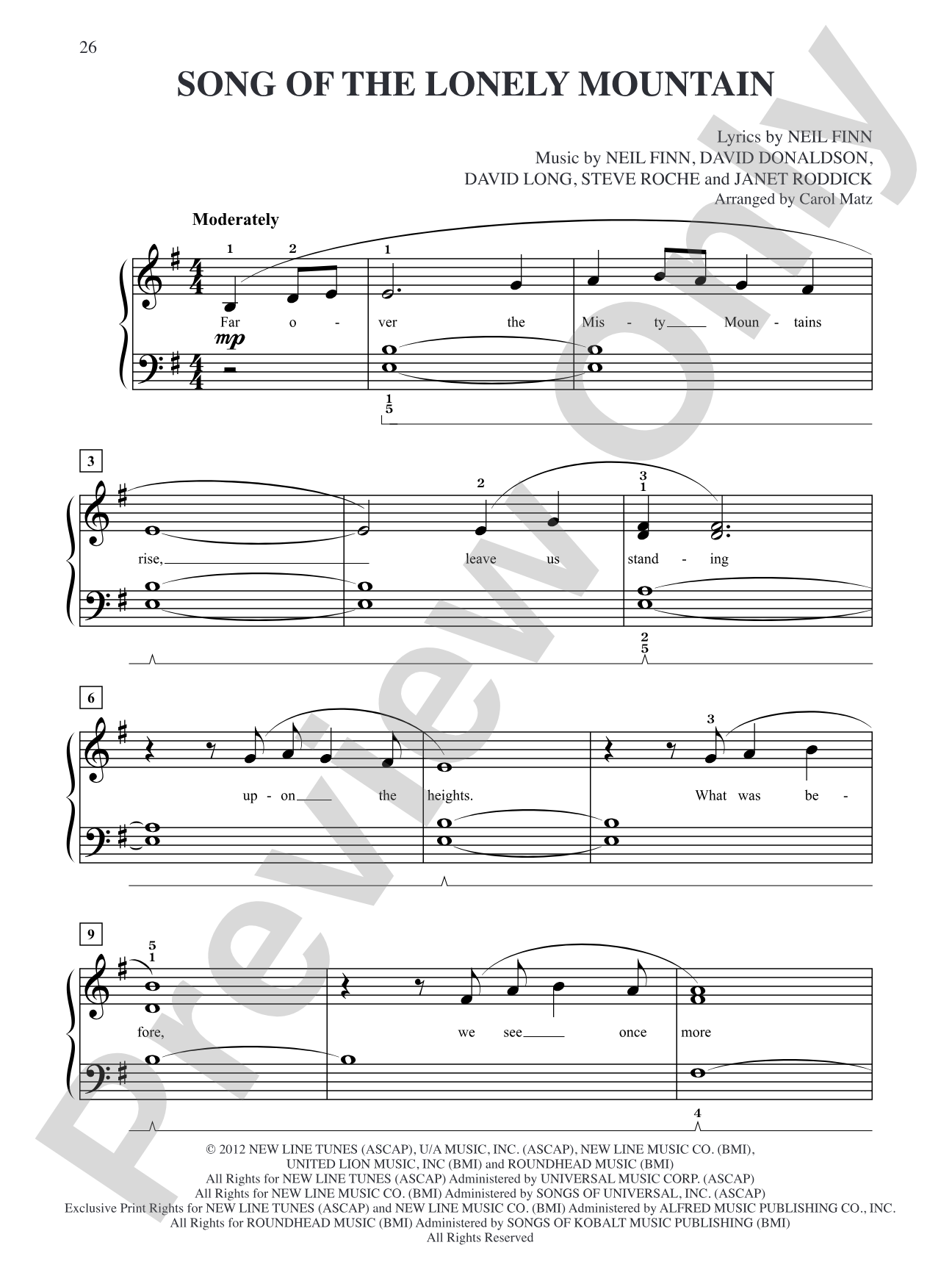

Song of the Lonely Mountain (from The Hobbit: An Unexpected Journey): Big Note Piano
Sheet Music Selections from the Motion Picture
Music composed by Howard Shore / arr. Carol Matz
Level: Big Note
Item: 00-PS-0015907
$4.99
One moment…
Related Items
An Unexpected Party (from The Hobbit: An Unexpected Journey): Big Note Piano |
$4.99
|
View | |
The Adventure Begins (from The Hobbit: An Unexpected Journey): Big Note Piano |
$4.99
|
View | |
The Dwarf Lords (from The Hobbit: An Unexpected Journey): Big Note Piano |
$4.99
|
View | |
Erebor (from The Hobbit: An Unexpected Journey): Big Note Piano |
$4.99
|
View | |
A Very Respectable Hobbit (from The Hobbit: An Unexpected Journey): Big Note Piano |
$4.99
|
View | |
Misty Mountains (from The Hobbit: An Unexpected Journey): Big Note Piano |
$4.99
|
View | |
Dreaming of Bag End (from The Hobbit: An Unexpected Journey): Big Note Piano |
$5.99
|
View | |
The Hobbit: An Unexpected Journey: Piano Book |
$14.99
|
View |
Description
With this collection, pianists in their early years of study can enjoy playing simplified arrangements of eight elections from Howard Shore's brilliant score to The Hobbit: An Unexpected Journey. Shore masterfully expands upon the musical palette of Middle-earth, blending familiar motifs from the The Lord of the Rings trilogy with an exciting array of memorable new themes. In addition to the piano arrangements, this beautifully produced souvenir folio features an array of colorful photos from the film. Titles: An Unexpected Party * Misty Mountains * The Adventure Begins * Song of the Lonely Mountain * Dreaming of Bag End * A Very Respectable Hobbit * Erebor * The Dwarf Lords.


Song of the Lonely Mountain (from The Hobbit: An Unexpected Journey): Big Note Piano isn't in MakeMusic Cloud just yet...but it could be. Let us know you'd like to see it, and you'll help shape what comes next. In the meantime, start a free trial and dive into thousands of interactive titles your students can play along with today.
Request This Title
Tell us you want it.
Start Your Free Trial
Explore everything that's ready to play right now.
Sample Audio
No sample audio found.
Sample Video
No sample videos found.
Additional Details
Publisher:
Alfred Music
Page Count:
36
SKU:
00-PS-0015907
More about this title
About the Composer: Neil Finn
Neil Finn is a composer and musician best known for his work with the New Zealand rock band Crowded House and as a solo artist. His ability to craft memorable melodies and emotionally resonant arrangements has made him a sought-after collaborator in film and television scoring. For The Hobbit trilogy, Finn contributed to Howard Shore's expansive orchestral palette, helping to shape the musical identity of Middle-earth across multiple films.
Why we love this
These arrangements preserve the emotional core of Shore's score while remaining genuinely playable for early-level pianists. The collection balances recognizable melodic material from the films with manageable hand positions and rhythmic patterns, making it accessible without feeling dumbed-down. Young pianists gain exposure to film scoring and orchestral thinking through music they actually want to play.
What to expect
Sweeping and cinematic without overwhelming the player. These arrangements capture the grandeur and warmth of Tolkien's world through accessible textures. Whether you're playing a quiet moment in the Shire or something more adventurous, the music conveys genuine emotion and invites you into a larger musical narrative.
Who it's for
Early-level pianists (typically after one year of study) who want to play recognizable film music while building fundamental skills. Students drawn to movie soundtracks find real motivation in this collection, and teachers often use it to keep practice engaging during the critical early stages.
How to get the most out of it
- Let the melody sing through even in a simplified texture. These themes deserve a lyrical quality, so shape phrases gently rather than playing mechanically.
- Pay close attention to dynamic markings as your primary tool for storytelling. Changes from soft to loud often mirror the emotional arc of each scene from the film.
- Sustain the pedal thoughtfully to create the rich harmonic color that defines Shore's orchestrations, but lift it clearly at phrase endings to keep textures clean.
How to use it
Feature individual pieces as recital selections for early-level students, or program multiple arrangements as a medley during a film music concert. The colorful photos in the folio make this collection engaging for family recitals and informal studio performances where young pianists benefit from seeing the story context alongside the music.
Skills your students will build
- Reading and sustaining simple melodies in treble clef
- Coordinating hands with different rhythmic patterns (simple note values in bass, slightly more active melody in treble)
- Dynamic control and phrase shaping within a limited hand position
- Pedal technique applied to harmonic color rather than purely for duration
- Recognizing thematic material and understanding how composers create emotional narrative through music