
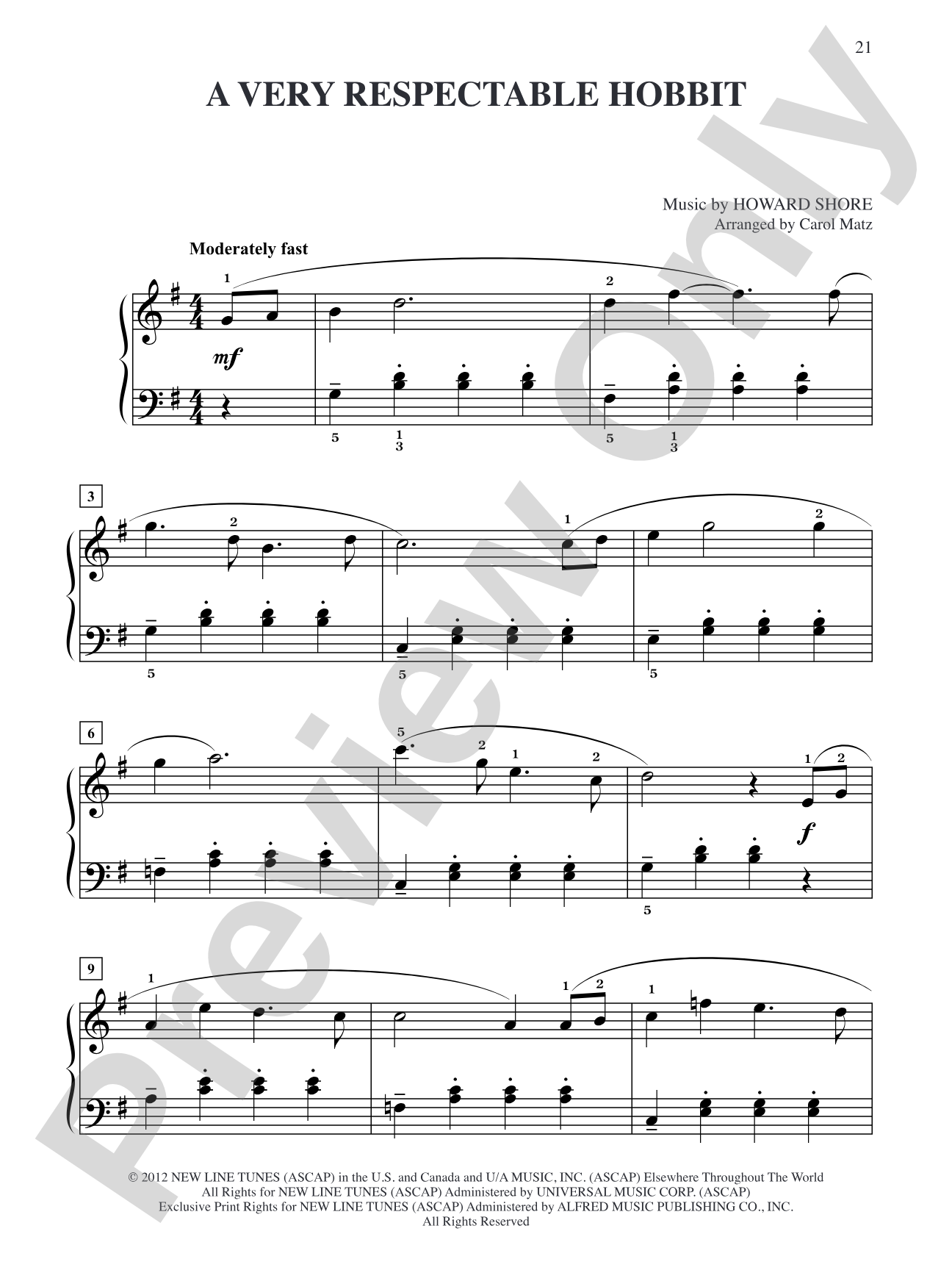

A Very Respectable Hobbit (from The Hobbit: An Unexpected Journey): Big Note Piano
Sheet Music Selections from the Motion Picture
Music composed by Howard Shore / arr. Carol Matz
Level: Big Note
Item: 00-PS-0015905
$4.99
One moment…
Related Items
An Unexpected Party (from The Hobbit: An Unexpected Journey): Big Note Piano |
$4.99
|
View | |
The Adventure Begins (from The Hobbit: An Unexpected Journey): Big Note Piano |
$4.99
|
View | |
The Dwarf Lords (from The Hobbit: An Unexpected Journey): Big Note Piano |
$4.99
|
View | |
Erebor (from The Hobbit: An Unexpected Journey): Big Note Piano |
$4.99
|
View | |
Misty Mountains (from The Hobbit: An Unexpected Journey): Big Note Piano |
$4.99
|
View | |
Song of the Lonely Mountain (from The Hobbit: An Unexpected Journey): Big Note Piano |
$4.99
|
View | |
Dreaming of Bag End (from The Hobbit: An Unexpected Journey): Big Note Piano |
$5.99
|
View | |
The Hobbit: An Unexpected Journey: Piano Book |
$14.99
|
View |
Description
With this collection, pianists in their early years of study can enjoy playing simplified arrangements of eight elections from Howard Shore's brilliant score to The Hobbit: An Unexpected Journey. Shore masterfully expands upon the musical palette of Middle-earth, blending familiar motifs from the The Lord of the Rings trilogy with an exciting array of memorable new themes. In addition to the piano arrangements, this beautifully produced souvenir folio features an array of colorful photos from the film. Titles: An Unexpected Party * Misty Mountains * The Adventure Begins * Song of the Lonely Mountain * Dreaming of Bag End * A Very Respectable Hobbit * Erebor * The Dwarf Lords.


A Very Respectable Hobbit (from The Hobbit: An Unexpected Journey): Big Note Piano isn't in MakeMusic Cloud just yet...but it could be. Let us know you'd like to see it, and you'll help shape what comes next. In the meantime, start a free trial and dive into thousands of interactive titles your students can play along with today.
Request This Title
Tell us you want it.
Start Your Free Trial
Explore everything that's ready to play right now.
Sample Audio
No sample audio found.
Sample Video
No sample videos found.
Additional Details
Publisher:
Alfred Music
Page Count:
36
SKU:
00-PS-0015905
More about this title
About the Composer: Howard Shore
Howard Shore is an Academy Award-winning composer known for his expansive orchestral film scores. His work on Peter Jackson's The Lord of the Rings trilogy established him as a master of fantasy storytelling through music, and he brought that same compositional sophistication to The Hobbit films, crafting themes that honor the earlier trilogy while introducing new musical landscapes for Middle-earth's prequel adventure.
Why we love this
These arrangements capture the grandeur and drama of Shore's score without overwhelming early pianists. Carol Matz's adaptations preserve the melodic integrity and emotional core of each theme, giving young players immediate access to film music they recognize and love. The inclusion of film photography transforms the book into a keepsake that celebrates both the music and the story.
What to expect
You're stepping into Middle-earth through your fingertips. One moment you're in a cozy hobbit-hole; the next you're swept into mountains and dwarf halls. The arrangements strike a balance between quiet charm and sweeping adventure, letting young pianists experience the emotional arc of Shore's original score in miniature.
Who it's for
Early elementary pianists (roughly grades 1-3 of study) who want to play recognizable film themes without the technical demands of standard repertoire at their level. Anyone studying piano who loves The Hobbit films will find motivation in performing music they already know and love.
How to get the most out of it
- Balance the melodic line in your right hand so the main theme sings clearly, even when left-hand accompaniment fills out the harmonic texture.
- Pay attention to tempo markings and any indicated dynamic changes; Shore's themes often shift between contemplative and adventurous moments within a single piece.
- Use the pedal sparingly in faster passages to keep clarity, but lean into it during the quieter, more atmospheric arrangements.
- Shape each phrase as if you're telling part of the story; these melodies carry narrative weight, so avoid playing them mechanically.
How to use it
Present these pieces as a film music unit in a spring or end-of-year recital, programming them as a set or interspersing individual selections throughout the program. They work particularly well as encore pieces or as a bridge between classical repertoire and contemporary music in a mixed recital.
Skills your students will build
- Reading and executing dynamic contrasts (piano, forte, and gradual changes)
- Balancing melody and accompaniment in both hands
- Sustaining musical phrasing across longer melodic lines
- Coordinating pedal use with harmonic changes
- Interpreting tempo markings and musical expression in film-inspired themes