
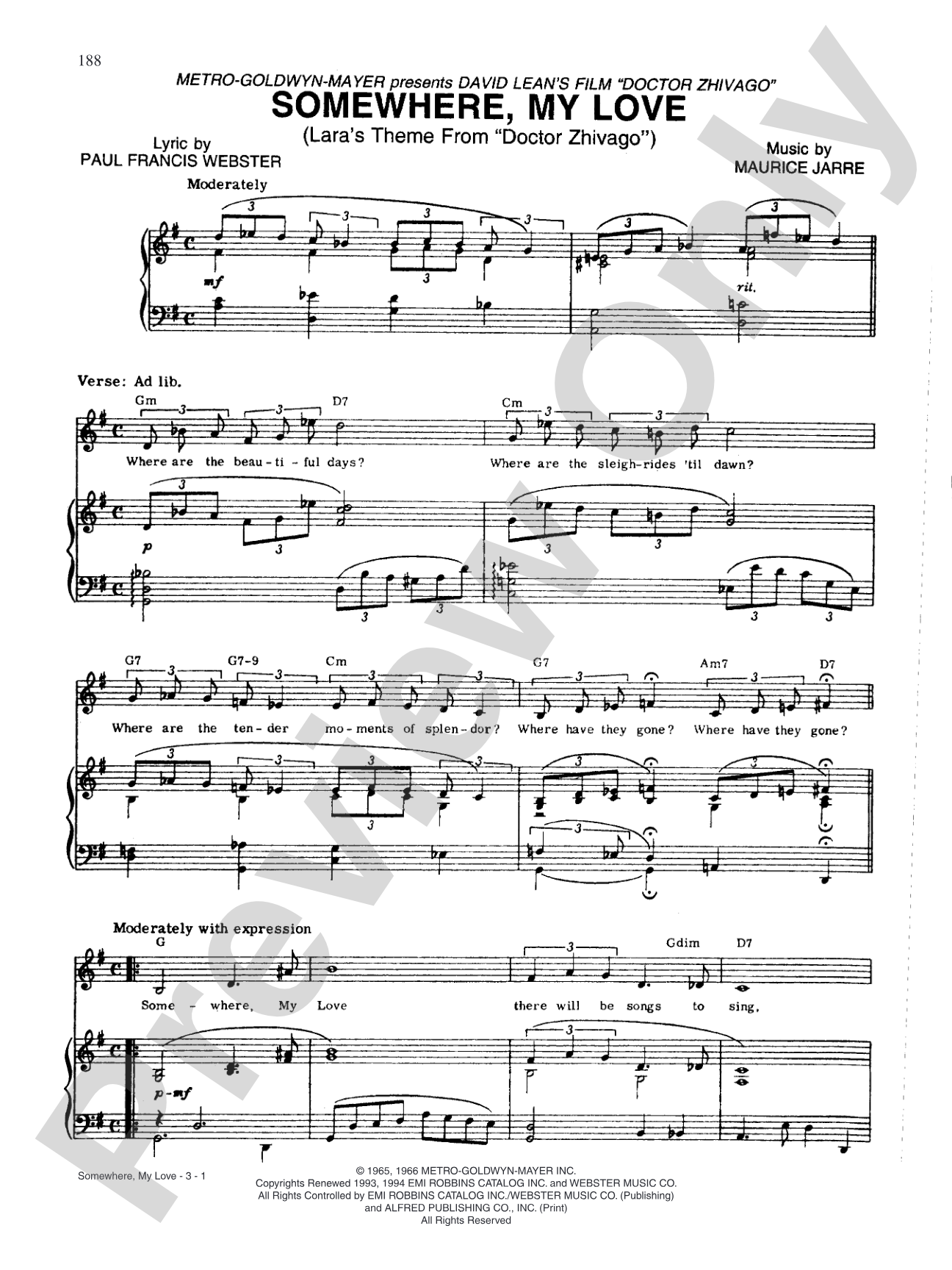

Somewhere My Love (from "Dr. Zhivago"): Piano/Vocal/Chords
Item: 00-PS-0010788
$4.99
One moment…
Related Items
Doctor Dolittle (from "Doctor Dolittle"): Piano/Vocal/Chords |
$5.99
|
View | |
Aquarius (from "Hair"): Piano/Vocal/Chords |
$4.99
|
View | |
Night Fever: Piano/Vocal/Chords |
$4.99
|
View | |
Flashdance...What a Feeling (from "Flashdance"): Piano/Vocal/Chords |
$4.99
|
View | |
Who's That Girl (Main Title): Piano/Vocal/Chords |
$4.99
|
View | |
Hopelessly Devoted to You: Piano/Vocal/Chords |
$4.99
|
View |
Description
Each songbook in the Big Book series provides musicians of all ability levels with a big list---usually 40 or more titles per book---of the very best songs from a favorite musical genre.
Songs include And All That Jazz (Chicago) * Circle of Life (The Lion King) * Eye of the Tiger (Rocky III) * Hopelessly Devoted to You (Grease) * Night Fever (Saturday Night Fever) * The Pink Panther (The Pink Panther) * Singin' in the Rain (Singin' in the Rain) * A Spoonful of Sugar (Mary Poppins) * Streets of Philadelphia (Philadelphia) * Under the Sea (The Little Mermaid) * The Work Song (Cinderella) * and many more.


Songs include And All That Jazz (Chicago) * Circle of Life (The Lion King) * Eye of the Tiger (Rocky III) * Hopelessly Devoted to You (Grease) * Night Fever (Saturday Night Fever) * The Pink Panther (The Pink Panther) * Singin' in the Rain (Singin' in the Rain) * A Spoonful of Sugar (Mary Poppins) * Streets of Philadelphia (Philadelphia) * Under the Sea (The Little Mermaid) * The Work Song (Cinderella) * and many more.
Somewhere My Love (from "Dr. Zhivago"): Piano/Vocal/Chords isn't in MakeMusic Cloud just yet...but it could be. Let us know you'd like to see it, and you'll help shape what comes next. In the meantime, start a free trial and dive into thousands of interactive titles your students can play along with today.
Request This Title
Tell us you want it.
Start Your Free Trial
Explore everything that's ready to play right now.
Sample Audio
No sample audio found.
Sample Video
No sample videos found.
Additional Details
Series:
The Big Book Series
Publisher:
Alfred Music
Page Count:
256
SKU:
00-PS-0010788
More about this title
About the Composer: Maurice Jarre
Maurice Jarre (1924-2009) composed some of the most recognizable film scores of the late twentieth century. His orchestral sensibility and gift for melody made him a three-time Academy Award winner, with iconic scores for Lawrence of Arabia, Doctor Zhivago, and A Passage to India. Jarre's approach to film music emphasized sweeping, singable themes that could stand alone as concert pieces and popular songs, a skill that made his work enduringly appealing to musicians across all genres.
Why we love this
This classic film ballad offers singers a chance to work with genuinely elegant melody writing and harmonic sophistication without requiring operatic technique or extensive range. The song's intimate scale and emotional directness make it accessible for student recitals, cabaret programs, and community performances while still delivering the dramatic satisfaction that comes from performing music written for cinema.
What to expect
Jarre's melody unfolds with the tenderness of a love letter, built on warm, consonant harmonies that feel both timeless and cinematic. The song carries a bittersweet longing, inviting the performer and listener into an intimate moment rather than demanding a grand gesture.
Who it's for
This song works for pianists accompanying singers in lessons or recitals, as well as for singers preparing audition material or concert repertoire at the intermediate level and above. It suits music theater students exploring classic film song repertoire and any musician looking for a piece with genuine emotional depth and sophisticated harmonic language.
How to get the most out of it
- Shape the melody with long, connected phrases rather than emphasizing individual notes; Jarre's writing rewards legato singing and flowing piano accompaniment.
- Treat the chord symbols as a foundation for your interpretation. The basic progression supports rubato and subtle tempo flexibility that enhances the song's emotional arc.
- Balance the vocal line and piano so neither overwhelms; this is a duet between voice and accompaniment, not a showcase for either alone.
- Establish a consistent harmonic rhythm in the left hand to anchor the piece, especially if you're working from chord symbols rather than a fully realized accompaniment.
How to use it
Include this as a standalone art song in a recital that mixes classical and popular repertoire, or pair it with other film music for an evening celebrating music written for cinema. Its sophisticated charm makes it an excellent bridge between standard song literature and contemporary musical theater selections.
Skills your students will build
- Sustaining long melodic phrases with consistent breath support and vocal line
- Interpreting chord symbols to create idiomatic piano accompaniment
- Balancing vocal and instrumental parts in collaborative performance
- Applying rubato and expressive timing within a song's harmonic structure
- Navigating the emotional arc of a ballad-style melody