
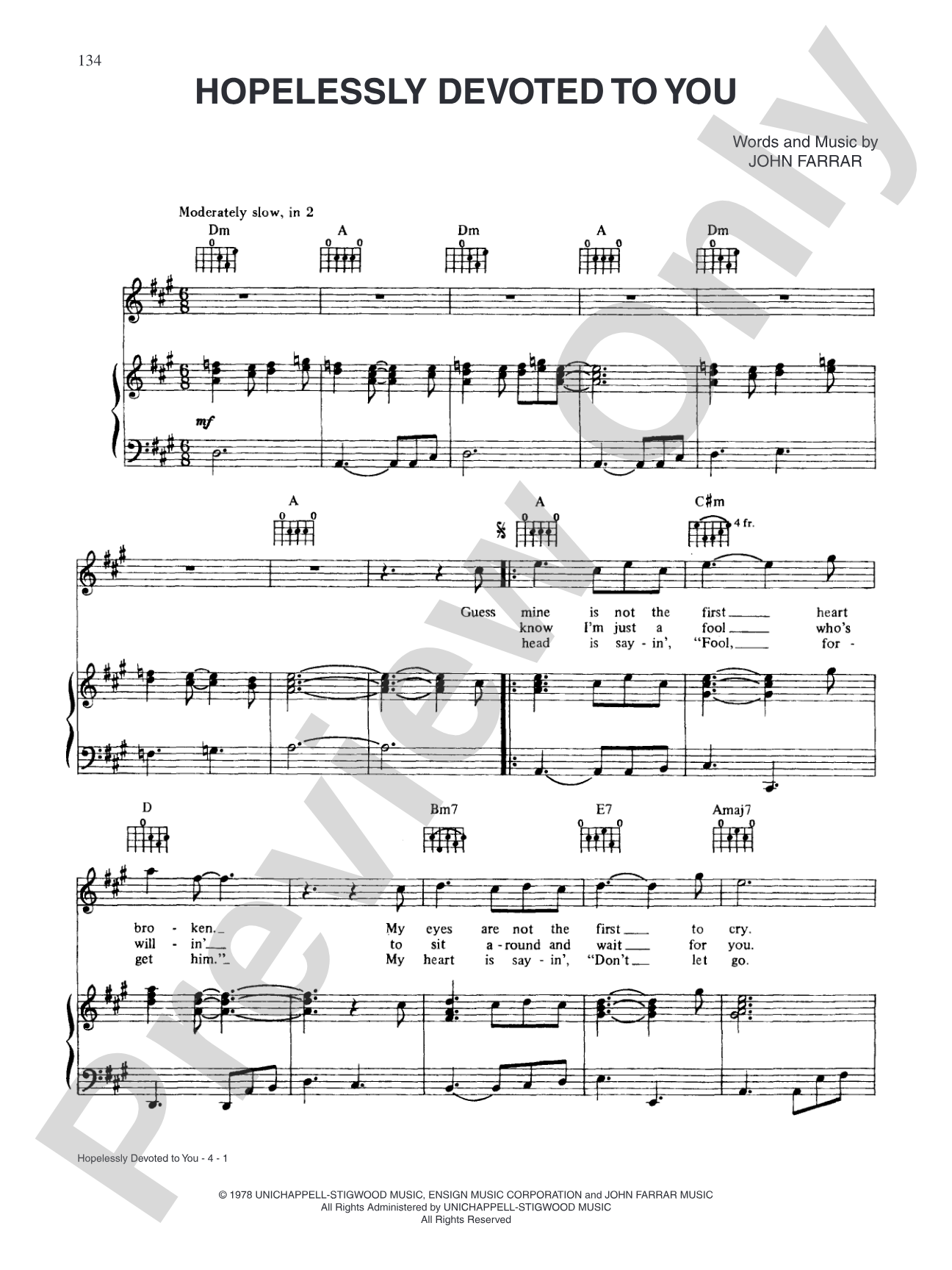

Hopelessly Devoted to You: Piano/Vocal/Chords
Item: 00-PS-0011021
$4.99
One moment…
Related Items
Doctor Dolittle (from "Doctor Dolittle"): Piano/Vocal/Chords |
$5.99
|
View | |
Somewhere My Love (from "Dr. Zhivago"): Piano/Vocal/Chords |
$4.99
|
View | |
Aquarius (from "Hair"): Piano/Vocal/Chords |
$4.99
|
View | |
Night Fever: Piano/Vocal/Chords |
$4.99
|
View | |
Flashdance...What a Feeling (from "Flashdance"): Piano/Vocal/Chords |
$4.99
|
View | |
Who's That Girl (Main Title): Piano/Vocal/Chords |
$4.99
|
View |
Description
Each songbook in the Big Book series provides musicians of all ability levels with a big list---usually 40 or more titles per book---of the very best songs from a favorite musical genre.
Songs include And All That Jazz (Chicago) * Circle of Life (The Lion King) * Eye of the Tiger (Rocky III) * Hopelessly Devoted to You (Grease) * Night Fever (Saturday Night Fever) * The Pink Panther (The Pink Panther) * Singin' in the Rain (Singin' in the Rain) * A Spoonful of Sugar (Mary Poppins) * Streets of Philadelphia (Philadelphia) * Under the Sea (The Little Mermaid) * The Work Song (Cinderella) * and many more.


Songs include And All That Jazz (Chicago) * Circle of Life (The Lion King) * Eye of the Tiger (Rocky III) * Hopelessly Devoted to You (Grease) * Night Fever (Saturday Night Fever) * The Pink Panther (The Pink Panther) * Singin' in the Rain (Singin' in the Rain) * A Spoonful of Sugar (Mary Poppins) * Streets of Philadelphia (Philadelphia) * Under the Sea (The Little Mermaid) * The Work Song (Cinderella) * and many more.
Hopelessly Devoted to You: Piano/Vocal/Chords isn't in MakeMusic Cloud just yet...but it could be. Let us know you'd like to see it, and you'll help shape what comes next. In the meantime, start a free trial and dive into thousands of interactive titles your students can play along with today.
Request This Title
Tell us you want it.
Start Your Free Trial
Explore everything that's ready to play right now.
Sample Audio
No sample audio found.
Sample Video
No sample videos found.
Additional Details
Series:
The Big Book Series
Publisher:
Alfred Music
Page Count:
256
SKU:
00-PS-0011021
More about this title
About the Composer: John Farrar
John Farrar is a British-Australian singer, songwriter, and producer who became a central creative force in 1970s pop and film music. His work with Olivia Newton-John yielded some of the era's most enduring songs, including "Hopelessly Devoted to You" from Grease, which showcased his gift for crafting intimate, emotionally direct melodies that connect immediately with listeners.
Farrar's compositions span film soundtracks, pop records, and theatrical works, consistently demonstrating a knack for writing singable, memorable material that serves both the narrative and the performer. His influence on contemporary musical theater and pop songwriting remains significant in music education, where his songs appear frequently in classroom and performance settings.
Why we love this
This collection anchors itself in genuine blockbuster moments across film and musical theater, giving singers and pianists legitimate repertoire that connects to the cultural touchstones their audiences recognize. The 40-plus selections span decades and styles, so whether you need a Gershwin standard, an animated film hit, or a contemporary pop-driven musical number, you'll find material that feels both accessible and musically substantial.
What to expect
This collection captures the polish and emotional directness of Hollywood's greatest musical moments. Whether you're navigating the soaring romanticism of a ballad or the rhythmic energy of a uptempo number, the writing sits comfortably in the voice and under the hands, inviting performers to focus on storytelling rather than technical struggle.
Who it's for
Piano teachers and their students who want to expand beyond classical repertoire into music theater and film songs; singers preparing audition material, recital programs, or casual performance settings; pianists accompanying vocalists or seeking crossover material that develops both classical technique and popular music literacy.
How to get the most out of it
- Let the piano part guide your phrasing when learning the melody; many of these songs rely on the interplay between voice and keyboard to establish their emotional arc.
- Pay attention to the chord symbols even if you're reading melody and lyrics. They cue important harmonic movement that shapes how a phrase should breathe.
- Build flexibility into your tempo choices. Songs from different eras sit at different speeds, and matching the recorded version or a reference recording will anchor your interpretation.
How to use it
Draw from this collection when building recitals that blend classical and popular idioms, or when you need recognizable material to anchor a program of less-familiar work. It's equally useful for students preparing for music theater auditions, for summer recitals where familiar repertoire builds audience confidence, or for accompanying community singers and church musicians seeking trusted, well-written material.
Skills your students will build
- Reading chord symbols and understanding their relationship to melody
- Balancing vocal line with keyboard accompaniment
- Interpreting lyrical content through musical phrasing
- Sight-reading across multiple repertoire styles and eras
- Managing different harmonic and rhythmic conventions across film and theatrical contexts