
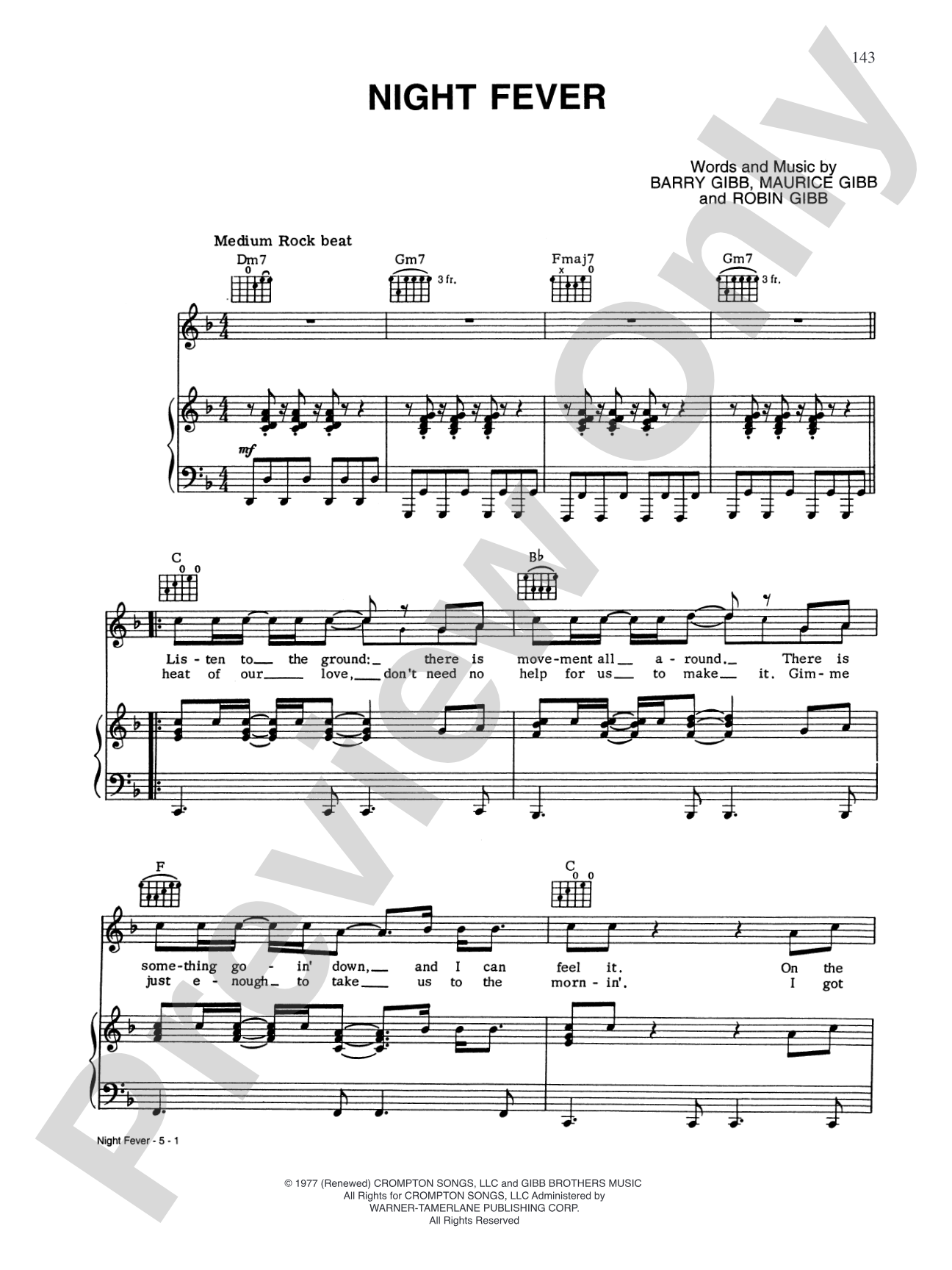

Night Fever: Piano/Vocal/Chords
Item: 00-PS-0010819
$4.99
One moment…
Related Items
Doctor Dolittle (from "Doctor Dolittle"): Piano/Vocal/Chords |
$5.99
|
View | |
Somewhere My Love (from "Dr. Zhivago"): Piano/Vocal/Chords |
$4.99
|
View | |
Aquarius (from "Hair"): Piano/Vocal/Chords |
$4.99
|
View | |
Flashdance...What a Feeling (from "Flashdance"): Piano/Vocal/Chords |
$4.99
|
View | |
Who's That Girl (Main Title): Piano/Vocal/Chords |
$4.99
|
View | |
Hopelessly Devoted to You: Piano/Vocal/Chords |
$4.99
|
View |
Description
Each songbook in the Big Book series provides musicians of all ability levels with a big list---usually 40 or more titles per book---of the very best songs from a favorite musical genre.
Songs include And All That Jazz (Chicago) * Circle of Life (The Lion King) * Eye of the Tiger (Rocky III) * Hopelessly Devoted to You (Grease) * Night Fever (Saturday Night Fever) * The Pink Panther (The Pink Panther) * Singin' in the Rain (Singin' in the Rain) * A Spoonful of Sugar (Mary Poppins) * Streets of Philadelphia (Philadelphia) * Under the Sea (The Little Mermaid) * The Work Song (Cinderella) * and many more.


Songs include And All That Jazz (Chicago) * Circle of Life (The Lion King) * Eye of the Tiger (Rocky III) * Hopelessly Devoted to You (Grease) * Night Fever (Saturday Night Fever) * The Pink Panther (The Pink Panther) * Singin' in the Rain (Singin' in the Rain) * A Spoonful of Sugar (Mary Poppins) * Streets of Philadelphia (Philadelphia) * Under the Sea (The Little Mermaid) * The Work Song (Cinderella) * and many more.
Night Fever: Piano/Vocal/Chords isn't in MakeMusic Cloud just yet...but it could be. Let us know you'd like to see it, and you'll help shape what comes next. In the meantime, start a free trial and dive into thousands of interactive titles your students can play along with today.
Request This Title
Tell us you want it.
Start Your Free Trial
Explore everything that's ready to play right now.
Sample Audio
No sample audio found.
Sample Video
No sample videos found.
Additional Details
Series:
The Big Book Series
Publisher:
Alfred Music
Page Count:
256
SKU:
00-PS-0010819
More about this title
About the Composer: Barry Gibb
Barry Gibb is a legendary songwriter and musician who shaped the sound of popular music across five decades. As the primary composer and vocalist for the Bee Gees alongside his brothers Maurice and Robin, he crafted some of the most recognizable melodies in film and commercial music, from the Saturday Night Fever soundtrack to numerous Disney features.
Gibb's compositional voice blends sophisticated harmonic sensibilities with immediately singable, conversational melodies. His work for film demonstrates a gift for emotional clarity and accessibility that has made his songs standards in vocal and piano performance contexts. His arrangements and production choices continue to inform contemporary approaches to song craft and orchestration in popular music.
Why we love this
This collection anchors itself in genuine movie moments rather than generic pop covers. The songs span decades and genres (musical theater, animated features, live-action drama) so you can build a program that feels intentional and varied rather than one-note. Vocalists get material that sits comfortably in contemporary ranges while still demanding musical maturity and emotional control.
What to expect
These songs carry the warmth and directness of their film origins. Whether you're singing a Disney classic, a disco anthem, or a contemporary drama ballad, the music connects immediately with listeners. There's an honesty in the melodic writing that makes even complex harmonic choices feel natural rather than showy.
Who it's for
Vocalists who need accessible, performance-ready material rooted in familiar films and theatrical traditions. Piano accompanists building a flexible repertoire of songs that work in auditions, recitals, and casual performance settings. Singers and pianists preparing for auditions who want contemporary material with emotional substance.
How to get the most out of it
- Pay attention to the rhythmic pocket in up-tempo numbers like 'Night Fever' and 'Eye of the Tiger.' The piano part often locks into a specific groove, and slight rushing or dragging undermines the whole effect.
- Ballad material like 'Hopelessly Devoted to You' and 'Streets of Philadelphia' rewards a flexible approach to the written rhythm. Use the chord symbols to shape your phrasing; you have more freedom than strict notation suggests.
- Balance vocal melody with the piano voicings. Many of these songs use rich, detailed chord work that supports rather than competes with the lyric. Resist over-accompanying behind singers.
- Reference the original film versions if you can. These songs were written to serve dramatic moments on screen. Understanding that context deepens your interpretation and helps justify interpretive choices.
How to use it
Build a recital that tells a story through contrasting film moments. Start with an upbeat theatrical number, move through a dramatic ballad or two, and close with something celebratory. This collection gives you the breadth to program a coherent evening without needing to hunt through multiple songbooks.
Skills your students will build
- Singing through rich harmonic changes while maintaining melodic clarity
- Interpreting rhythm flexibly in ballad and rubato contexts
- Reading chord symbols and understanding their relationship to written voicings
- Balancing vocal line with piano accompaniment in mixed ensemble contexts
- Connecting musical interpretation to dramatic narrative and film context