
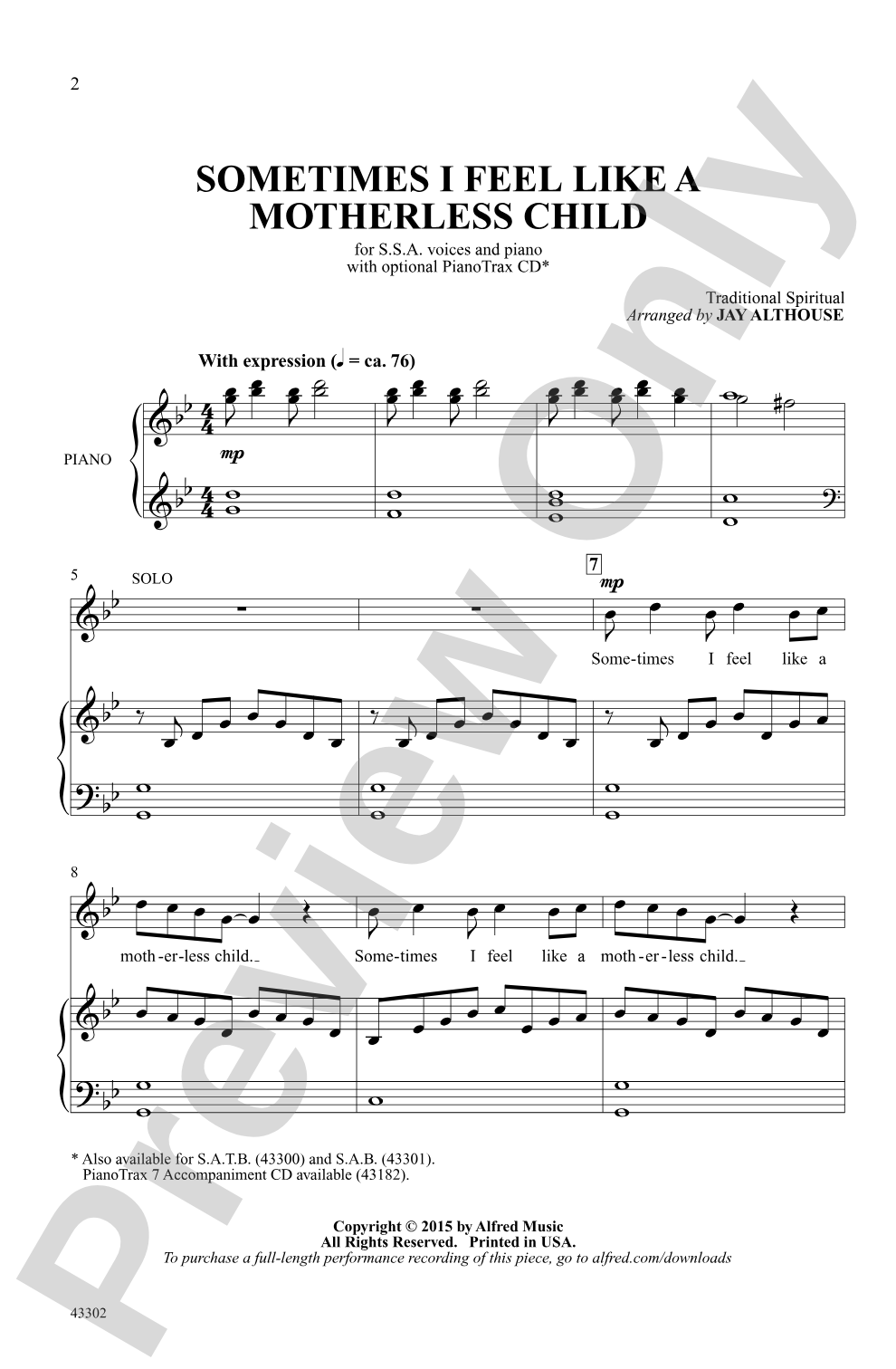

Sometimes I Feel Like a Motherless Child: SSA Choral Octavo
Traditional Spiritual / arr. Jay Althouse
Item: 00-PO-0003268
$1.90
Minimum order quantity: 20 copies
Pickup currently not available
Related Items
Sometimes I Feel Like a Motherless Child: PianoTrax Digital Download |
$9.99
|
View | |
Sometimes I Feel Like a Motherless Child: SATB Choral Octavo |
$1.90
|
View | |
Sometimes I Feel Like a Motherless Child: SAB Choral Octavo |
$1.90
|
View | |
Sometimes I Feel Like a Motherless Child: SATB Choral Octavo |
$1.90
|
View | |
Sometimes I Feel Like a Motherless Child: SAB Choral Octavo |
$1.90
|
View | |
Sometimes I Feel Like a Motherless Child: SSA Choral Octavo |
$1.90
|
View |
Description
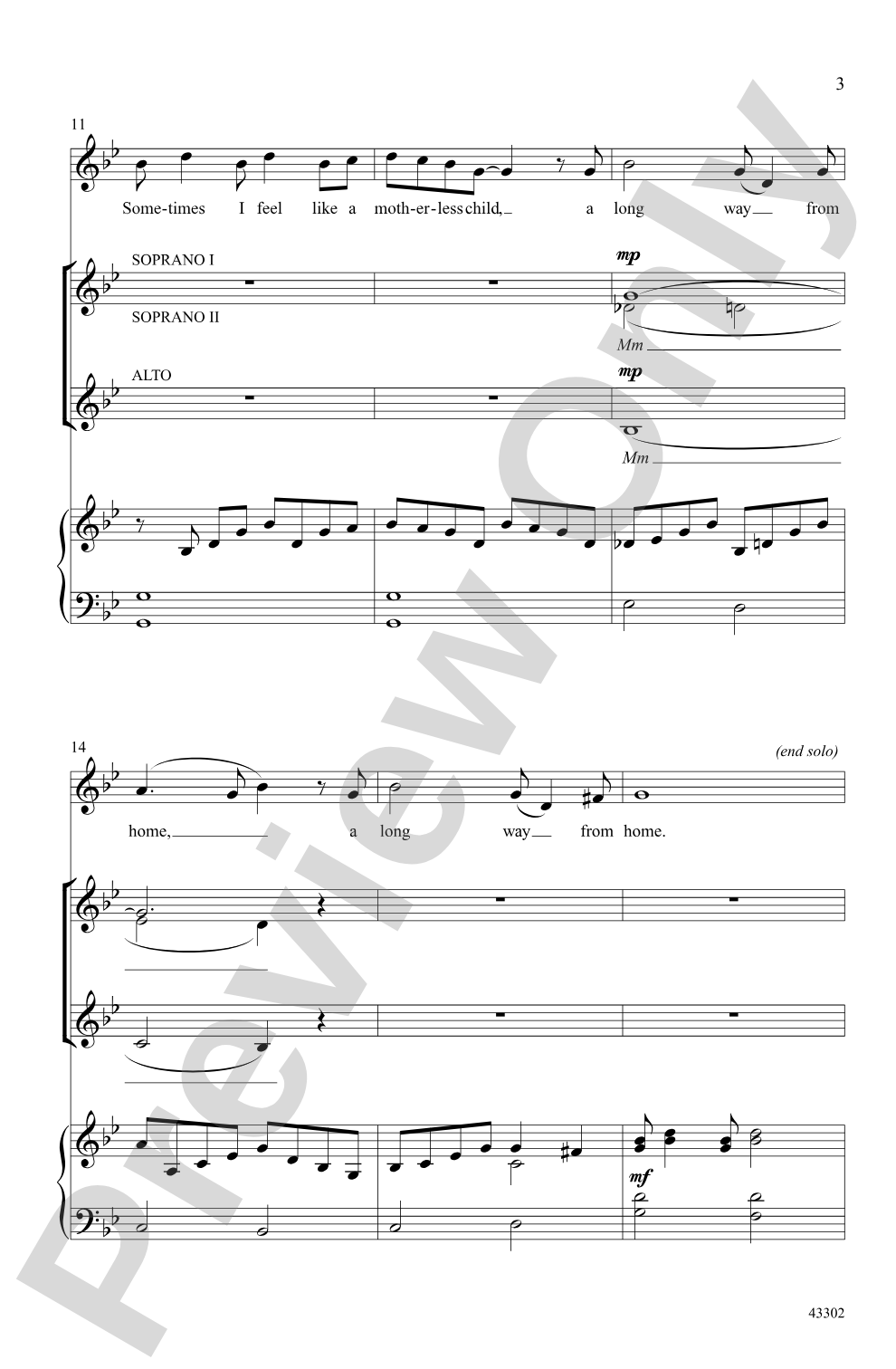
Adapted from Jay's popular American Folk Songs for Solo Singers, this remarkable new choral arrangement works beautifully. The languid minor-key melody is passed from soloist to choir and part to part, often accompanied by mournful background vocals. Not difficult to perform, but appropriately weighty.


Sometimes I Feel Like a Motherless Child: SSA Choral Octavo isn't in MakeMusic Cloud just yet...but it could be. Let us know you'd like to see it, and you'll help shape what comes next. In the meantime, start a free trial and dive into thousands of interactive titles your students can play along with today.
Request This Title
Tell us you want it.
Start Your Free Trial
Explore everything that's ready to play right now.
Sample Audio
1
Audio File
--:--
0:00
0:00
Sample Video
No sample videos found.
Additional Details
Series:
Alfred Choral Designs
Publisher:
Alfred Music
Page Count:
8
SKU:
00-PO-0003268
More about this title
About the Arranger: Jay Althouse

Jay Althouse studied Music Education and Music at Indiana University of Pennsylvania, earning both his B.S. and M.Ed. from the same institution, where he later received the Distinguished Alumni award. His career spans eight years in rights and licensing administration at a major educational music publisher, a term on the Executive Board of the Music Publishers Association of America, and decades as a prolific composer with more than 800 choral works in print across all levels. His output includes collaborations with his wife Sally K. Albrecht on children's musicals, widely performed vocal collections, reference books like The Complete Choral Warm-up Book and Accent on Composers, and classroom resources. He and Albrecht co-wrote I Hear America Singing, performed by the San Francisco Girls and Boys Choirs at President Obama's inauguration in 2009.
Althouse holds membership in ASCAP and has been a regular recipient of the ASCAP Special Award. His choral music circulates throughout the English-speaking world and continues to be performed in schools, churches, and concert halls. Currently based in Wake Forest, North Carolina, he has contributed to the folk arts community through his work with the Folk Art Society of America's National Advisory Board and regular contributions to their quarterly publication.
Why we love this
Althouse's touch with spiritual material is unmistakable here. He resists sentimentality while honoring the weight of the text, letting the minor-key melody breathe and shift among the voices in a way that feels organic rather than contrived. Choirs at this level will find the arrangement singable without sacrificing emotional depth.
What to expect
The languid, mournful quality sits in a vulnerable minor-key space. As the melody passes between soloist and choir, between voice parts, listeners experience a kind of call and response that deepens reflection on longing and loss. The arrangement never rushes; it inhabits the sadness with dignity.
Who it's for
This arrangement serves choirs with developing musicianship and text comprehension. The SSA/SSAA voicing makes it accessible to middle school and high school choirs, church choirs, and community ensembles seeking repertoire that combines accessibility with genuine artistic substance.
How to get the most out of it
- Balance the solo passages against the choral responses with care. The solo voice needs clarity and space to establish the melody before the choir enters, but the mournful background vocals should support rather than overshadow.
- Shape the melodic line with long, connected phrases. This arrangement asks for restraint and a lyrical approach; avoid clipping the ends of notes or rushing the natural rubato the minor key invites.
- Use the part-to-part passing of the melody as an opportunity to build textural awareness. Mark where the melody moves from soprano to second soprano (or other voice parts) and rehearse those transitions with precision so the melodic line remains seamless.
How to use it
Program this alongside other spirituals or sacred choral literature for a concert segment on American traditions. Its moderate length and modest difficulty make it suitable for mid-year performances when your choir has developed ensemble cohesion but before major spring concerts. It works equally well as a featured concert piece or as part of a thematic program exploring grief, resilience, or folk heritage.
Skills your students will build
- Passing a melodic line between individual singers and the full choir while maintaining linear continuity
- Singing sustained, mournful background vocals that support rather than distract from the principal melody
- Balancing solo and choral textures in close proximity
- Phrasing and breath control across longer melodic lines in minor keys
- Interpreting text that carries historical and emotional significance with maturity and respect