
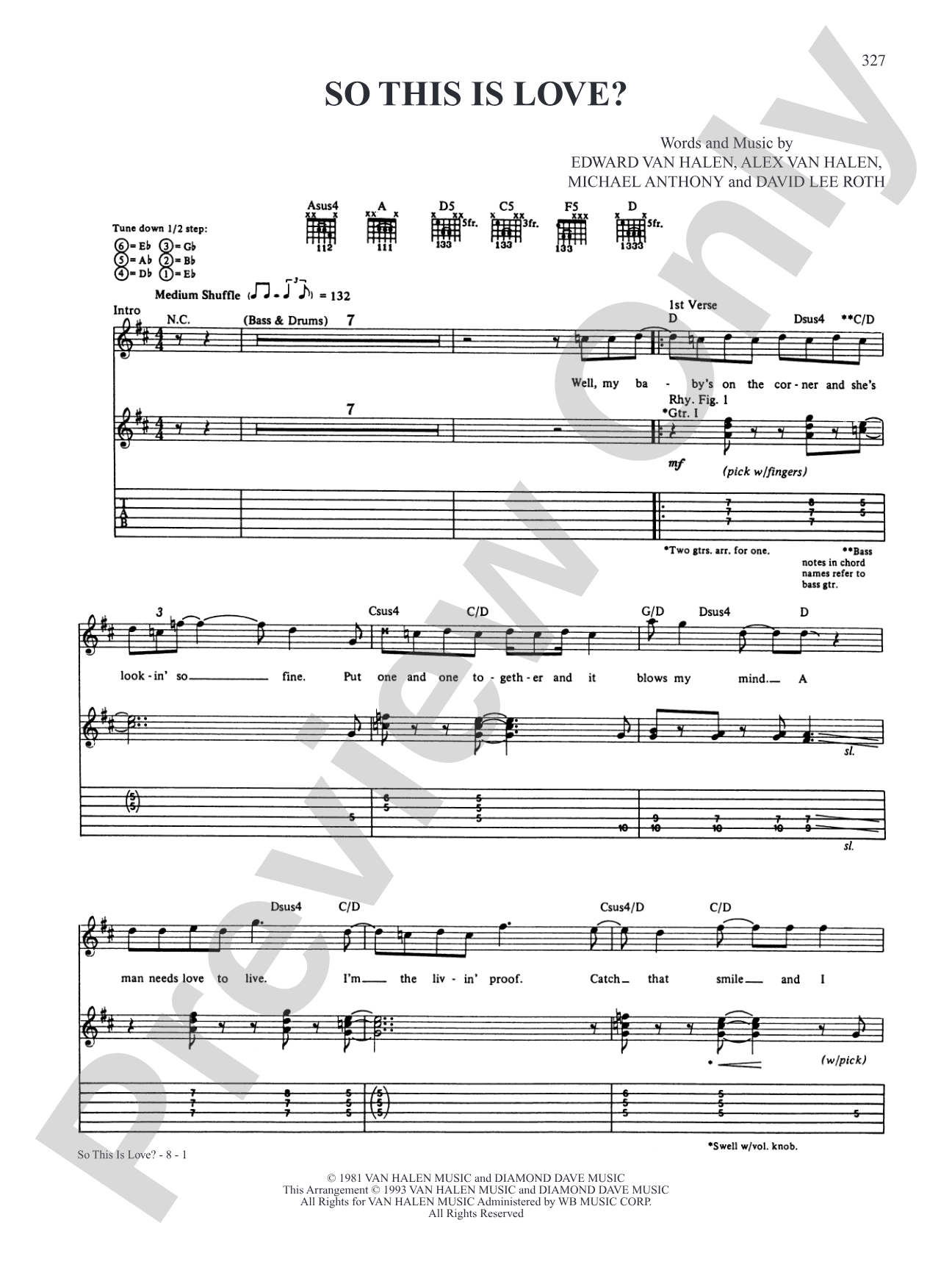
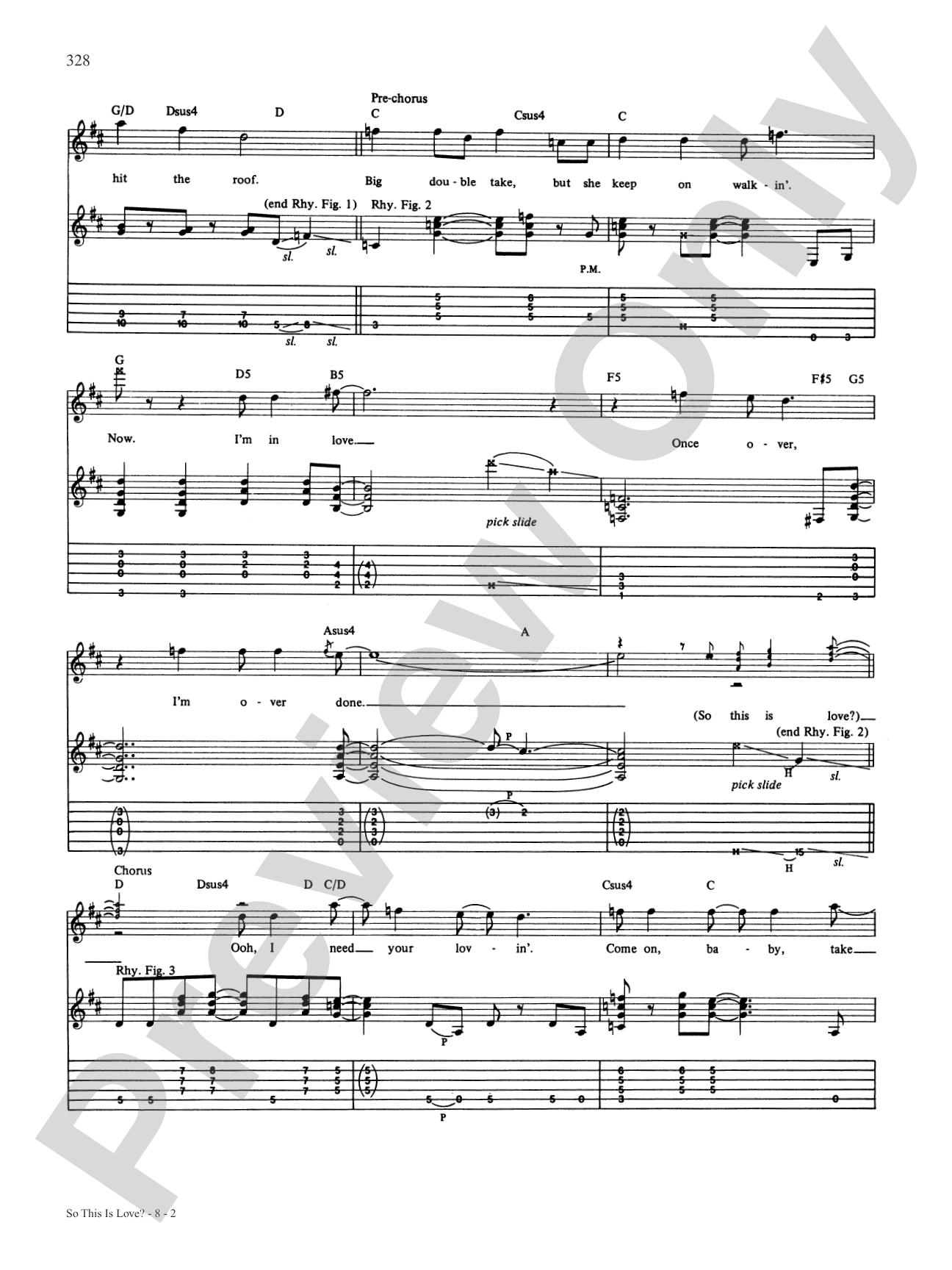

So This Is Love: Authentic Guitar TAB
Compete
Van Halen
Item: 00-PSG-000488
$5.99
One moment…
Related Items
Could This Be Magic: Authentic Guitar TAB |
$9.99
|
View | |
Fools: Authentic Guitar TAB |
$9.99
|
View | |
The Full Bug: Authentic Guitar TAB |
$5.99
|
View | |
Hang Em High: Authentic Guitar TAB |
$9.99
|
View | |
Hear About It Later: Authentic Guitar TAB |
$9.99
|
View | |
In A Simple Rhyme: Authentic Guitar TAB |
$9.99
|
View | |
Intruder: Authentic Guitar TAB |
$4.99
|
View | |
Loss Of Control: Authentic Guitar TAB |
$5.99
|
View | |
One Foot Out The Door: Authentic Guitar TAB |
$5.99
|
View | |
Push Comes To Shove: Authentic Guitar TAB |
$9.99
|
View | |
Romeo Delight: Authentic Guitar TAB |
$9.99
|
View | |
Secrets: Authentic Guitar TAB |
$9.99
|
View | |
Sinner's Swing: Authentic Guitar TAB |
$9.99
|
View | |
Sunday Afternoon In The Park: Authentic Guitar TAB |
$4.99
|
View | |
Take Your Whiskey Home: Authentic Guitar TAB |
$5.99
|
View | |
Where Have All The Good Times Gone: Authentic Guitar TAB |
$5.99
|
View | |
Without You: Authentic Guitar TAB |
$9.99
|
View | |
One I Want: Authentic Guitar TAB |
$9.99
|
View | |
From Afar: Authentic Guitar TAB |
$9.99
|
View | |
Dirty Water Dog: Authentic Guitar TAB |
$9.99
|
View | |
Once: Authentic Guitar TAB |
$9.99
|
View | |
Josephina: Authentic Guitar TAB |
$9.99
|
View | |
Year To The Day: Authentic Guitar TAB |
$9.99
|
View | |
Ballot Or The Bullet: Authentic Guitar TAB |
$9.99
|
View | |
Big Bad Bill (Is Sweet William Now): Authentic Guitar TAB |
$5.99
|
View | |
Inside: Authentic Guitar TAB |
$5.99
|
View | |
Good Enough: Authentic Guitar TAB |
$9.99
|
View | |
5150: Authentic Guitar TAB |
$9.99
|
View | |
Get Up: Authentic Guitar TAB |
$9.99
|
View | |
A.F.U. (Naturally Wired): Authentic Guitar TAB |
$9.99
|
View | |
Source Of Infection: Authentic Guitar TAB |
$9.99
|
View | |
Sucker In A 3 Piece: Authentic Guitar TAB |
$9.99
|
View | |
Mine All Mine: Authentic Guitar TAB |
$9.99
|
View | |
Cabo Wabo: Authentic Guitar TAB |
$9.99
|
View | |
Judgement Day: Authentic Guitar TAB |
$9.99
|
View | |
Spanked: Authentic Guitar TAB |
$9.99
|
View | |
Pleasure Dome: Authentic Guitar TAB |
$9.99
|
View | |
In 'n' Out: Authentic Guitar TAB |
$9.99
|
View | |
Man On A Mission: Authentic Guitar TAB |
$9.99
|
View | |
The Dream Is Over: Authentic Guitar TAB |
$5.99
|
View | |
The Seventh Seal: Authentic Guitar TAB |
$9.99
|
View | |
Don't Tell Me (What Love Can Do): Authentic Guitar TAB |
$9.99
|
View | |
Amsterdam: Authentic Guitar TAB |
$9.99
|
View | |
Big Fat Money: Authentic Guitar TAB |
$9.99
|
View | |
Aftershock: Authentic Guitar TAB |
$9.99
|
View | |
Take Me Back (Deja Vu): Authentic Guitar TAB |
$5.99
|
View |
Description
This amazing 1200-page collection features the complete guitar TAB for every single Van Halen album, including smash hit records like Van Halen, 1984, and 5150! Songs include "Runnin' with the Devil," "Ain't Talkin' 'Bout Love," "Mean Streets," "Jump," "Panama," "Hot For Teacher," "Why Can't This Be Love," "Dreams," "Best of Both Worlds," "Right Now," and many, many more! This is a must-have for every true Van Halen fan.


So This Is Love: Authentic Guitar TAB isn't in MakeMusic Cloud just yet...but it could be. Let us know you'd like to see it, and you'll help shape what comes next. In the meantime, start a free trial and dive into thousands of interactive titles your students can play along with today.
Request This Title
Tell us you want it.
Start Your Free Trial
Explore everything that's ready to play right now.
Sample Audio
No sample audio found.
Sample Video
No sample videos found.
Additional Details
Series:
The Ultimate Song Pages
Publisher:
Alfred Music
SKU:
00-PSG-000488
More about this title
About the Artist: Van Halen
Van Halen revolutionized rock guitar in the late 1970s through a combination of technical innovation, raw energy, and compositional craft. Fronted by vocalist David Lee Roth and anchored by Eddie Van Halen's groundbreaking electric guitar work, the band achieved massive commercial success across four decades while influencing generations of musicians across multiple genres.
Eddie Van Halen's approach to the instrument introduced techniques (tapping, harmonics, and whammy bar manipulation) that became fundamental to rock vocabulary. The band's catalog spans hard rock, pop-metal, funk-influenced grooves, and power ballads, making them essential study for anyone serious about contemporary electric guitar.
Why we love this
This collection captures the full scope of one of rock's most influential guitarists at work across multiple stylistic territories. Students get to see how Eddie Van Halen adapted his technical vocabulary to serve different song contexts, from the synth-driven precision of "Jump" to the raw riffing of "Panama," providing concrete models for how virtuosity serves songwriting rather than existing for its own sake.
What to expect
This music swings between explosive, syncopated riffing and carefully crafted melodies, all delivered with the confidence of a band that dominated arenas. The guitar work balances show-stopping technical passages with surprisingly grounded, bluesy phrasing, creating a sound that's both flashy and soulful.
Who it's for
Intermediate to advanced guitarists working on rock repertoire and electric technique will find extensive material here. Students studying rock history, guitar innovation, and how compositional ideas interact with technical execution benefit from having the complete transcriptions in one resource.
How to get the most out of it
- Approach the tapping passages with clean, deliberate finger placement on the fretboard. The articulation matters as much as the speed; rushing these sections undercuts their musicality.
- Pay attention to Eddie's use of the whammy bar as a rhythmic tool, not just an effect. Study how it shapes phrasing and dynamics across different sections.
- Lock the rhythm section feel before attempting the lead lines. Many of these songs rely on pocket playing that grounds the more elaborate guitar work.
- Use distortion settings that allow harmonic clarity. The original recordings often use specific amp and effects configurations that let each note speak; cheap overdrive will muddy the TAB execution.
How to use it
Guitarists preparing for solo recitals can draw individual songs from this collection to demonstrate range in both technique and style. In ensemble settings, electric guitarists and bands studying rock arranging will find detailed models for how rhythm guitar interacts with leads, keyboards, and rhythm section.
Skills your students will build
- Reading and executing tapped harmonics and two-hand tapping techniques
- Interpreting whammy bar notation and mastering controlled pitch bending
- Analyzing how distortion and amp settings interact with fretboard execution
- Understanding syncopated riffing and pocket feel in a rock context
- Studying how lead guitar lines interact with keyboard and bass arrangements