

Sing with Pleasure (from Saul): SAB Choral Octavo
From Saul
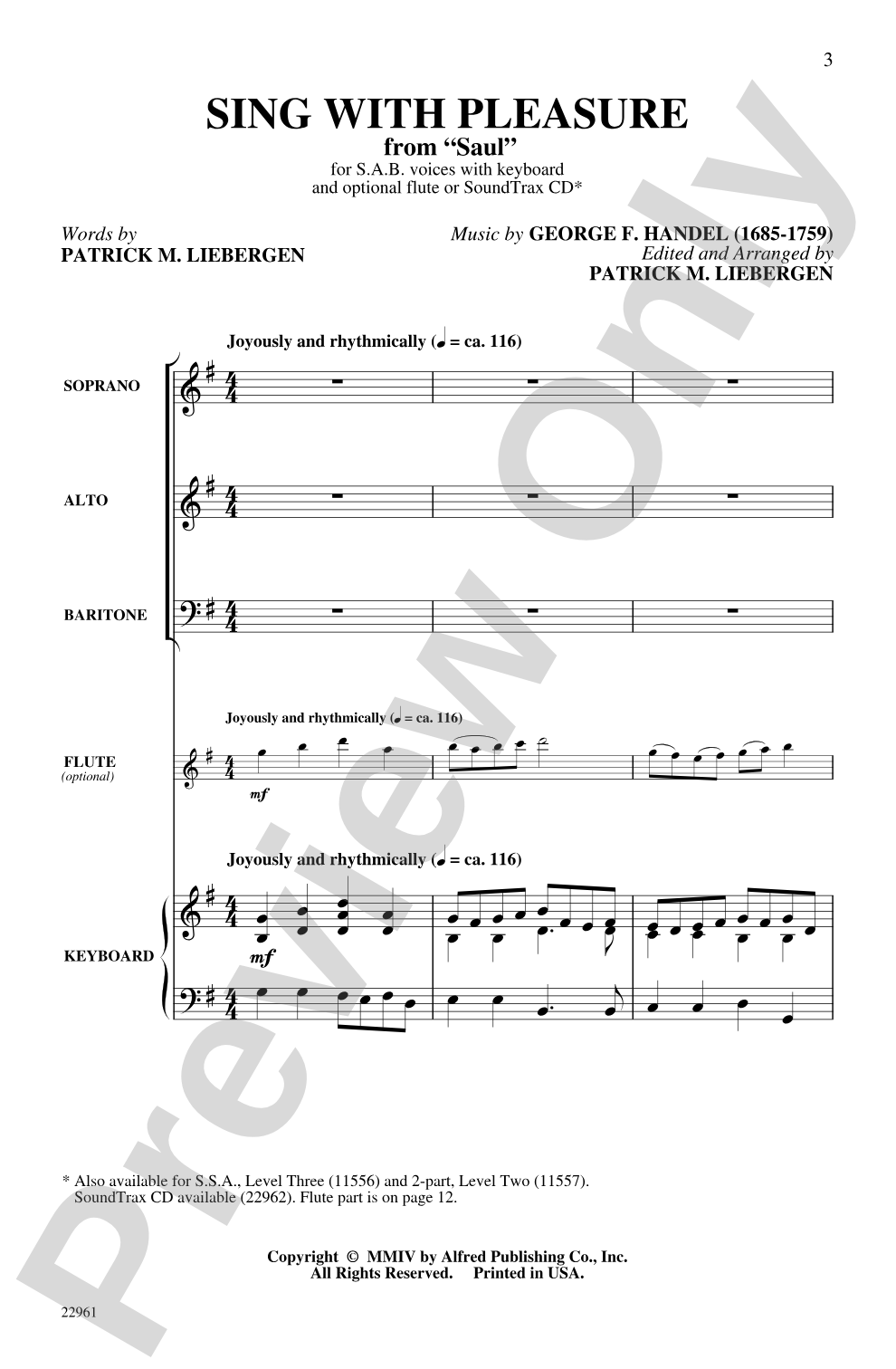
Music by George Frideric Handel / arr. Patrick M. Liebergen
Item: 00-PO-0004317
$2.25
Minimum order quantity: 20 copies
Pickup currently not available
Related Items
Sing with Pleasure (from Saul): SSA Choral Octavo |
$2.25
|
View | |
Sing with Pleasure (from Saul): 2-Part Choral Octavo |
$2.25
|
View | |
Sing with Pleasure: SAB Choral Octavo |
$2.25
|
View | |
Sing with Pleasure: SSA Choral Octavo |
$2.25
|
View | |
Sing with Pleasure: 2-Part Choral Octavo |
$2.25
|
View | |
Sing with Pleasure: Choral Octavo SoundTrax CD |
$27.99
|
View |
Description
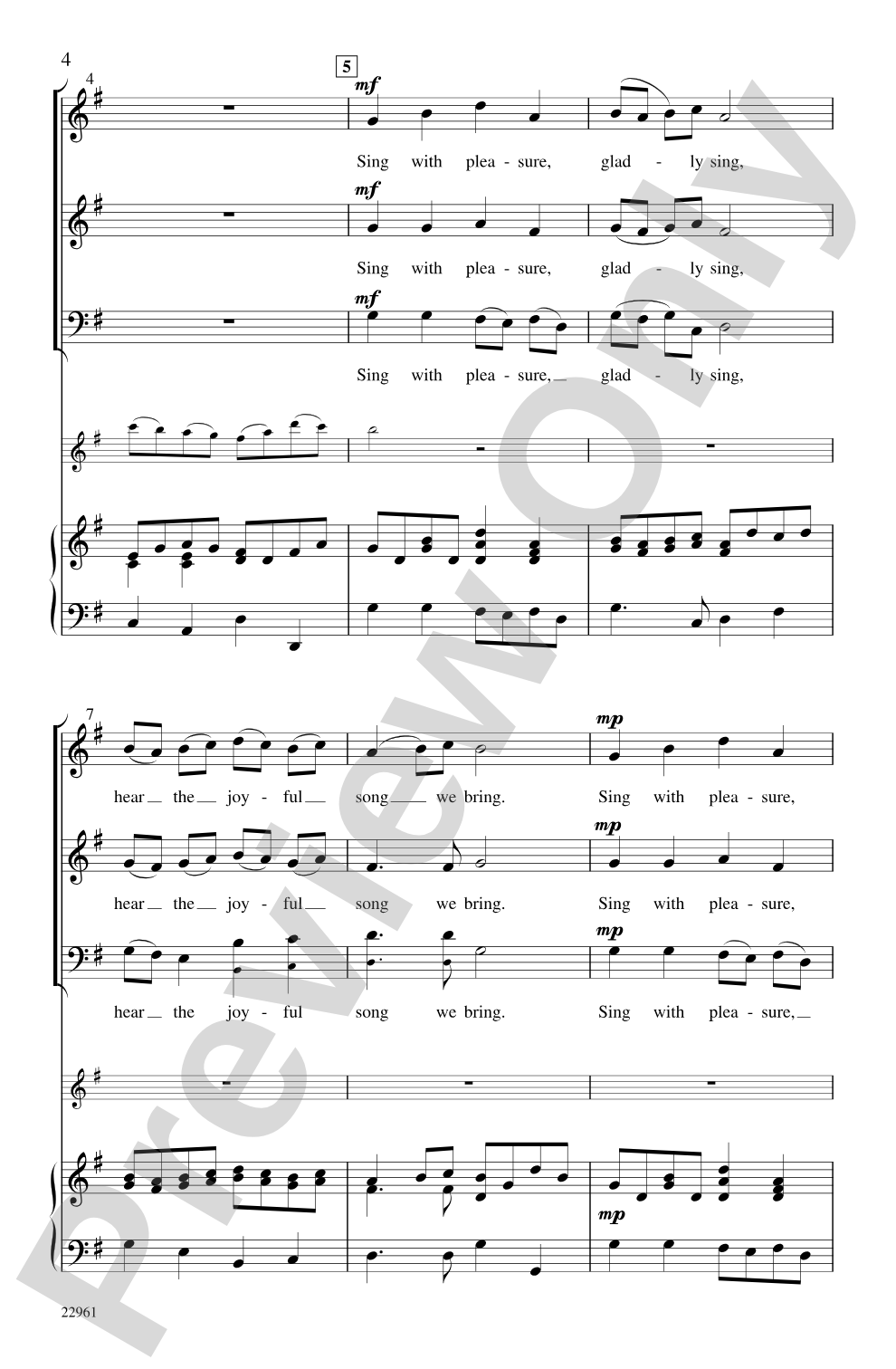
A classic choral work from the oratorio Saul by Handel, skillfully edited and arranged by Patrick Liebergen. New secular text by the arranger makes it ideal for school use. The optional easy flute part is simple, yet effective to add. An excellent introduction to the Baroque style. A top-seller for treble voices, now available for SAB. New SoundTrax, too! This title is available in MakeMusic Cloud.


Sing with Pleasure (from Saul): SAB Choral Octavo isn't in MakeMusic Cloud just yet...but it could be. Let us know you'd like to see it, and you'll help shape what comes next. In the meantime, start a free trial and dive into thousands of interactive titles your students can play along with today.
Request This Title
Tell us you want it.
Start Your Free Trial
Explore everything that's ready to play right now.
Sample Audio
1
Audio File
--:--
0:00
0:00
Sample Video
No sample videos found.
Additional Details
Series:
Alfred Archive Edition: Alfred Choral Designs
Publisher:
Alfred Music
Page Count:
12
SKU:
00-PO-0004317
Instrumentation:
Opt. Flute
More about this title
About the Composer: George Frideric Handel
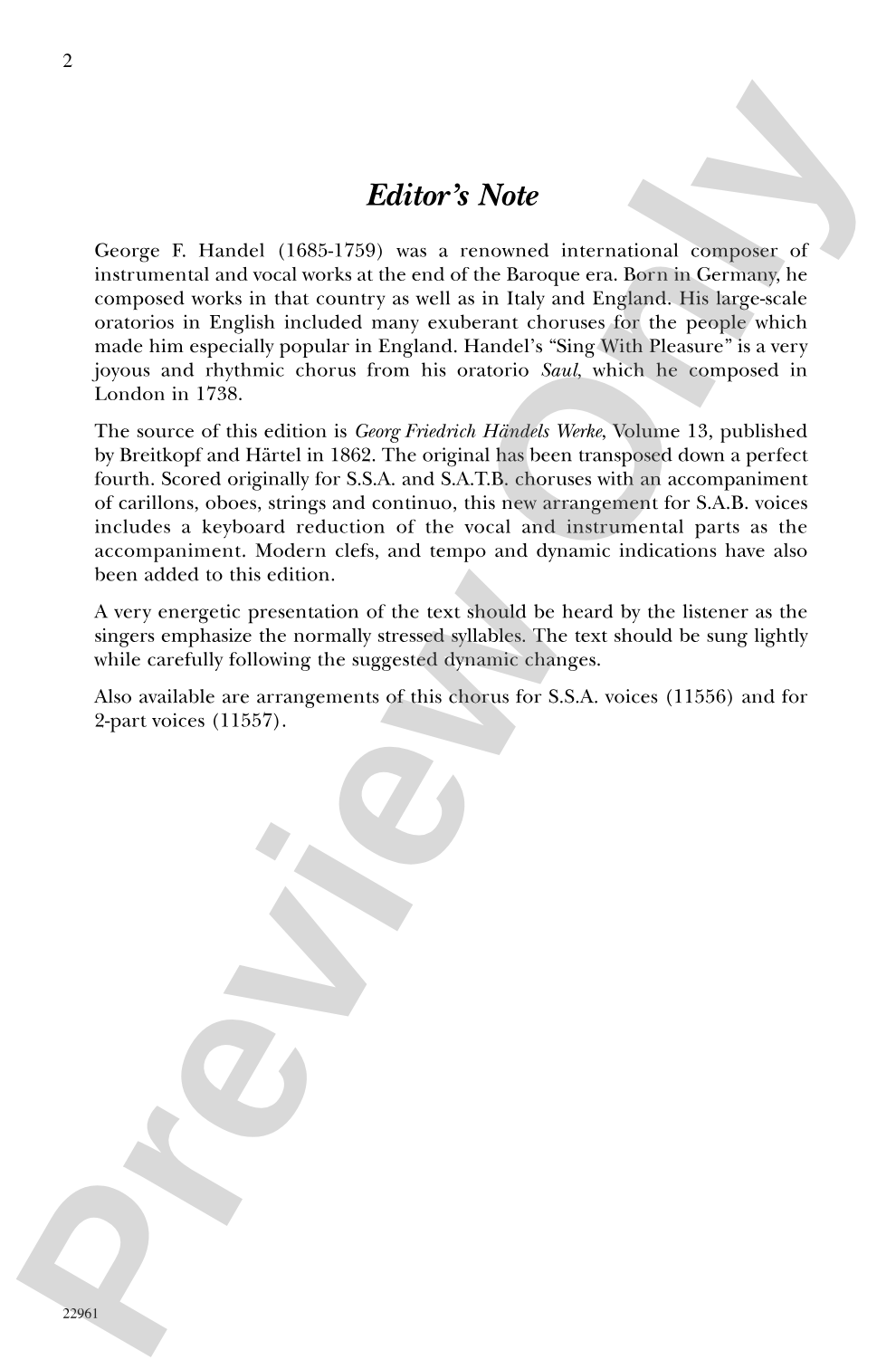
George Frideric Handel (1685-1759) was a German-born composer who spent most of his career in England, where he became the dominant figure in vocal music for nearly five decades. His mastery of melody and harmonic architecture made him one of the most performed composers of the Baroque era, and his works remain central to the choral and orchestral repertoire.
Handel's oratorios, particularly works like Saul, showcase his gift for combining dramatic storytelling with singable, memorable lines. For educators, his music offers students direct access to Baroque vocal writing at its most elegant and expressive, with clear harmonic progressions and character-driven melodies that engage both singers and audiences.
Why we love this
Handel's music is inherently rewarding to teach because his melodies sing naturally and his harmonic language remains instantly accessible to modern ears. Liebergen's arrangement opens this masterwork to mixed voices while the new secular text removes any period-specific barriers, making genuine Baroque repertoire viable for school programs without requiring extensive contextual setup.
What to expect
Pleasure and ease radiate through this piece; the melody is buoyant and graceful, moving with natural confidence through a harmonic landscape that feels both sophisticated and warm. The secular text removes any formality, letting singers experience Baroque beauty as straightforward joy rather than historical duty.
Who it's for
This arrangement serves middle school and high school choirs with three-part mixed voicing, offering strong accessibility for programs new to Baroque repertoire. It works equally well for contest preparation or concert programming where directors want quality classical material with modern educational appeal.
How to get the most out of it
- Shape phrases with the natural arc of the melodic line rather than pushing for maximum volume; Baroque style rewards elegance over force, and the melody will carry without aggressive singing.
- Balance the SAB sections so that altos can anchor the harmonic foundation while sopranos and basses provide clear outer voices; use the recorded accompaniment to establish this blend during early rehearsals.
- If adding the optional flute, position it to double the soprano line without overwhelming it; the flute works best as a gentle reinforcement that adds color during returns of the main melody.
- Keep articulation crisp and clean on sixteenth-note figures to maintain Baroque character; rhythmic clarity matters more than legato smoothness in this style.
How to use it
Program this as a bridge piece between contemporary music and classical literature, or place it early on a concert to establish vocal warmth and ensemble cohesion before tackling heavier repertoire. It also works as a festival or contest selection where accessibility and musical substance must both be present.
Skills your students will build
- Baroque phrasing and shaping melodic lines
- Three-part mixed voicing with clear harmonic function
- Singing sixteenth-note figures with rhythmic precision
- Blending with optional instrumental parts
- Reading and performing classical repertoire at school level