
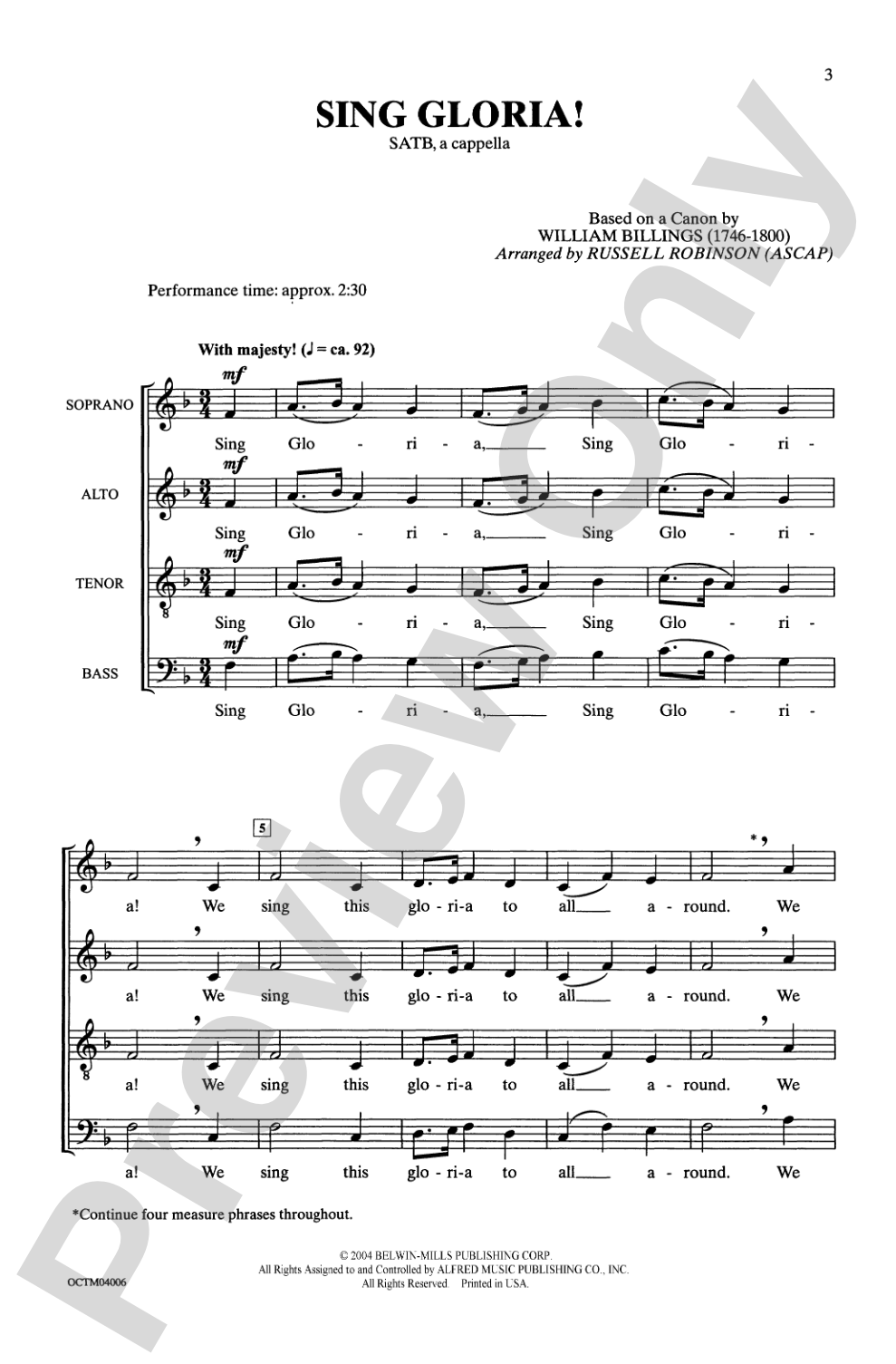

Sing Gloria!: SATB, a cappella Choral Octavo
Based on a canon by William Billings / arr. Russell Robinson
Level: Moderately Easy
Item: 00-PO-0005178
$2.25
Minimum order quantity: 20 copies
Pickup currently not available
Description
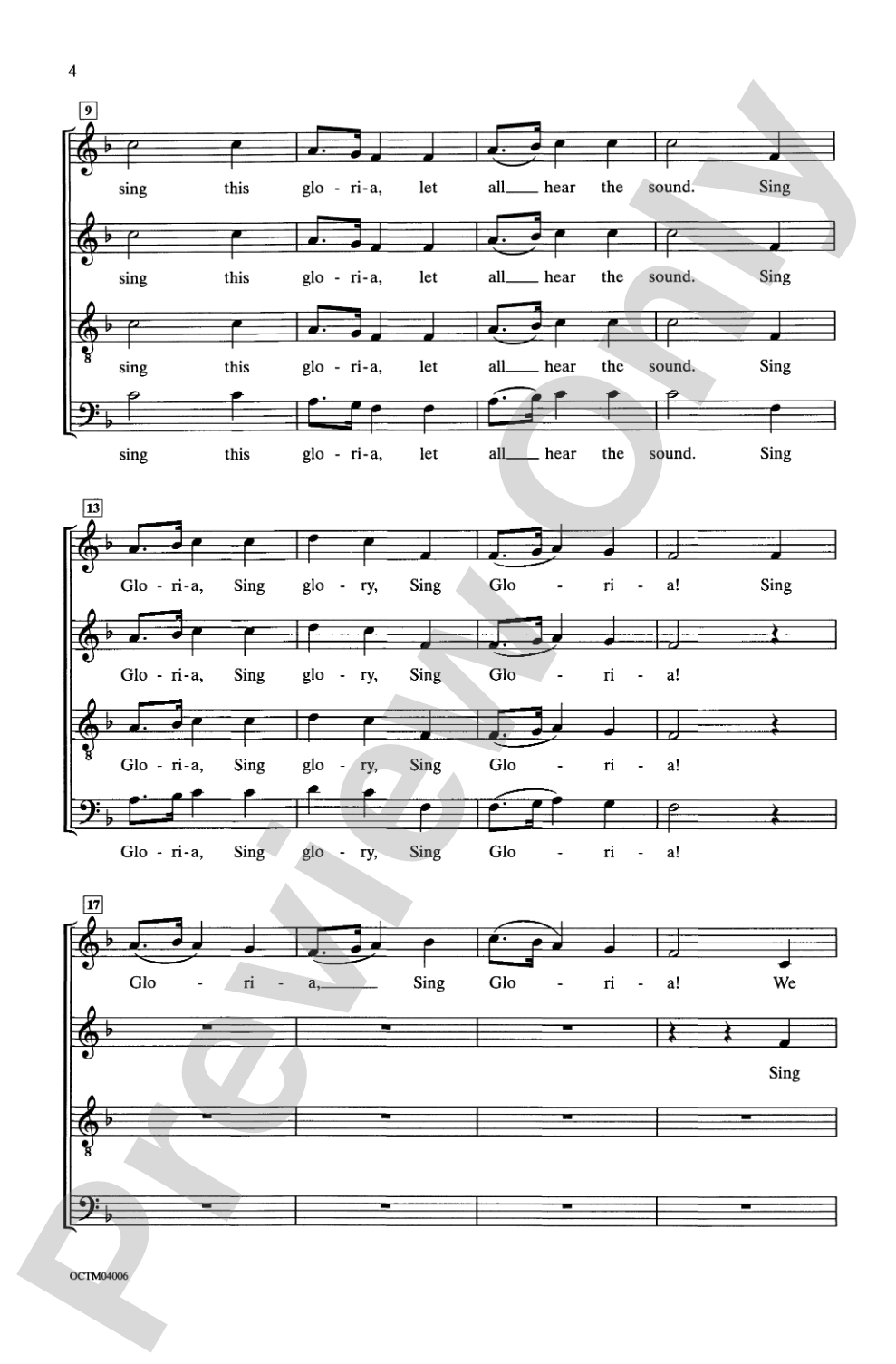
This easy-to-sing concert work is built on Billing's Wake Ev'ry Breath canon. It's an ideal concert opener that will be a welcome addition to every choral library.


Sing Gloria!: SATB, a cappella Choral Octavo isn't in MakeMusic Cloud just yet...but it could be. Let us know you'd like to see it, and you'll help shape what comes next. In the meantime, start a free trial and dive into thousands of interactive titles your students can play along with today.
Request This Title
Tell us you want it.
Start Your Free Trial
Explore everything that's ready to play right now.
Sample Audio
No sample audio found.
Sample Video
No sample videos found.
Additional Details
Series:
Alfred Archive Edition: Belwin Festival Series
Publisher:
Alfred Music
Page Count:
12
SKU:
00-PO-0005178
More about this title
About the Arranger: Russell Robinson

Russell Robinson is an emeritus professor of music education at the University of Florida with an extensive career as a conductor and clinician across six continents. His work has taken him to prestigious venues including Carnegie Hall, Lincoln Center, the Kennedy Center, and the White House, where he has led festivals, workshops, and honor choirs at state, regional, national, and international levels.
Robinson's contributions to music education run deep. He served as Associate Dean of the UF College of the Arts, held the National Collegiate Chair for Choral Music at the National Association for Music Education (NAfME), and was inducted into the Florida Music Educators Association Hall of Fame in 2016. As a published composer and arranger, he has over 500 works in print spanning choral compositions, arrangements, articles, books, and instructional videos.
Why we love this
Robinson has crafted an arrangement that honors Billings' canonical heritage while creating something immediately singable for moderately easy choirs. The piece opens a concert with confidence and warmth, establishing ensemble unity without demanding the technical resources of a larger work. Choirs at this level will find genuine musical satisfaction in the clarity of its construction and the accessibility of its part-writing.
What to expect
The piece carries the reverent, crystalline quality of early American sacred music grounded in Billings' compositional voice. The canon creates a sense of voices in conversation, each line entering to weave with those already singing, building a texture that feels both intimate and structured.
Who it's for
This octavo works beautifully for developing choirs that have mastered basic four-part voicing and are ready to navigate the slight complexity of staggered entries. Directors seeking a concert opener that projects musical maturity without overextending singers will find this piece especially valuable.
How to get the most out of it
- Establish the melodic shape of the canon early in rehearsal by having all voices sing the opening line in unison before introducing the staggered entries. This builds understanding of how the voices interact and prevents rhythmic confusion.
- Balance the voicing so that the canonical structure remains audible. The overlapping lines create counterpoint, so resist the urge to make any single voice prominent. Blend as a priority.
- Find the breath points collaboratively with your singers rather than imposing them. Since the piece is a cappella, natural phrase breathing will affect both musicality and ensemble cohesion.
- Use the reflective quality of the text to shape dynamics with subtlety. Avoid dramatic contrasts; instead allow the text and canonical structure to communicate the meaning without theatrical interpretation.
How to use it
Open a sacred or mixed concert with this piece to establish a focused, contemplative mood that invites the audience in. Its moderate length and complete musical statement make it an excellent standalone work that needs no padding, yet it also pairs naturally with other early American choral works or serves as a bridge into more complex repertoire later in the program.
Skills your students will build
- Singing canon entries in the correct measure while maintaining steady tempo and pitch
- Maintaining independent voice lines within a four-part texture
- Balancing voicing across SATB without abandoning individual part clarity
- Navigating a cappella singing with attention to intonation and blend
- Interpreting early American sacred music style and phrasing