

Silent Night: SSAA Choral Octavo
Arr. Mark Hayes
Item: 00-PO-0004294
$2.25
Minimum order quantity: 20 copies
Pickup currently not available
Related Items
Silent Night: SATB Choral Octavo |
$2.25
|
View | |
Silent Night: Choral SoundPax |
$20.00
|
View | |
Silent Night: SATB Choral Octavo |
$2.25
|
View | |
Silent Night: SAB Choral Octavo |
$1.65
|
View | |
Silent Night: SSAA Choral Octavo |
$2.25
|
View | |
Silent Night: Choral Octavo SoundTrax CD |
$27.99
|
View | |
Silent Night: Choral SoundPax |
$20.00
|
View |
Description
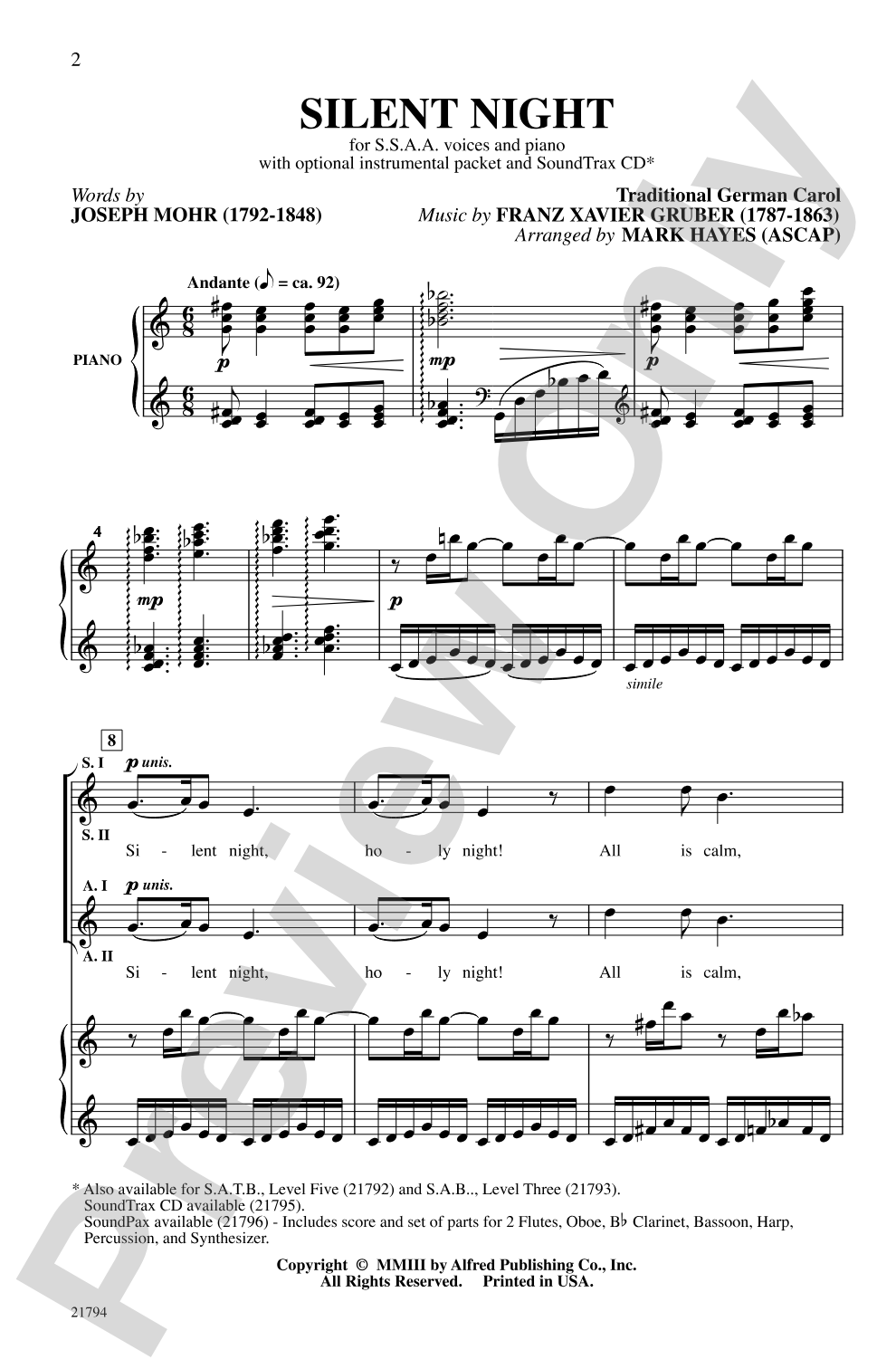
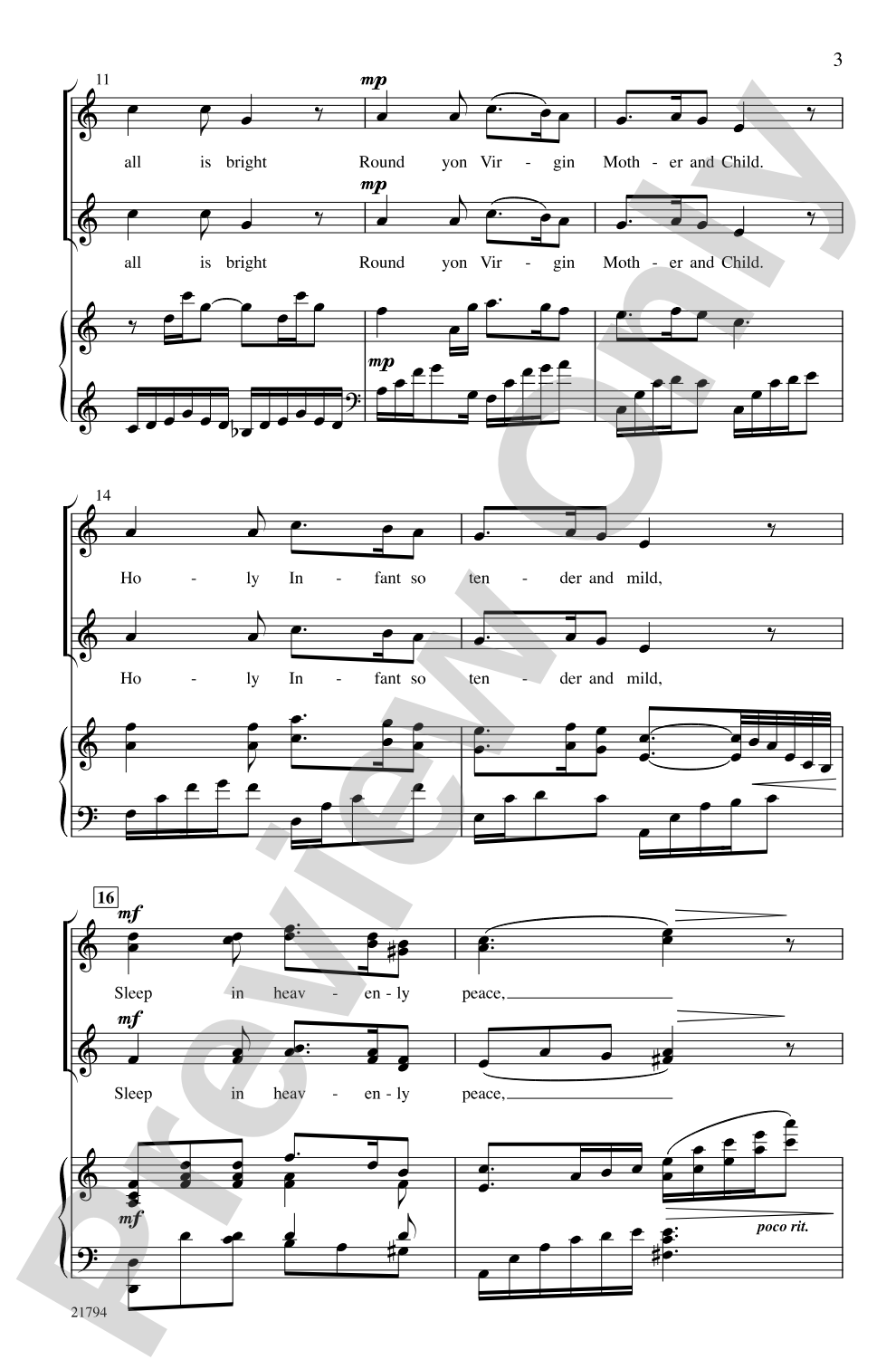
This is the definitive Silent Night arrangement you have been waiting for. An ethereal and contemporary treatment of the cherished carol. The accompaniment shimmers with awe, and the chorus illuminates the senses as they sing the pure unisons and the lush harmonies of accomplished arranger Mark Hayes. Magnificent text painting and tone colors. Each of three verses more striking that the last. The heavenly angels themselves would have chosen this arrangement to sing on that first Christmas night


Silent Night: SSAA Choral Octavo isn't in MakeMusic Cloud just yet...but it could be. Let us know you'd like to see it, and you'll help shape what comes next. In the meantime, start a free trial and dive into thousands of interactive titles your students can play along with today.
Request This Title
Tell us you want it.
Start Your Free Trial
Explore everything that's ready to play right now.
Sample Audio
1
Audio File
--:--
0:00
0:00
Sample Video
No sample videos found.
Additional Details
Series:
Alfred Archive Edition: Alfred Choral Designs
Publisher:
Alfred Music
Page Count:
8
SKU:
00-PO-0004294
More about this title
About the Arranger: Mark Hayes
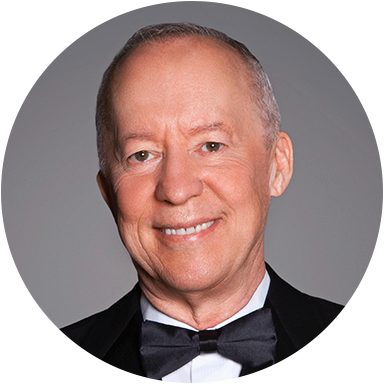
Mark Hayes is a prolific composer, arranger, and conductor whose output spans more than 1,750 published works across sacred and secular genres. He earned his Bachelor of Music degree summa cum laude in Piano Performance from Baylor University in 1975 and has established himself as a versatile musician equally at home at the keyboard, the podium, or the composition desk.
Throughout his career, Hayes has conducted major concert halls including Lincoln Center, the National Cathedral, and Carnegie Hall, premiering significant works like his Requiem in 2013. In 2010, Baylor University recognized his contributions to Christian music with the Award for Exemplary Leadership. His compositional voice ranges across orchestral works, choral literature, theatrical scores, and more than 100 piano books spanning styles from gospel to classical to jazz. Based in Kansas City, Missouri, Hayes continues to define his artistic mission through creating music that serves both the concert stage and the worshiping community.
Why we love this
Hayes treats this beloved carol as a vehicle for genuine musical architecture rather than mere sentimentality. The progression across three verses, each building in intensity and harmonic richness, gives choirs something substantive to shape and reveal. The combination of unison passages that allow pure text expression alongside fuller harmonies creates natural musical and emotional breathing room that singers find deeply satisfying.
What to expect
The opening feels spare and luminous, allowing the text to establish intimacy before the harmonies gradually illuminate the space around the melody. By the final verse, the arrangement blooms into lush four-part writing that feels inevitable rather than sudden, as though the carol itself has unfolded naturally toward transcendence.
Who it's for
This arrangement is ideal for accomplished treble or mixed choirs seeking a fresh interpretation of Silent Night that respects tradition while offering musical sophistication. It works equally well for concert choirs, church choirs, and chamber ensembles performing holiday programs at intermediate-advanced levels.
How to get the most out of it
- Shape the unison sections with particular care for line and phrase, since these moments allow the text to speak with clarity before the harmonies expand
- Balance the shimmer of the accompaniment so it enhances rather than overshadows the choir; think of the piano as atmospheric support, not competition
- Take time in rehearsal to explore the harmonic transitions between verses, helping singers hear how each new section adds color without losing the carol's intrinsic warmth
- Use the recorded accompaniment to lock ensemble and tempo, then gradually release singers to breathe and phrase independently within a secure harmonic framework
How to use it
Place this near the climax of a holiday concert to provide both familiar comfort and musical substance; its elegance works beautifully as the bridge between purely devotional moments and more elaborate choral works. It also serves as an effective closer for a sacred or seasonal concert, offering audiences a piece they know in a form that honors both the original and the artistry involved.
Skills your students will build
- Balancing unison melody with awareness of harmonic support underneath
- Singing pure vowels across shifts in harmonic function and color
- Responding to text painting through dynamic shape and tonal adjustment
- Ensemble cohesion across changing accompaniment textures