
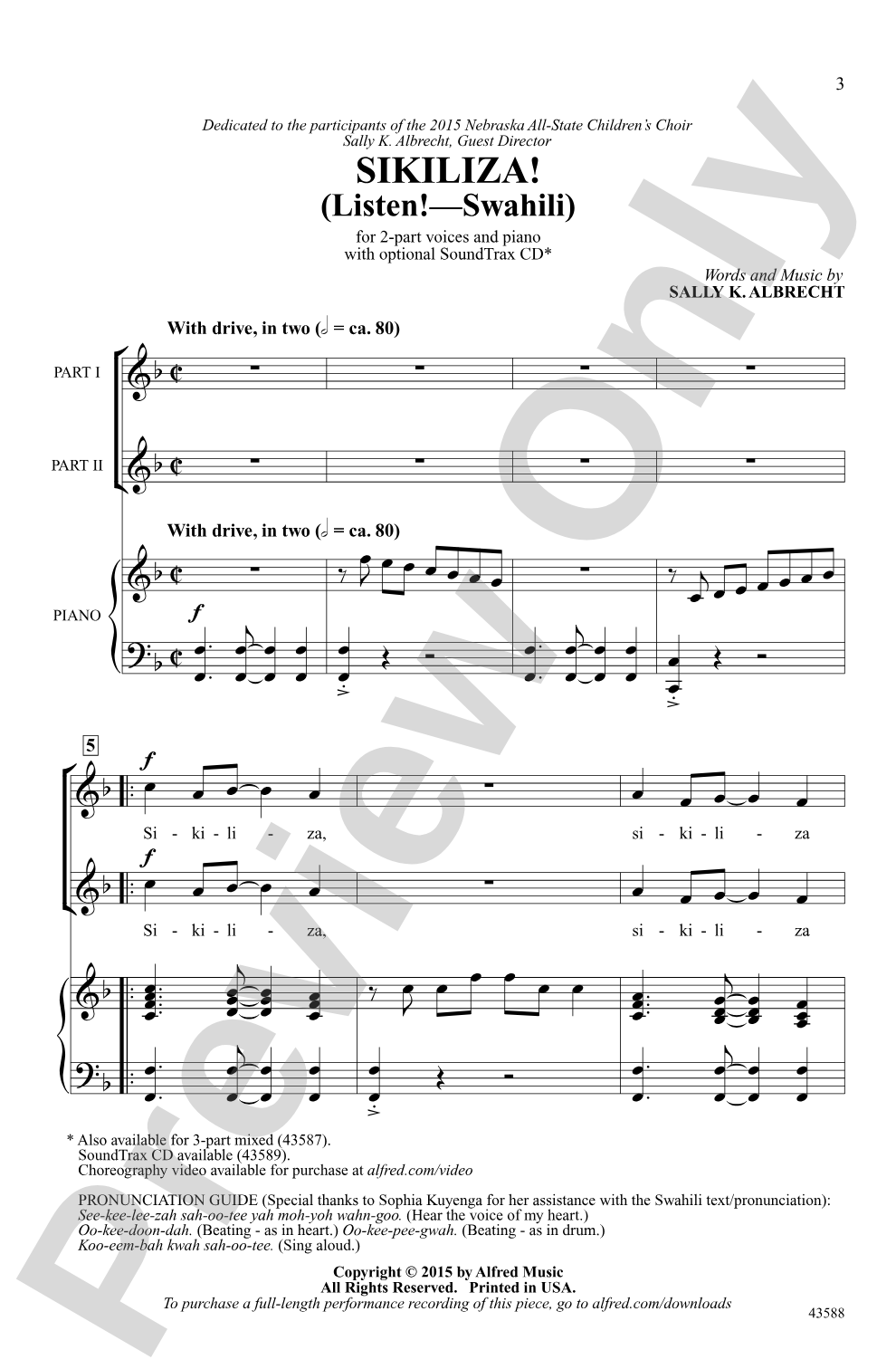

Sikiliza! (Listen! -- Swahili): 2-Part Choral Octavo
(Listen! -- Swahili)
Words and music by Sally K. Albrecht
Item: 00-PO-0003566
$1.90
Minimum order quantity: 20 copies
Pickup currently not available
Description
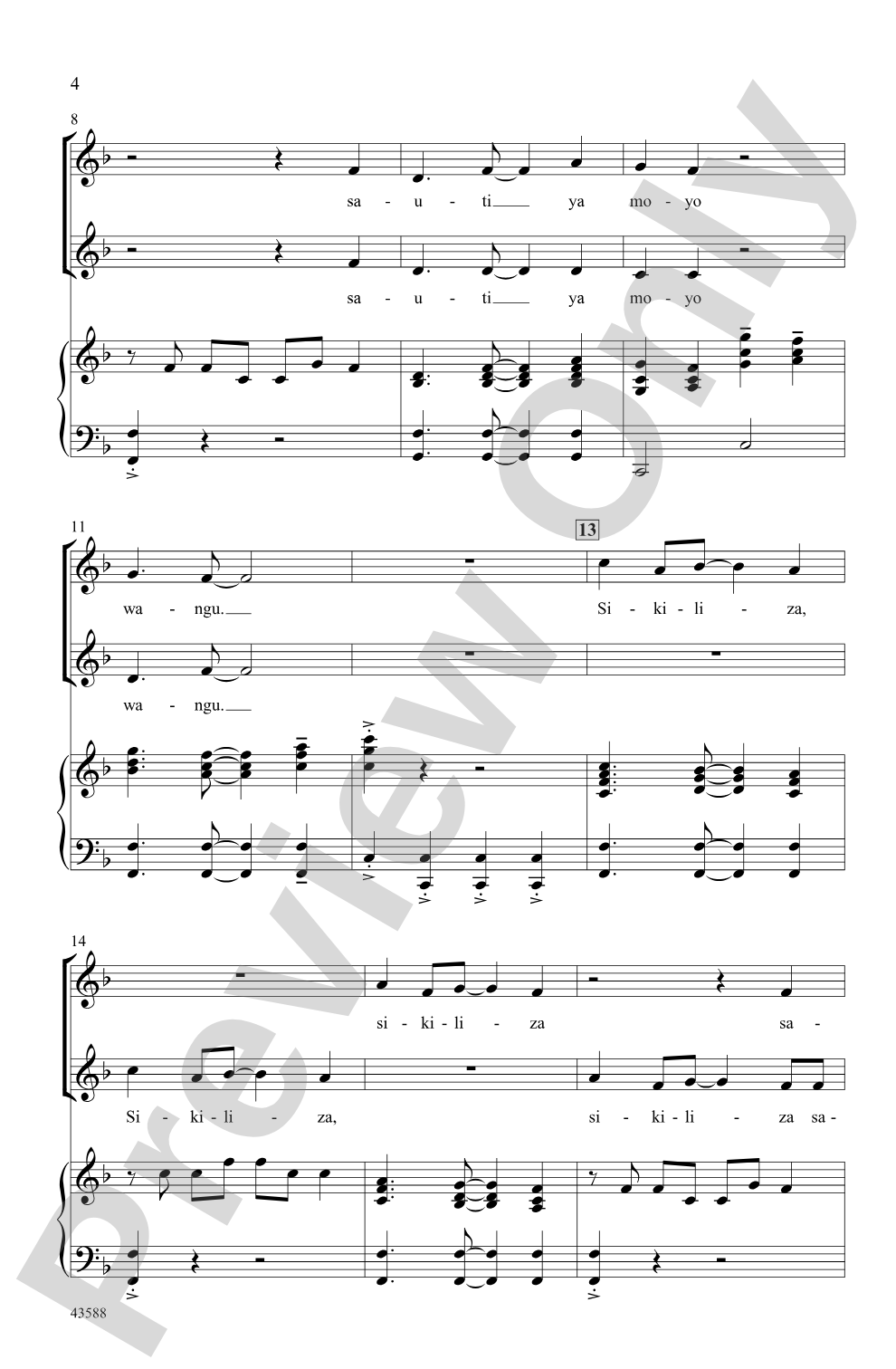
Listen to the infectious African rhythms and stacking triads of this joyous multicultural number, with a text that features several Swahili words and phrases. A unison melody becomes a rhythmic echo section before breaking into spoken chant and body percussion, easily demonstrated on the Step One! movement DVD.


Sikiliza! (Listen! -- Swahili): 2-Part Choral Octavo isn't in MakeMusic Cloud just yet...but it could be. Let us know you'd like to see it, and you'll help shape what comes next. In the meantime, start a free trial and dive into thousands of interactive titles your students can play along with today.
Request This Title
Tell us you want it.
Start Your Free Trial
Explore everything that's ready to play right now.
Sample Audio
1
Audio File
--:--
0:00
0:00
Sample Video
No sample videos found.
Additional Details
Series:
Alfred Choral Designs
Publisher:
Alfred Music
Page Count:
12
SKU:
00-PO-0003566
More about this title
About the Composer: Sally K. Albrecht

Sally K. Albrecht has shaped American choral music through decades of composition, conducting, and educational leadership. Since 1987, she has been a consistent recipient of the ASCAP Special Music Award, with over 600 choral publications and 75 full-length musicals and songbooks in circulation. She has conducted honor choirs at Lincoln Center, Carnegie Hall, and The Kennedy Center, and spent more than thirty years directing school choral and vocal publications at major educational music publishers, including her tenure at Alfred Music.
Albrecht's academic background spans both music and theater. She earned a B.A. from Rollins College in 1976, followed by an M.A. in Drama and an M.M. in Accompanying from the University of Miami. Throughout her career, she has taught at Oakland University, Jersey City State College, and Meredith College. Her contributions to music education leadership extend beyond composition; she chaired the Board of Trustees for the Omicron Delta Kappa National Leadership Honor Society and received their Pillar of Leadership award. In 2021, both the University of Miami Frost School of Music and Rollins College honored her with Distinguished Alumna Awards.
Why we love this
Albrecht writes for ensembles that want to move. This piece combines rhythmic precision with an irresistible groove, layering Swahili language and cultural authenticity into something your singers will genuinely want to perform. The architectural simplicity of two parts means no one gets lost in the texture, while the progression from unison to rhythmic echo to spoken chant creates natural opportunities for kinesthetic engagement without requiring specialized training.
What to expect
Sikiliza! radiates joy through tight rhythmic precision and textural layering. The stacking triads create warmth and harmonic richness even within the simple voicing, while the movement from melody to echo to spoken chant keeps the energy propulsive and engaging.
Who it's for
Middle school and high school choirs looking for accessible repertoire with genuine cultural substance. The two-part voicing opens this piece to treble choirs, developing singers, and mixed ensembles with limited lower voice resources.
How to get the most out of it
- Establish the pulse physically before tackling the rhythmic echo section. Have singers tap the ostinato on their legs or desks while singing to internalize the relationship between the melody and the accompaniment pattern.
- Work the Swahili pronunciation separately so it lands with confidence and authenticity. Slow the phrases down to isolate vowel sounds and stress patterns, then gradually bring the tempo back up.
- Build the body percussion sections deliberately. Introduce clapping, patting, and snapping one layer at a time rather than all at once, letting each group solidify their part before adding the next.
- Use the recorded accompaniment to lock in the rhythmic accuracy of the echo sections. Singing along with the track reveals exactly where precision matters most.
How to use it
Pair this with other world music selections to create a multicultural concert section, or use it as an opener to establish energy and engagement early in your program. The kinesthetic element and infectious rhythm make it ideal for family concerts, spring shows, or any context where you want the audience to feel the joy and movement your singers are experiencing.
Skills your students will build
- Rhythm ostinato reading and layering (melody against rhythmic accompaniment)
- Swahili pronunciation and articulation
- Rhythmic echo technique (listening and responding precisely to sung patterns)
- Coordination of singing with body percussion and physical movement
- Call-and-response phrasing and dialogue between voice parts