
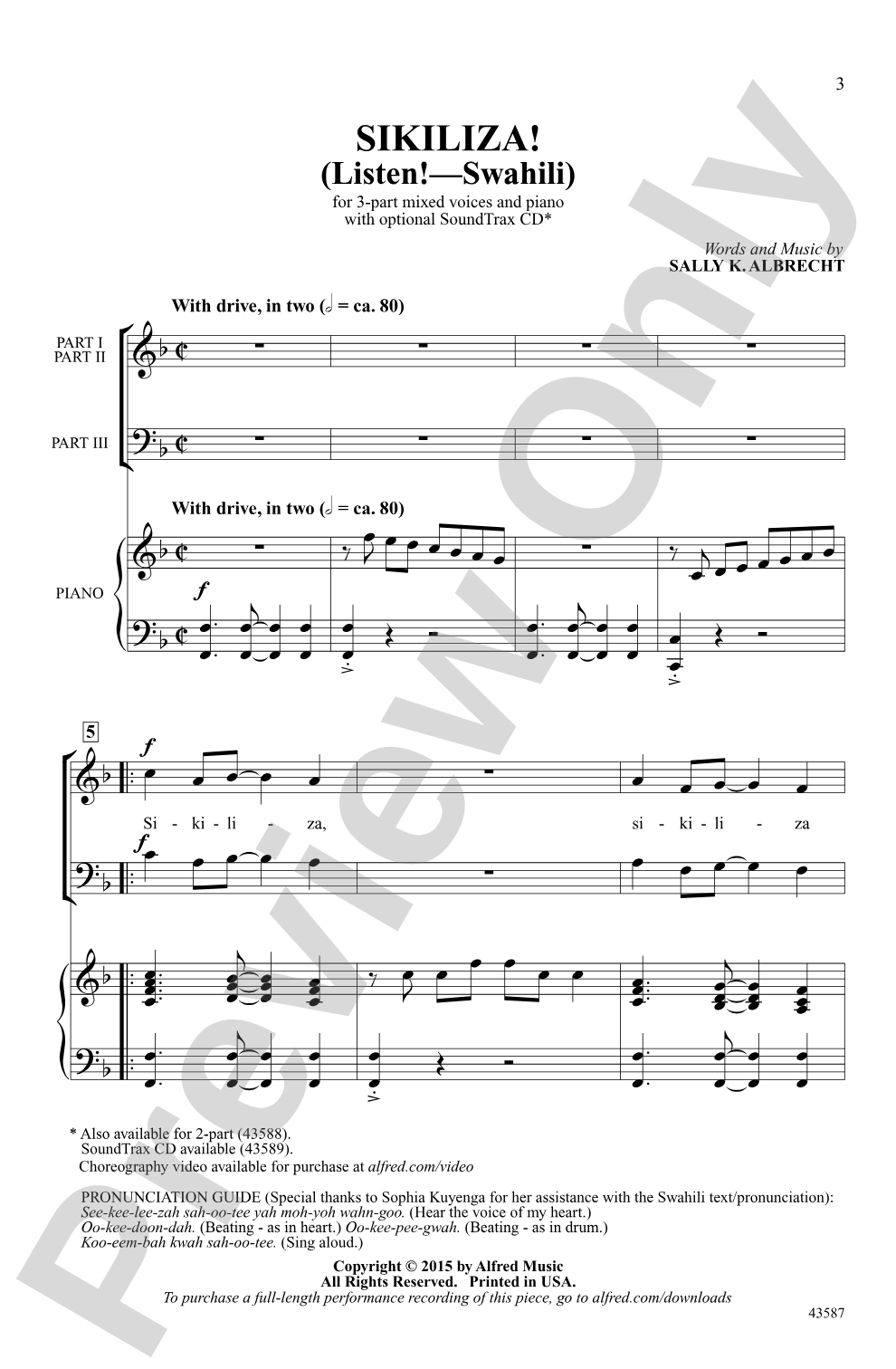
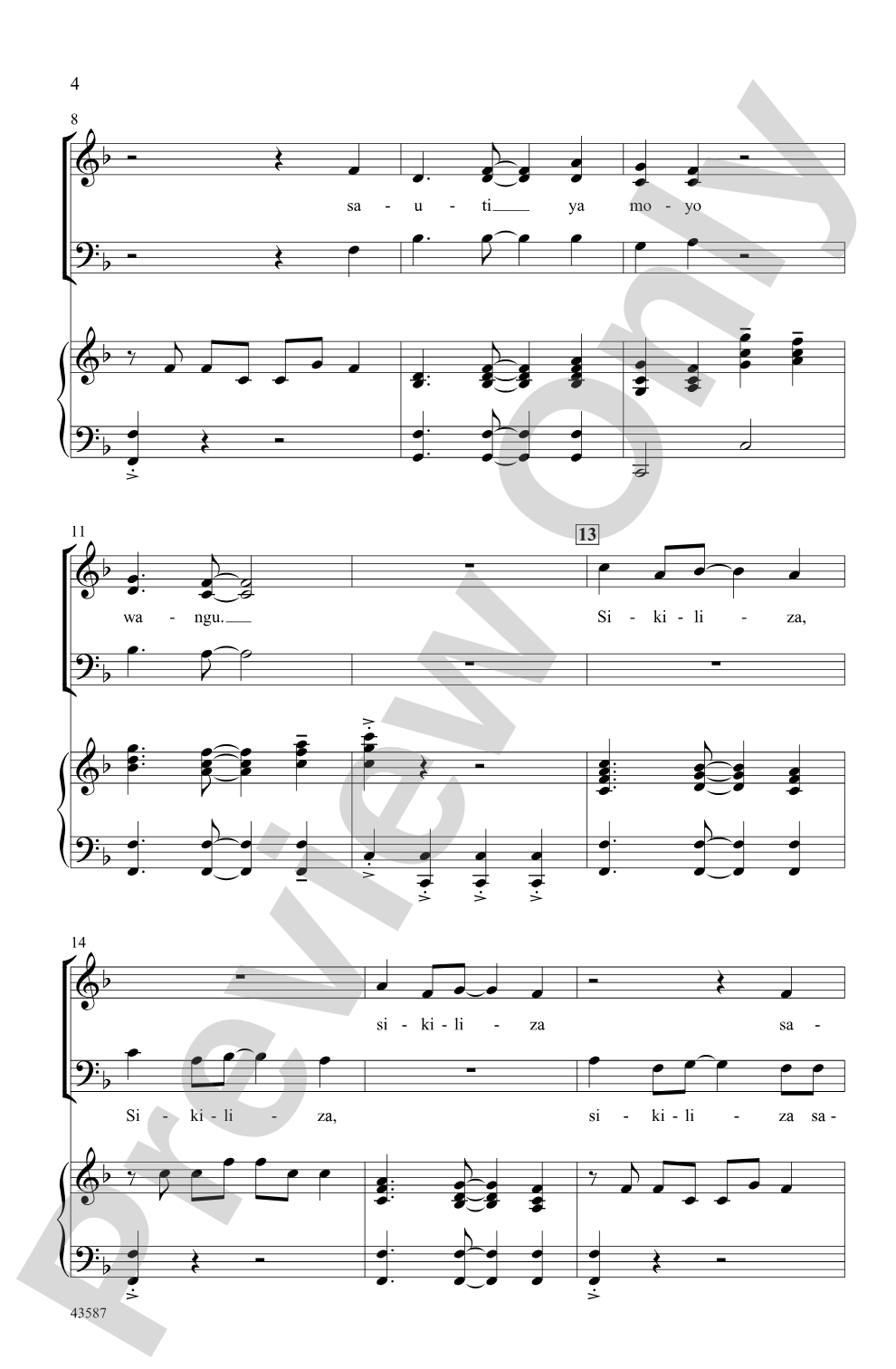

Sikiliza! (Listen! -- Swahili): 3-Part Mixed Choral Octavo
(Listen! -- Swahili)
Words and music by Sally K. Albrecht
Item: 00-PO-0003565
$1.90
Minimum order quantity: 20 copies
Pickup currently not available
Description
Listen to the infectious African rhythms and stacking triads of this joyous multicultural number, with a text that features several Swahili words and phrases. A unison melody becomes a rhythmic echo section before breaking into spoken chant and body percussion, easily demonstrated on the Step One! movement DVD.


Sikiliza! (Listen! -- Swahili): 3-Part Mixed Choral Octavo isn't in MakeMusic Cloud just yet...but it could be. Let us know you'd like to see it, and you'll help shape what comes next. In the meantime, start a free trial and dive into thousands of interactive titles your students can play along with today.
Request This Title
Tell us you want it.
Start Your Free Trial
Explore everything that's ready to play right now.
Sample Audio
1
Audio File
--:--
0:00
0:00
Sample Video
Additional Details
Series:
Alfred Choral Designs
Publisher:
Alfred Music
Page Count:
12
SKU:
00-PO-0003565
More about this title
About the Composer: Sally K. Albrecht
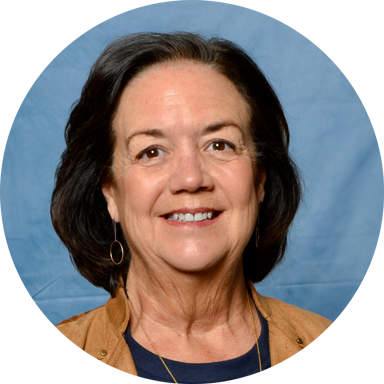
Sally K. Albrecht has shaped American choral music for decades as a composer, conductor, and clinician with a distinctive focus on movement and physicality in singing. Since 1987, she has earned annual ASCAP Special Music Awards and maintains over 600 choral publications in print, along with 75 larger works for stage and concert. She has led honor choirs at major venues including Lincoln Center, Carnegie Hall, and The Kennedy Center, and spent more than thirty years directing choral and vocal publications at major educational publishers, including her role as Director of School Choral, Vocal, and Elementary Publications at Alfred Music.
Albrecht holds degrees from Rollins College (B.A. in Music and Theater, 1976), the University of Miami (M.A. in Drama, 1977, and M.M. in Accompanying, 1979), and has taught at Oakland University, Jersey City State College, and Meredith College. She received the Distinguished Alumna Award from both the University of Miami Frost School of Music and Rollins College in 2021, and serves as a Board member and past Chair of Omicron Delta Kappa National Leadership Honor Society. She lives in Wake Forest, North Carolina, with her husband, composer and arranger Jay Althouse.
Why we love this
Albrecht's integration of body percussion and spoken chant transforms a three-part mixed arrangement into a physical and vocal experience that engages singers beyond traditional note-reading. The text mixing English and Swahili creates an immediate cultural connection and accessibility, while the stacking triads and rhythmic layering offer genuine harmonic interest without demanding advanced sight-reading skills. This is the kind of piece that students remember years later because they moved, chanted, and felt the joy of ensemble music together.
What to expect
Infectious and celebratory, with the kind of rhythmic drive that makes singers sit up straighter and audiences lean forward. The piece balances structured harmonic writing with moments of release and playfulness, creating an arc that feels both polished and genuinely fun to perform.
Who it's for
Directors of middle school, high school, and community choirs who want a piece that energizes singers with movement and cultural engagement without requiring advanced vocal technique. This works equally well for school concerts, multicultural festivals, or any program that values student participation and joy in making music together.
How to get the most out of it
- Learn the body percussion patterns before rehearsing with voices; establish the rhythmic foundation as a spoken ensemble exercise first, then layer in the melody
- Emphasize the unison section as rhythmically locked and energized, treating each repetition as building momentum rather than simply repeating material
- Reference the Step One! movement DVD for exact demonstration of body percussion techniques, ensuring all singers execute the same movements and create visual unity on stage
- Build the spoken chant section with intentional dynamics and articulation so it reads as a percussive instrument itself, not just words being recited
How to use it
Place this early in a concert to establish an energetic tone, or use it as a midpoint refresh in longer programs. It pairs naturally with other world music selections or multicultural repertoire, and its accessible three-part voicing makes it ideal for introducing movement-based rehearsal techniques to less experienced ensembles.
Skills your students will build
- Reading and performing SAB voicing with stacking triads
- Maintaining independent rhythmic patterns while singing
- Coordinating body percussion with vocal lines
- Pronunciation and performance of Swahili text
- Responding to conducted cues for dynamic shifts between melody, ostinato, and spoken sections