
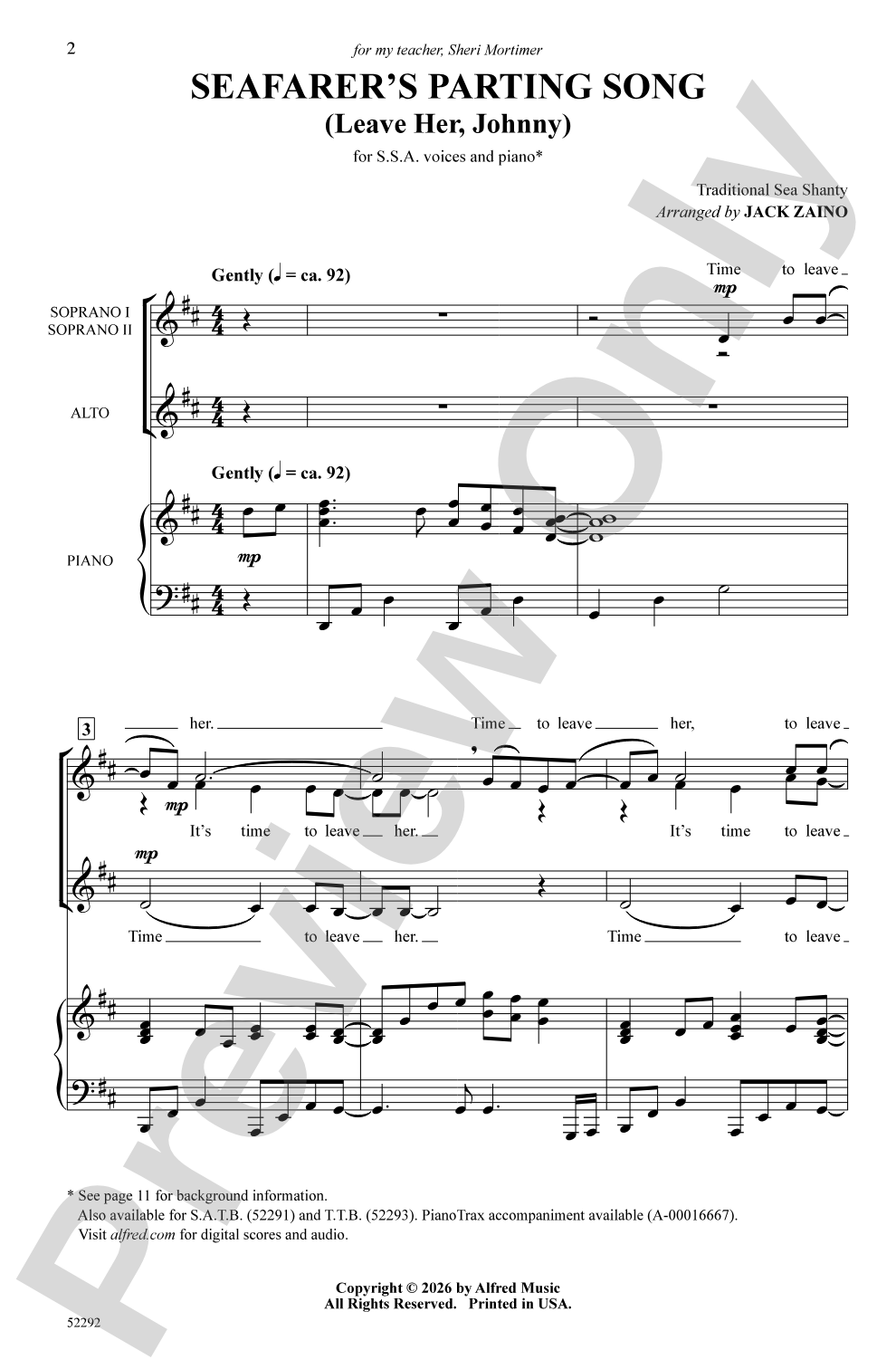
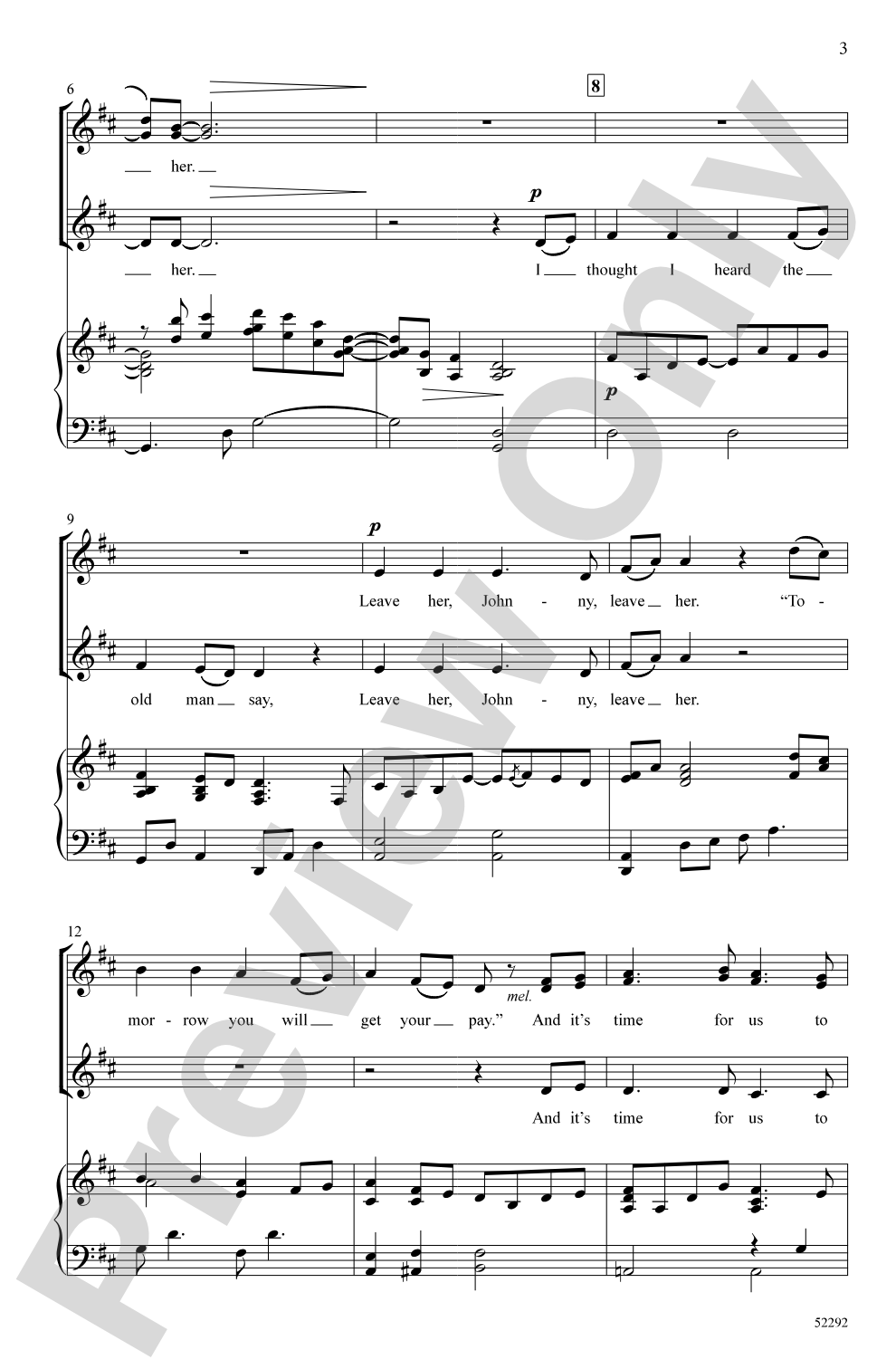

Seafarer's Parting Song: SSA Choral Octavo
Traditional Sea Shanty / arr. Jack Zaino
Item: 00-PO-0007861
$2.50
Minimum order quantity: 20 copies
Pickup currently not available
Description
Bring a touch of maritime history to your concert program with this poignant reimagining of a traditional sea shanty. Far from the boisterous nature of typical work songs, this sensitive setting offers a warm farewell in a lyrical contemporary style. Flowing vocal lines and expressive phrasing highlight the reflective nature of leaving the ship, and a few short solo opportunities bring a sense of personal storytelling. Though the slow tempo and legato nature imply melancholy, this is ultimately a hopeful song: Home is on the horizon.


Seafarer's Parting Song: SSA Choral Octavo isn't in MakeMusic Cloud just yet...but it could be. Let us know you'd like to see it, and you'll help shape what comes next. In the meantime, start a free trial and dive into thousands of interactive titles your students can play along with today.
Request This Title
Tell us you want it.
Start Your Free Trial
Explore everything that's ready to play right now.
Sample Audio
1
Audio File
--:--
0:00
0:00
Sample Video
Additional Details
Series:
Alfred Choral Designs
Publisher:
Alfred Music
Page Count:
12
SKU:
00-PO-0007861
More about this title
About the Arranger: Jack Zaino

Jack Zaino brings deep roots in New England choral music as both an educator and creative voice. He holds degrees in Voice and Music Education from the University of Connecticut, where he was a founding member of the UConn Chamber Singers, and earned his Master's in Curriculum and Instruction from the same institution. His teaching experience spans middle school music in Connecticut public schools, where he developed a keen eye for repertoire that serves young singers.
Now a choral editor and clinician at Alfred Music, Zaino has built a distinctive catalog of contemporary arrangements that honor popular artists while maintaining artistic integrity. His work with songs by Kacey Musgraves, Dan + Shay, and Lizzo demonstrates his commitment to finding substance in modern styles. Recognition from Connecticut ACDA, which named him Young Choral Director of the Year in 2020, reflects his contributions to the choral community. He currently serves as composition chair on the Connecticut ACDA repertoire and resources committee and remains active in local choral organizations.
Why we love this
Zaino transforms a sea shanty into something genuinely moving without sacrificing the narrative strength of the source material. The arrangement respects SSA voicing while creating genuine musical interest through its flowing lines and strategic use of solo moments, making it accessible yet sophisticated enough to hold an audience's attention. Programming a piece this reflective and historically grounded offers a welcome counterpoint to the typical choral concert arc.
What to expect
The piece unfolds like a quiet moment on a dock at twilight: reflective and tender, with the weight of departure softened by the promise of return. Flowing melodic lines and warm harmonic writing create an atmosphere of bittersweet remembrance, where sadness and hope exist together.
Who it's for
This octavo serves choirs with solid musicianship who can handle legato singing and expressive control. The SSA voicing and accessible range make it ideal for treble choirs in high school, college, and community settings, though mature middle school ensembles with strong vocal technique can also succeed with it.
How to get the most out of it
- Shape the phrase endings with breath and intention rather than allowing them to drop off; the hopeful text demands forward motion even as the tempo stays contemplative.
- Identify which singers will carry the brief solo moments during rehearsal and give them ownership of their personal storytelling; these passages deserve individual color and vulnerability.
- Balance the SSA voicing so that the soprano and alto parts reinforce each other melodically without the sopranos dominating the texture; lean into the arrangement's warmth rather than brightness.
- Use the recorded accompaniment (if available) to establish the legato quality and expressive phrasing; follow its rubato to ensure your choir stays unified when the arrangement calls for subtle tempo shifts.
How to use it
Position this as a centerpiece of a concert's second half, where its contemplative nature can provide both contrast and emotional depth alongside lighter opening selections. It works particularly well in programs exploring maritime themes, folk traditions, or historical narratives, and its arrangement makes it suitable for both concert and festival contexts.
Skills your students will build
- Legato phrasing across longer melodic lines in SSA voicing
- Expressive control and dynamic shaping in a slow tempo
- Solo singing and personal storytelling within an ensemble context
- Blending and balance between soprano and alto parts in a harmonic texture
- Interpretation of text that carries emotional weight and narrative specificity