
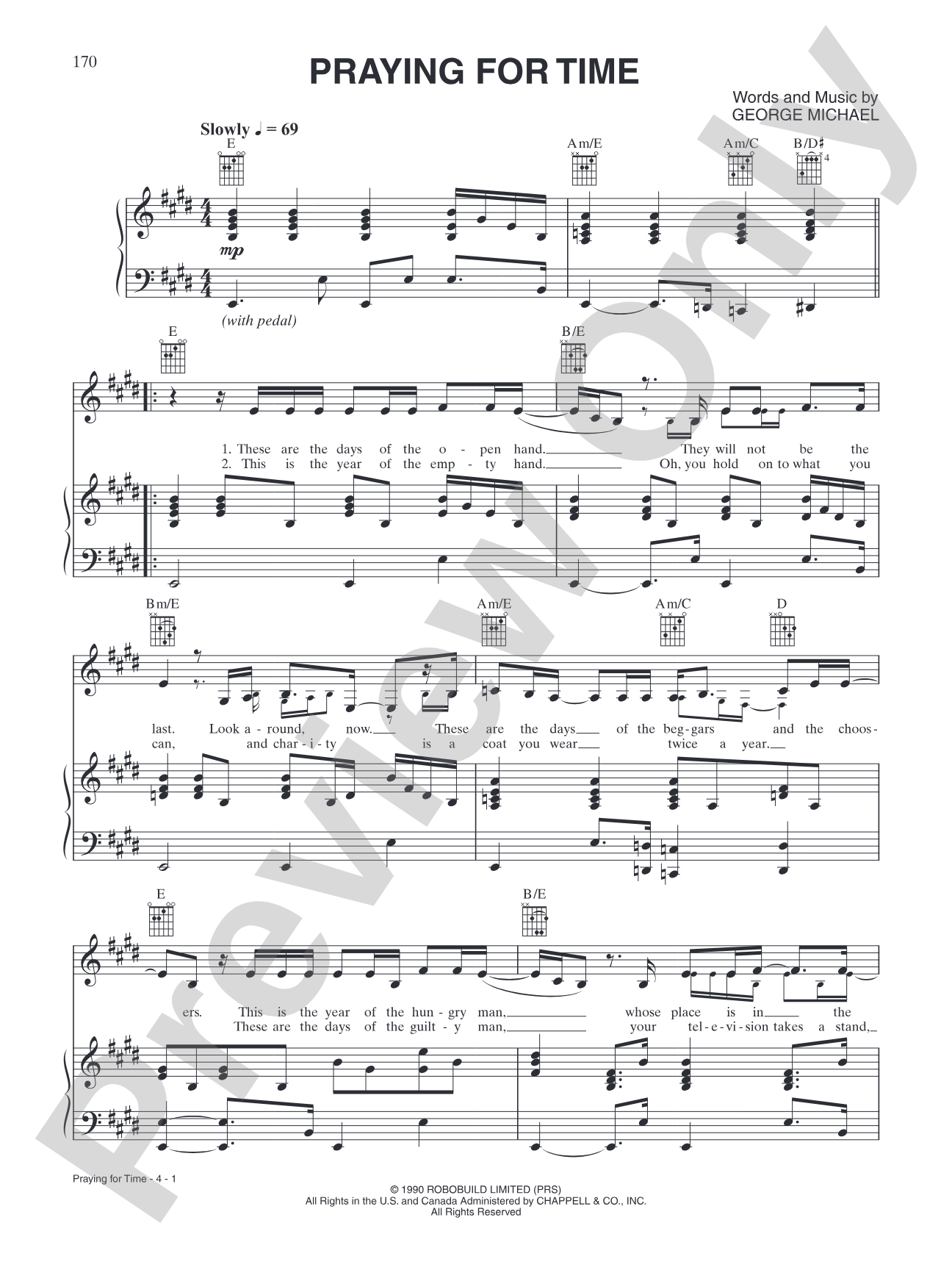

Praying for Time: Piano/Vocal/Chords
Songs That Made the Year!
Item: 00-PS-0010885
$4.99
One moment…
Related Items
Sorry: Piano/Vocal/Chords |
$4.99
|
View | |
Lost: Piano/Vocal/Chords |
$5.99
|
View | |
That's What You Get: Piano/Vocal/Chords |
$5.99
|
View | |
Psycho: Piano/Vocal/Chords |
$5.99
|
View | |
The Story: Piano/Vocal/Chords |
$5.99
|
View | |
4 Minutes: Piano/Vocal/Chords |
$5.99
|
View | |
Leavin': Piano/Vocal/Chords |
$4.99
|
View | |
Paralyzer: Piano/Vocal/Chords |
$5.99
|
View | |
Whatever it Takes: Piano/Vocal/Chords |
$5.99
|
View | |
Porcelain Doll: Piano/Vocal/Chords |
$5.99
|
View |
Description
Titles: 4 Minutes (Madonna and Justin Timberlake) * All Summer Long (Kid Rock) * Almost Lover (A Fine Frenzy) * A-Punk (Vampire Weekend) * Auld Lang Syne (Mairi Campbell and Dave Francis) * Crush (David Archuleta) * Do You Believe Me Now (Jimmy Wayne) * Don't Stop the Music (Rihanna) * Everything (Michael Bublé) * Falling Slowly (from Once) (Glen Hansard and Marketa Irglova) * Goodbye Philadelphia (Peter Cincotti) * Halo 3 Theme: One Final Effort (Martin O'Donnell and Michael Salvatori) * Hey There Delilah (Plain White T's) * Home (Blake Shelton) * Hot N Cold (Katy Perry) * I Kissed a Girl (Katy Perry) * In Love with a Girl (Gavin DeGraw) * In My Arms (Plumb) * Just Got Started Lovin' You (James Otto) * Last Name (Carrie Underwood) * Leavin' (Jesse McCartney) * Lost (Michael Bublé) * New Soul (Yael Naïm) * One Step at a Time (Jordin Sparks) * Our Time Now (Plain White T's) * Paralyzer (Finger Eleven) * Porcelain Doll (Megan McCauley) * Praying for Time (Carrie Underwood) * Psycho (Puddle of Mudd) * Sorry (Buckcherry) * The Story (Brandi Carlile) * That's What You Get (Paramore) * What About Now (Daughtry) * Whatever It Takes (Lifehouse).


Praying for Time: Piano/Vocal/Chords isn't in MakeMusic Cloud just yet...but it could be. Let us know you'd like to see it, and you'll help shape what comes next. In the meantime, start a free trial and dive into thousands of interactive titles your students can play along with today.
Request This Title
Tell us you want it.
Start Your Free Trial
Explore everything that's ready to play right now.
Sample Audio
No sample audio found.
Sample Video
No sample videos found.
Additional Details
Series:
Sheet Music Playlist
Publisher:
Alfred Music
Page Count:
208
SKU:
00-PS-0010885
More about this title
About the Composer: George Michael
George Michael (1963-2016) was a British singer, songwriter, and producer whose career spanned from the 1980s through the 2000s. Known for blending pop, soul, and R&B sensibilities with sophisticated production and emotionally direct songwriting, Michael created some of the most enduring popular music of his era. His work demonstrated how accessible melodies and relatable lyrics could coexist with musical depth and genuine artistic conviction.
Why we love this
This collection assembles 35 contemporary pop and rock songs that pianists and vocalists actually want to perform. The mix spans multiple decades and styles, from acoustic folk-influenced pieces like 'Hey There Delilah' and 'Falling Slowly' to upbeat pop hits from Katy Perry and Rihanna, ensuring every student finds material that resonates with them personally. For teachers programming recitals or building student repertoire lists, this folio eliminates the hunt for individual sheet music across dozens of titles.
What to expect
Flipping through these pages feels like stepping into a cultural snapshot of the late 2000s, with songs that balance infectious pop hooks against moments of genuine vulnerability. Whether you're drawn to uptempo anthems that make you want to move or slower ballads that invite introspection, these pieces carry the emotional directness that makes popular music resonate with listeners and performers alike.
Who it's for
Piano students and vocalists working at the intermediate level who want to explore contemporary popular music beyond classical or traditional standards. This collection also serves teachers building a diverse recital program or teaching students who connect most deeply with songs from their own musical world.
How to get the most out of it
- Study the chord progression voicings closely. Many of these songs use contemporary pop chord structures that differ from classical voice-leading conventions; experimenting with inversions and extensions will reveal the intended harmonic color.
- Balance melody and accompaniment intentionally. Since these pieces span both rock and pop-ballad styles, some require a driving rhythmic pulse from the left hand while others need the accompaniment to recede and support vocal storytelling.
- Consider the original recording's tempo and arrangement as a starting point, not a rule. Students often discover personal interpretations by comparing their instincts to the commercial version, then making deliberate choices about which elements to keep or adapt.
- Attend to lyrical phrasing and emotional arc even when accompanying. Understanding what the vocalist is expressing in each section will guide your dynamic choices and rubato, making the piano part feel like a conversation rather than mere accompaniment.
How to use it
This folio works beautifully as a recital collection, allowing performers to program a set of songs that tell a story through varying moods and tempos. Many teachers use selections from this book as bridge repertoire for students transitioning from method materials to self-directed song selection, building confidence and independence along the way.
Skills your students will build
- Reading lead sheets and chord symbols across multiple song styles and key signatures
- Adapting left-hand accompaniment patterns to match the harmonic and rhythmic character of each song
- Interpreting dynamic and emotional nuance in popular song arrangements
- Coordinating vocal phrasing with piano accompaniment in contemporary pop and rock contexts
- Recognizing and performing contemporary harmonic language (seventh chords, suspended chords, modal interchange)