
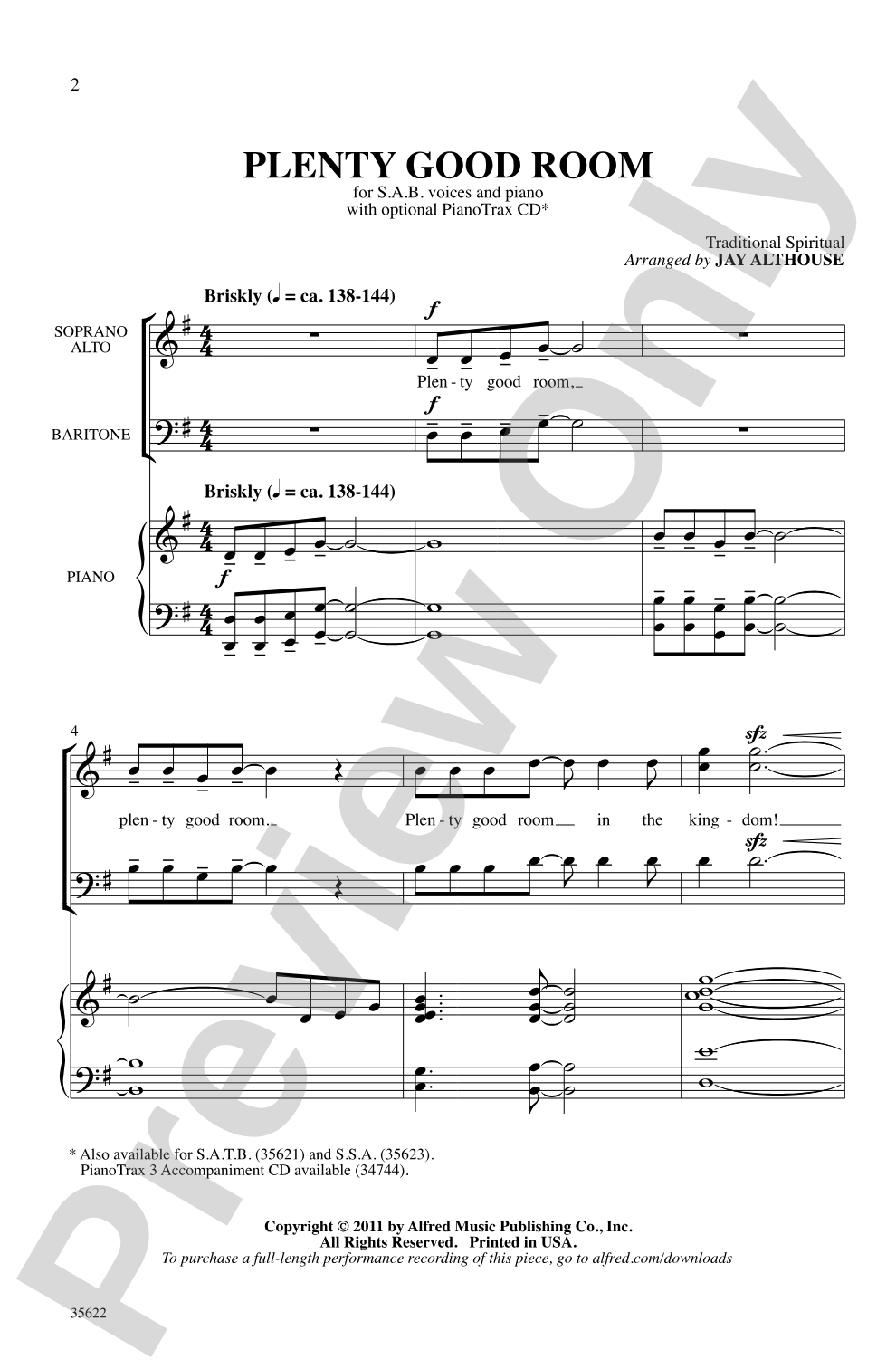

Plenty Good Room: SAB Choral Octavo
Traditional Spiritual / arr. Jay Althouse
Item: 00-PO-0001011
$1.80
Minimum order quantity: 20 copies
Pickup currently not available
Related Items
Plenty Good Room: PianoTrax Digital Download |
$9.99
|
View | |
Plenty Good Room: SATB Choral Octavo |
$1.80
|
View | |
Plenty Good Room: SSA Choral Octavo |
$1.80
|
View | |
Plenty Good Room: SATB Choral Octavo |
$1.80
|
View | |
Plenty Good Room: SAB Choral Octavo |
$1.80
|
View | |
Plenty Good Room: SSA Choral Octavo |
$1.80
|
View |
Description
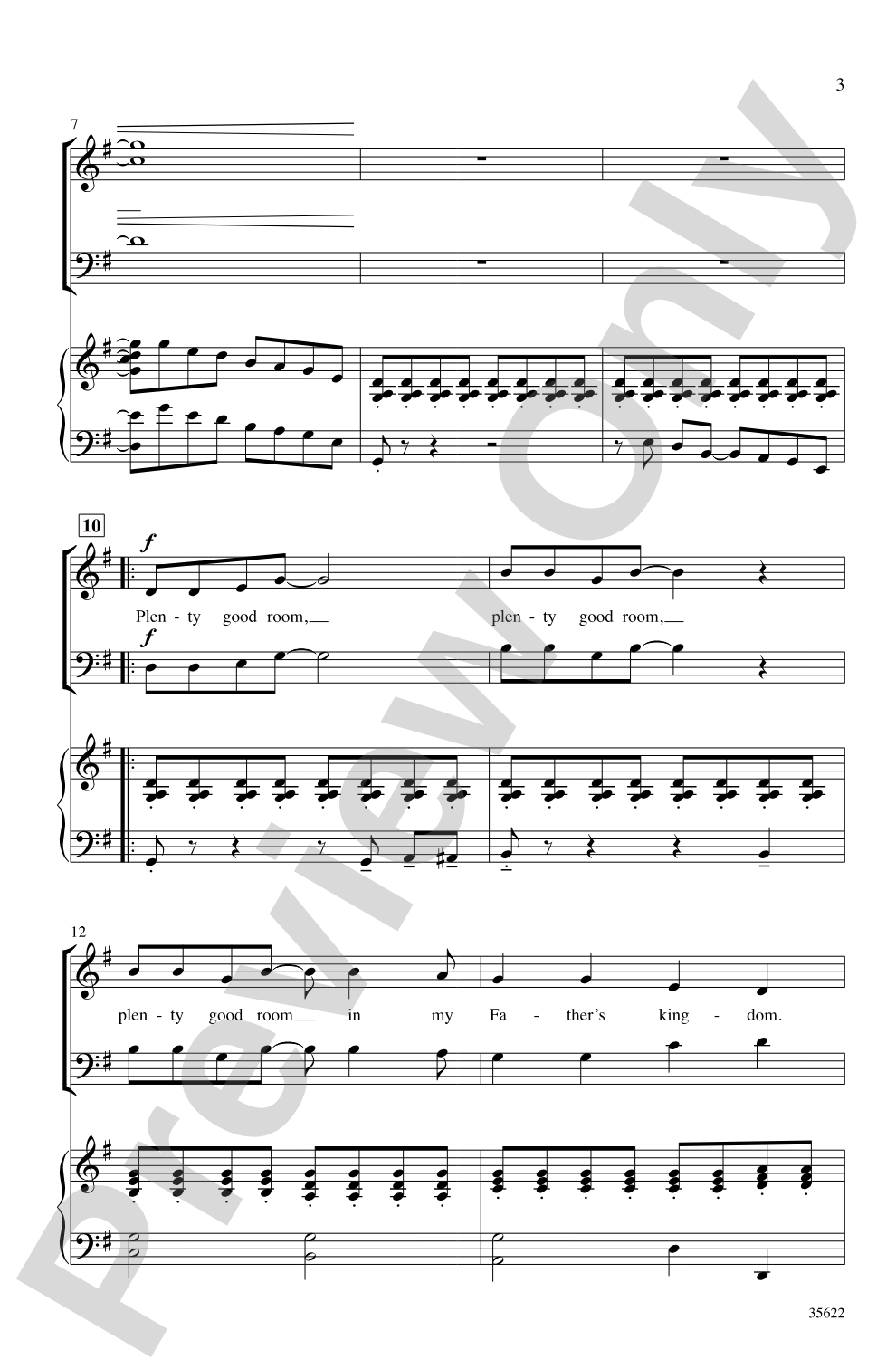
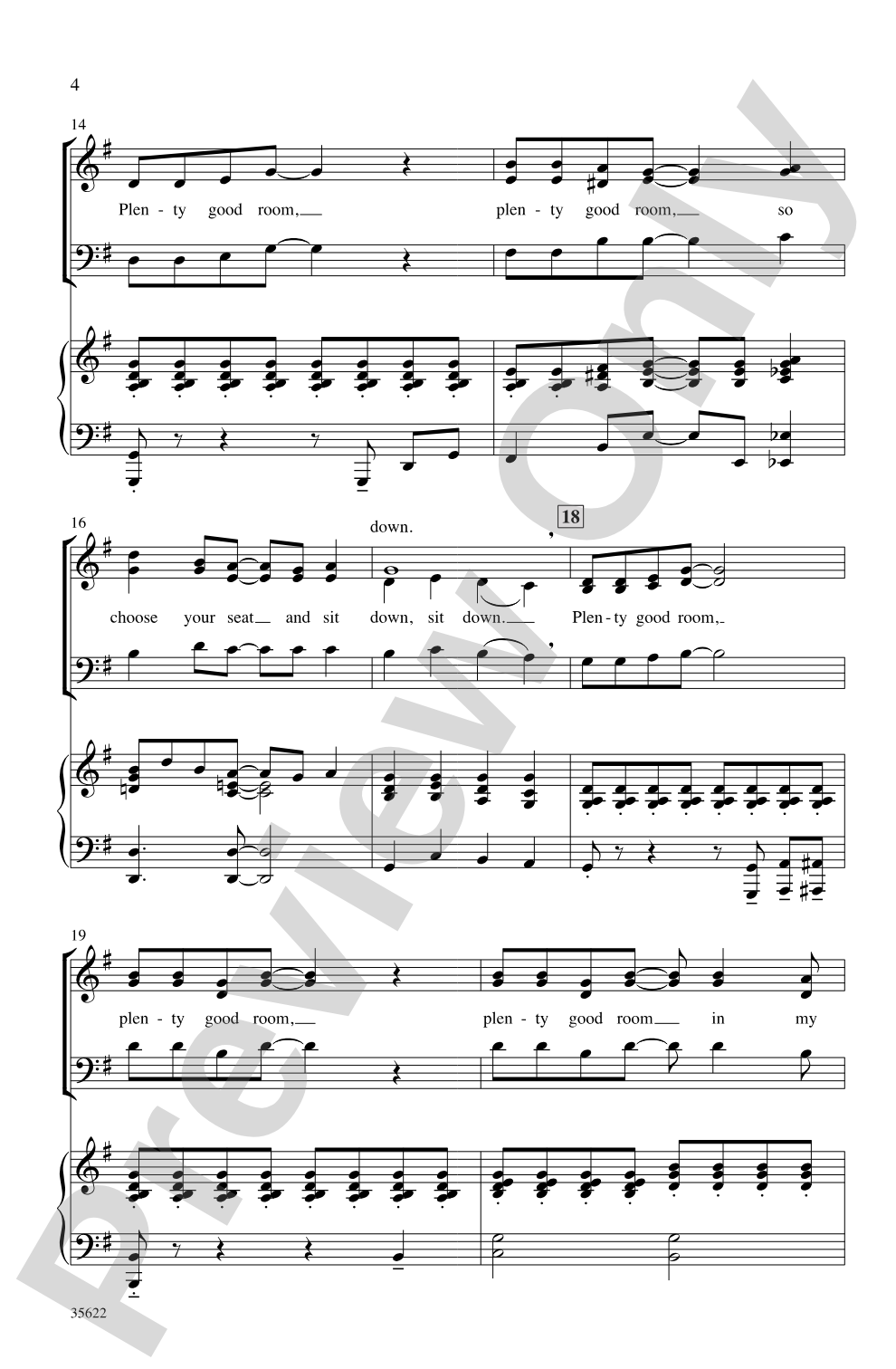
This masterful arrangement drives forward with fortitude and rhythmic energy. Features a fantastic piano accompaniment, rich harmonies, and two brief solos. Exceptional! Featured on PianoTrax 3 Accompaniment CD (00-34744).


Plenty Good Room: SAB Choral Octavo isn't in MakeMusic Cloud just yet...but it could be. Let us know you'd like to see it, and you'll help shape what comes next. In the meantime, start a free trial and dive into thousands of interactive titles your students can play along with today.
Request This Title
Tell us you want it.
Start Your Free Trial
Explore everything that's ready to play right now.
Sample Audio
1
Audio File
--:--
0:00
0:00
Sample Video
No sample videos found.
Additional Details
Series:
Alfred Choral Designs
Publisher:
Alfred Music
Page Count:
12
SKU:
00-PO-0001011
More about this title
About the Arranger: Jay Althouse

Jay Althouse holds degrees in Music Education and Music from Indiana University of Pennsylvania, where he was recognized as a Distinguished Alumni honoree. His career spans both the publishing side of music education (eight years as a rights and licenses administrator, culminating in a term on the Executive Board of the Music Publishers Association of America) and prolific composition, with over 800 choral works now in circulation across all choir levels.
As a composer, Althouse has established himself across multiple genres and formats. He is a writer member of ASCAP and a repeat recipient of the ASCAP Special Award for his standard music compositions. Beyond choral writing, he has co-written children's musicals with Sally K. Albrecht, compiled respected vocal solo collections including Folk Songs for Solo Singers, and authored or co-authored instructional resources such as The Complete Choral Warm-up Book, Accent on Composers, Ready to Read Music, and Sixty Music Quizzes. His choral composition I Hear America Singing, written with Albrecht, was performed by the San Francisco Girls and Boys Choirs at President Obama's 2009 inauguration. Althouse currently serves on the National Advisory Board of the Folk Art Society of America and resides in Wake Forest, North Carolina.
Why we love this
Althouse understands how to energize a spiritual without losing its soul. The arrangement propels forward with genuine rhythmic momentum while the rich harmonic writing and accessible SAB voicing keep it performable by young and developing choirs. Two built-in solo moments give singers a chance to step into the spotlight without requiring auditions or extensive rehearsal.
What to expect
The piece unfolds with genuine forward momentum, never settling into a slow plod. Rich harmonies bloom underneath the melody, creating warmth that feels lived-in and earned rather than merely decorative. The solos break the surface tension, inviting moments of vulnerability within the steady, purposeful accompaniment.
Who it's for
This arrangement suits developing choirs and mixed ensembles seeking a spiritual with substance and style. Directors working with high school treble or mixed choirs will find the three-part voicing manageable without sacrificing harmonic interest, while the rhythmic drive engages singers who might otherwise approach sacred music passively.
How to get the most out of it
- Keep the rhythm section locked and driving from the downbeat. The piano accompaniment anchors the piece's forward energy, so the singers' parts must sync with its pulse throughout.
- Balance the two solo passages so they read as intimate moments within the larger choral fabric. Avoid pulling back the ensemble too much; these are soloists singing within the spiritual, not concert recitals.
- Shape the harmonies deliberately in the ensemble sections. With three parts, you have room to voice-lead smoothly; listen for moments where upper and lower parts can crescendo or diminish independently for textural depth.
How to use it
Program this as a concert centerpiece in a choral concert focused on spirituals and sacred music, pairing it with other arrangements that share similar energy and cultural resonance. Its rhythmic confidence and shorter length make it ideal for festival or competition programming, where it can anchor a set without monopolizing rehearsal time.
Skills your students will build
- Rhythmic precision and ensemble lock with a driving accompaniment
- Independent part singing in three-part harmony with attention to voice-leading
- Building and sustaining harmonic texture through dynamic control within the ensemble
- Solo performance and text communication within a group context