
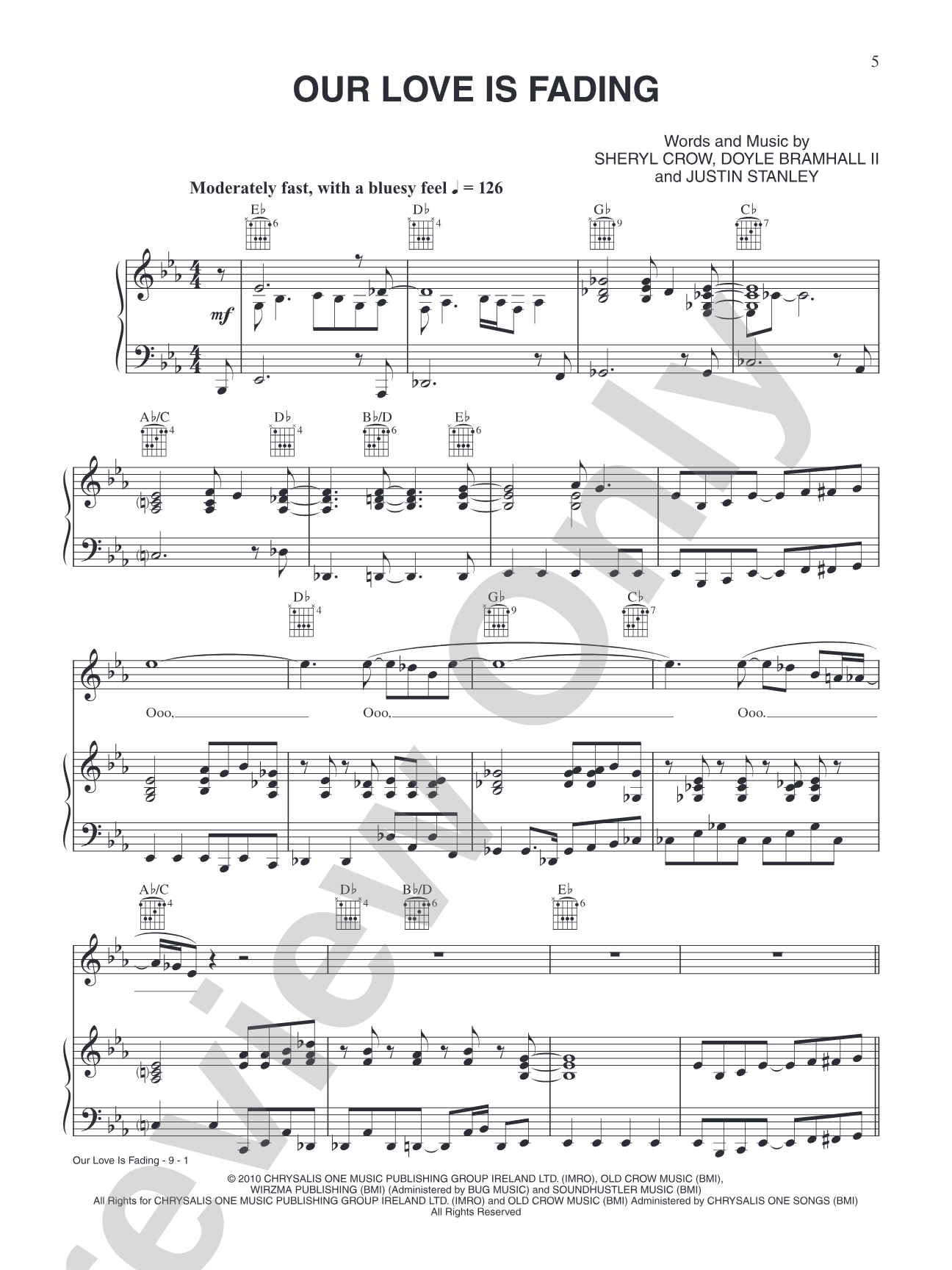
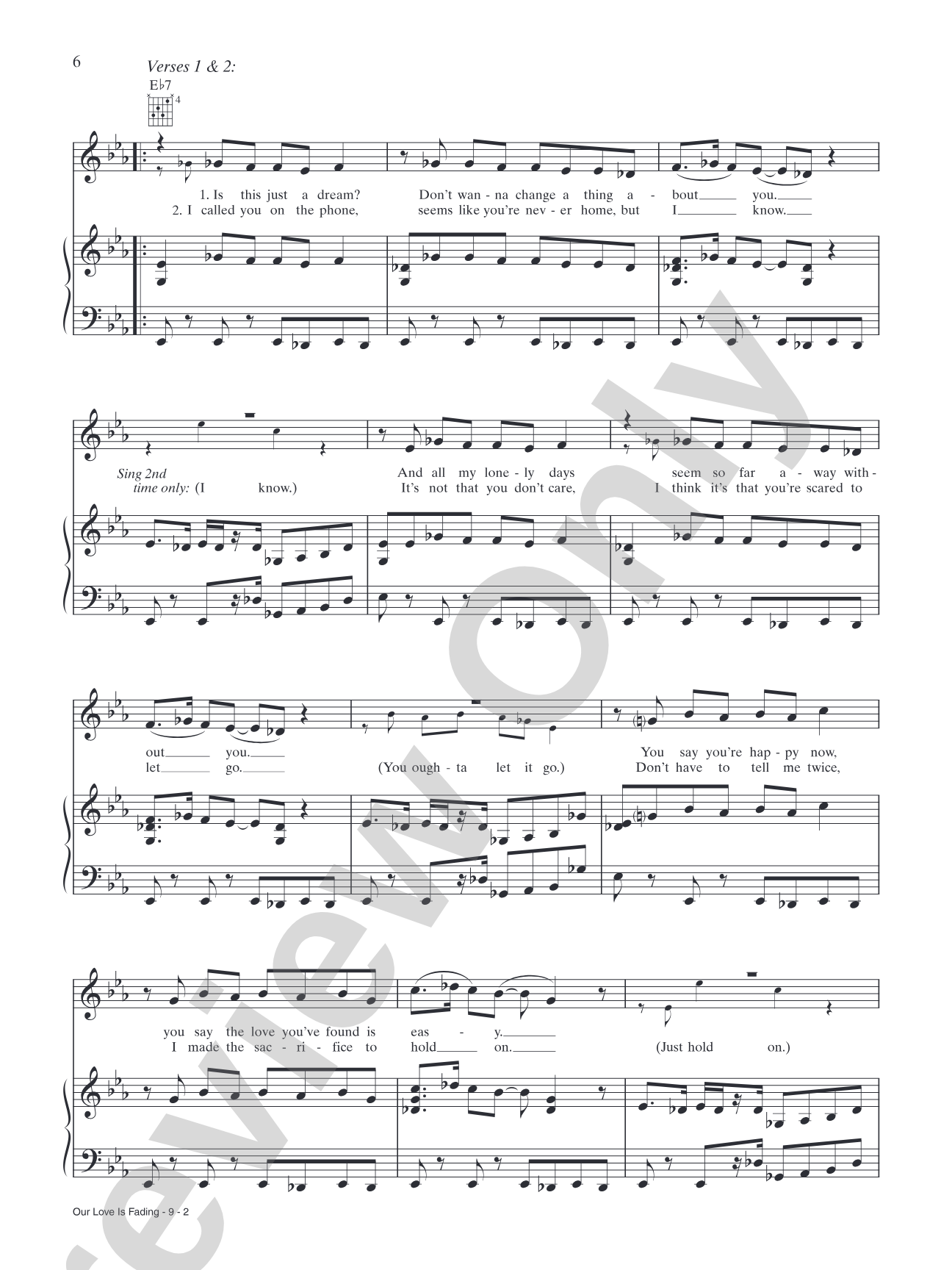

Our Love is Fading: Piano/Vocal/Chords
Sheryl Crow
Item: 00-XS-0000122
$5.99
Pickup currently not available
Related Items
Summer Day: Piano/Vocal/Chords |
$5.99
|
View | |
Eye To Eye: Piano/Vocal/Chords |
$9.99
|
View | |
Long Road Home: Piano/Vocal/Chords |
$5.99
|
View | |
Say What You Want: Piano/Vocal/Chords |
$5.99
|
View | |
Peaceful Feeling: Piano/Vocal/Chords |
$5.99
|
View | |
100 Miles From Memphis: Piano/Vocal/Chords |
$5.99
|
View | |
Roses and Moonlight: Piano/Vocal/Chords |
$5.99
|
View | |
Stop: Piano/Vocal/Chords |
$4.99
|
View |
Description
Alfred is proud to present the matching piano/vocal/guitar songbook to 100 Miles From Memphis, Sheryl Crow's seventh studio release. Every arrangement plays beautifully and captures Crow's signature blend of rock, folk, country, and pop.


Our Love is Fading: Piano/Vocal/Chords isn't in MakeMusic Cloud just yet...but it could be. Let us know you'd like to see it, and you'll help shape what comes next. In the meantime, start a free trial and dive into thousands of interactive titles your students can play along with today.
Request This Title
Tell us you want it.
Start Your Free Trial
Explore everything that's ready to play right now.
Sample Audio
No sample audio found.
Sample Video
No sample videos found.
Additional Details
Publisher:
Alfred Music
Page Count:
92
SKU:
00-XS-0000122
More about this title
About the Composer: Sheryl Crow
Sheryl Crow emerged from the St. Louis music scene in the early 1990s to become one of rock music's most distinctive voices. Her ability to move seamlessly between rock edge, folk intimacy, and country warmth has defined a career spanning multiple decades and Grammy Awards. As a composer, Crow writes from lived experience, crafting songs that balance vulnerability with a producer's ear for arrangement and sonic detail.
Crow's work across jazz, country, and rock contexts demonstrates her deep understanding of how different genres can coexist within a single song. Her collaborations with artists like Emmylou Harris and Bonnie Raitt have shown her commitment to musical authenticity and storytelling. In the classroom or rehearsal room, her catalog offers singers and musicians examples of how strong melodies and honest lyrics can anchor complex arrangements.
Why we love this
This collection captures Crow's signature ability to layer rock, folk, country, and pop textures without losing melodic clarity, making it an excellent teaching tool for singers navigating genre-blending arrangements. The piano/vocal/guitar format gives vocalists, pianists, and guitarists equally satisfying material to study how these voices interact. Having all 92 pages in one resource means your ensemble can work through a full album's worth of material with consistent harmonic and melodic language.
What to expect
These songs occupy a reflective, emotionally open space where rock instrumentation meets folk storytelling. The melodies feel both conversational and carefully shaped, with harmonic movement that supports rather than complicates the lyrical content. Piano and guitar arrangements preserve Crow's intimate production style while remaining playable in educational settings.
Who it's for
Vocalists preparing contemporary art song recitals or exploring how pop and rock writing functions at an interpretive level will find rich material here. Pianists and guitarists looking to accompany singers in a contemporary context can develop skills balancing harmonic support with independent musicality. Music programs building a contemporary American songbook will value having complete, singable arrangements by a composer known for vocal accessibility.
How to get the most out of it
- Balance the vocal line against the piano voicings by listening for where Crow's melody sits in the mix; these arrangements often place the vocal slightly forward, so adjust accompaniment volume accordingly.
- Pay attention to the rhythmic pushes and pulls in the piano part, as Crow's songs often sit slightly behind or ahead of the beat in subtle ways that give them their character.
- Use the chord symbols as a starting point for guitarists to develop their own textures; these arrangements allow flexibility for fingerstyle interpretation or strumming patterns that fit your ensemble's needs.
- Work through passages where the piano and voice move in different rhythmic directions to ensure both players understand the underlying pulse before adding emotional interpretation.
How to use it
Program selections from this collection alongside classic rock and pop repertoire in a contemporary vocal recital to show how recent songwriting builds on earlier traditions. Use individual songs as study material in voice lessons to help students understand how melody functions across different harmonic and rhythmic frameworks. Assign pieces to chamber ensembles exploring the intersection of songwriting and arrangement, particularly for pianists and guitarists developing accompaniment skills.
Skills your students will build
- Singing through complex harmonic movement while maintaining clear vocal line
- Reading and interpreting chord symbols for flexible accompaniment realization
- Balancing vocal phrasing against piano and guitar rhythmic independence
- Understanding genre blending across rock, folk, country, and pop vocabularies
- Developing interpretive choices when working with contemporary songbook material