
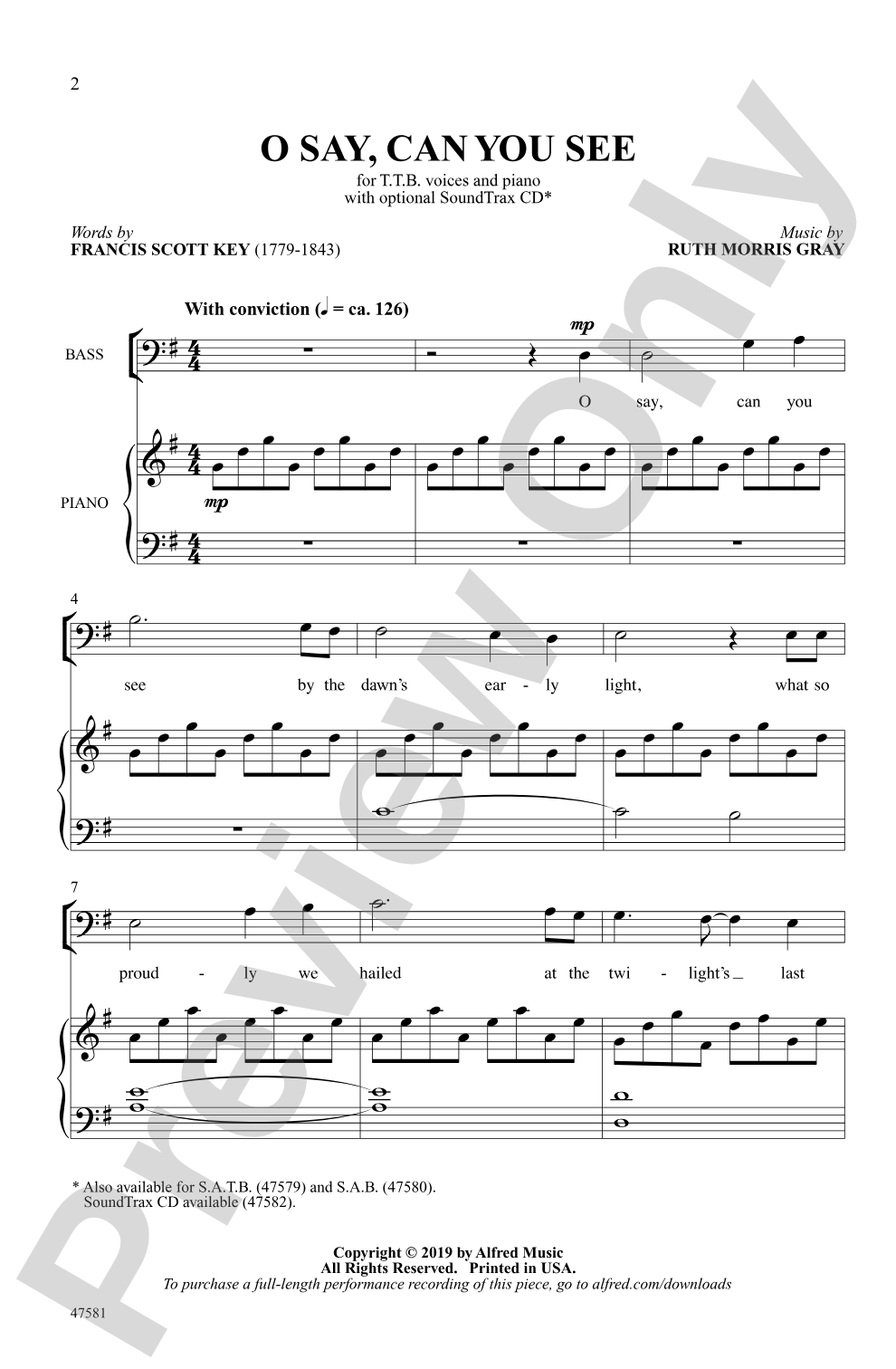
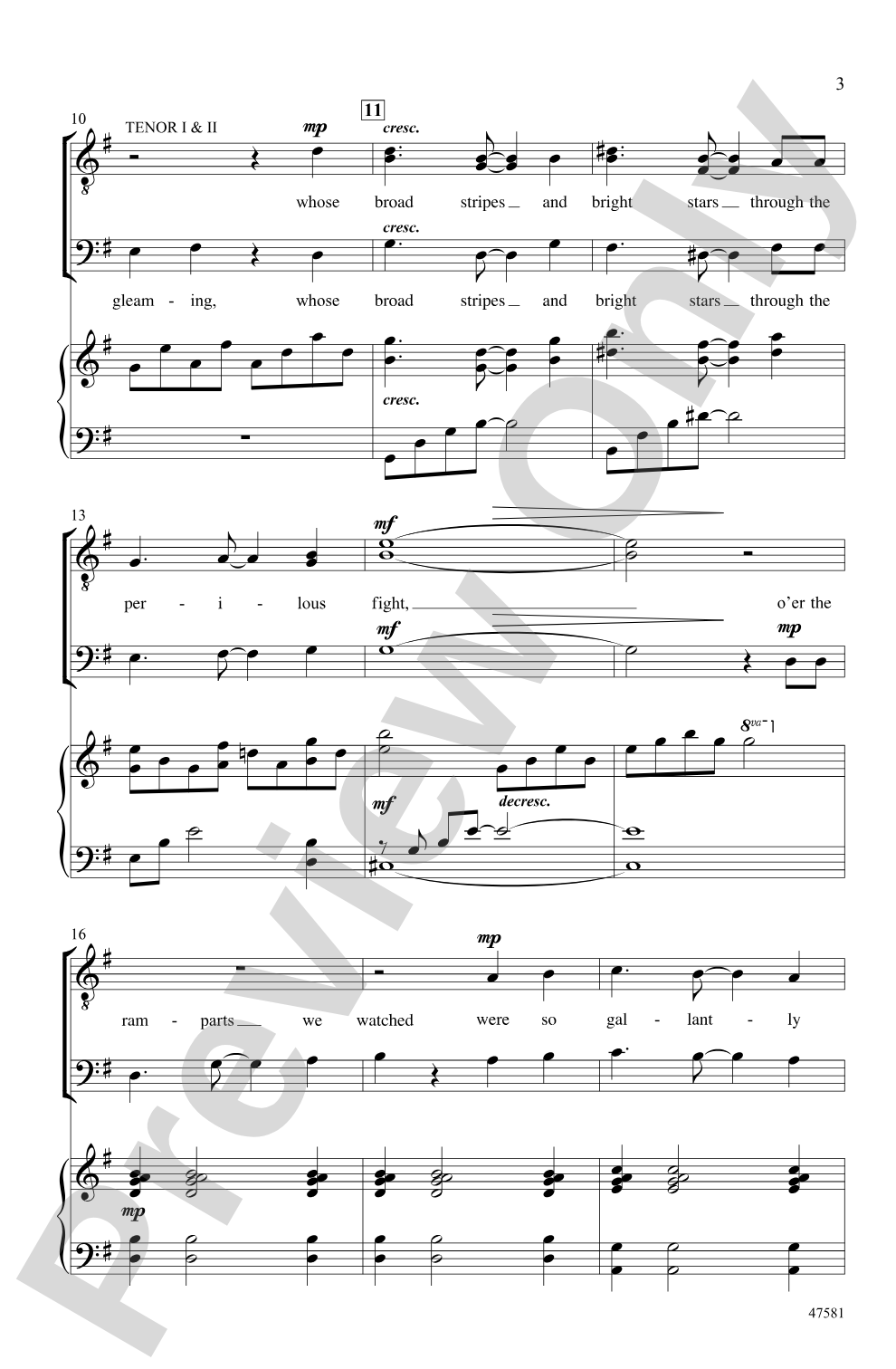

O Say, Can You See: TTB Choral Octavo
Words by Francis Scott Key, music by Ruth Morris Gray
Item: 00-PO-0005943
$2.05
Minimum order quantity: 20 copies
Pickup currently not available
Related Items
O Say, Can You See: SoundTrax Digital Audio Download |
$27.99
|
View | |
O Say, Can You See: SATB Choral Octavo |
$2.05
|
View | |
O Say, Can You See: SAB Choral Octavo |
$2.05
|
View | |
O Say, Can You See: SATB Choral Octavo |
$2.05
|
View | |
O Say, Can You See: SAB Choral Octavo |
$2.05
|
View | |
O Say, Can You See: TTB Choral Octavo |
$2.05
|
View | |
O Say, Can You See: Choral Octavo SoundTrax CD |
$27.99
|
View |
Description
Program this moving patriotic piece to celebrate our country at any time of year. An all-new original melody and a shimmering accompaniment beautifully highlight Francis Scott Key's words from “The Star-Spangled Banner.” Toward the end, a lush musical quote from the national anthem blossoms into a final glorious refrain, a soaring penultimate cadence, and one last introspective accolade for “the brave!”


O Say, Can You See: TTB Choral Octavo isn't in MakeMusic Cloud just yet...but it could be. Let us know you'd like to see it, and you'll help shape what comes next. In the meantime, start a free trial and dive into thousands of interactive titles your students can play along with today.
Request This Title
Tell us you want it.
Start Your Free Trial
Explore everything that's ready to play right now.
Sample Audio
1
Audio File
--:--
0:00
0:00
Sample Video
Additional Details
Series:
Alfred Choral Designs
Publisher:
Alfred Music
Page Count:
12
SKU:
00-PO-0005943
More about this title
About the Composer: Ruth Morris Gray

Ruth Morris Gray directs choirs at Rosemead High School in California, a position she has held since 2004 alongside teaching piano. She holds a Bachelor of Music in Piano Performance and Composition from Biola University and earned both a Master of Arts in Music Composition from UC Santa Barbara and her California Single Subject Music Credential from Cal State Northridge.
With over 100 published choral compositions to her name, Gray has established herself as a prolific voice in choral music education. Beyond the page, she is an active performer and traveler who finds creative energy in swimming, reading, and cycling with her husband.
Why we love this
Gray's fresh melodic approach respects Key's iconic words without leaning on the familiar tune, which frees your singers to engage the text anew. The strategic insertion of the national anthem melody near the end rewards the choir's emotional investment with a moment of genuine resonance, and the writing sits naturally for TTB voices without requiring excessive range or agility.
What to expect
The original melody unfolds with dignity, supported by a piano accompaniment that shimmers with quiet reflection. When the familiar national anthem melody surfaces near the end, it arrives as an earned moment of transcendence, building toward a soaring cadence that feels both powerful and deeply respectful.
Who it's for
TTB choirs seeking patriotic repertoire that feels substantive rather than ceremonial. This works equally well for groups performing around Independence Day and for ensembles programming a concert centered on American texts and values.
How to get the most out of it
- Balance the shimmering accompaniment carefully so it supports rather than overwhelms the men's voices; the piano part is lush but should never compete with the melodic line.
- Shape the text expressively in the opening sections, allowing the gravity of Key's language to guide phrasing and dynamic choices before the anthem quote arrives.
- Approach the penultimate cadence with deliberate control; the soaring quality Gray describes requires breath support and unified vowel formation across all three parts.
- Reserve full intensity for the final refrain and the closing accolade on 'the brave,' treating everything prior as emotional preparation for that culminating moment.
How to use it
Open a patriotic concert or mixed program with this piece to set a thoughtful, reverent tone. Its moderate difficulty and 12-page length make it substantial enough to anchor a concert section on American themes without overwhelming a full rehearsal schedule.
Skills your students will build
- Reading and sustaining original melodic lines independent of familiar harmonic patterns
- Balancing individual voice parts with piano accompaniment in a dense harmonic texture
- Interpreting text-driven phrasing across a patriotic arc
- Maintaining vocal control through a soaring, climactic cadential moment
- Ensemble blend and intonation in three-part male voicing