
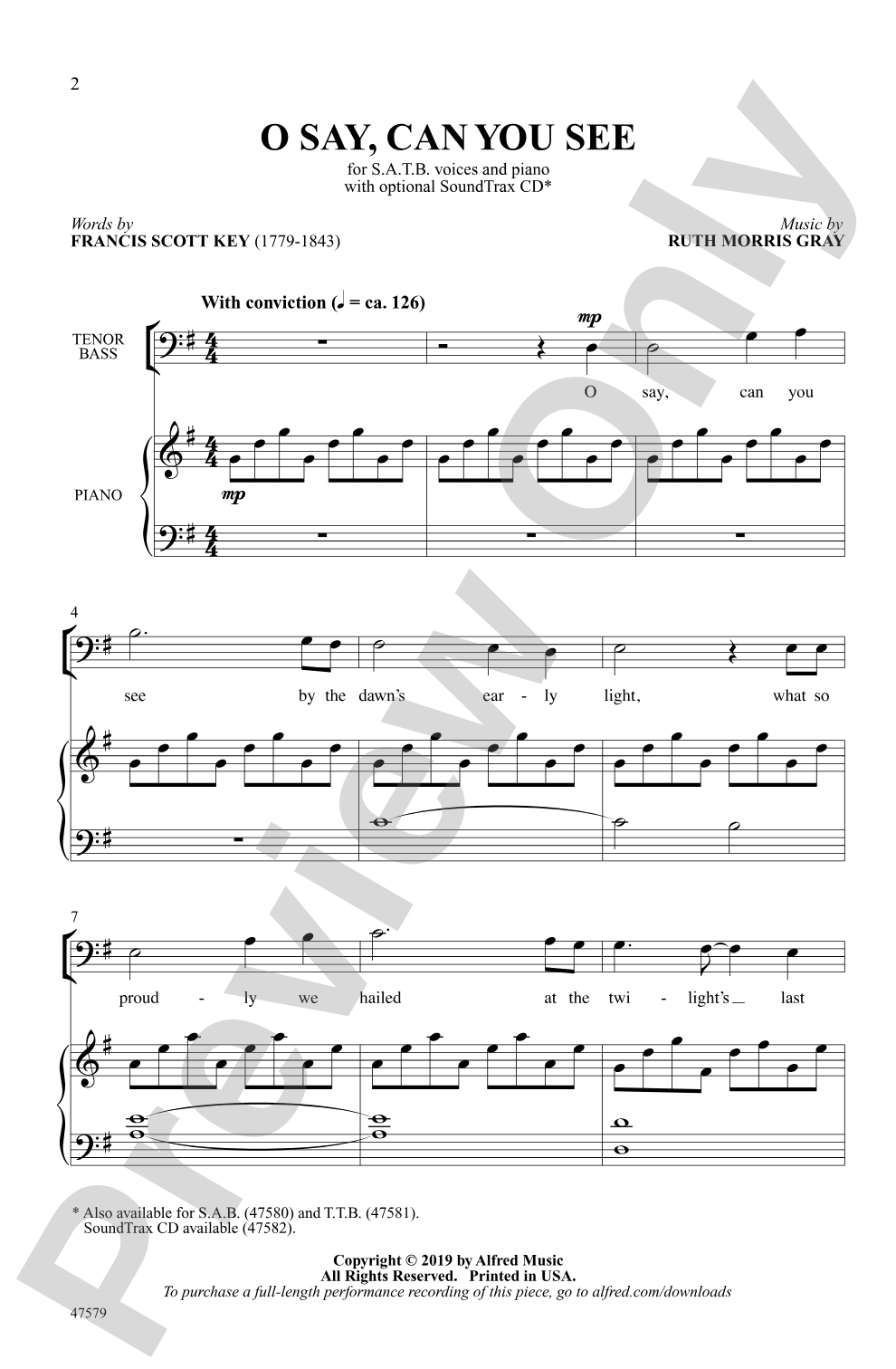
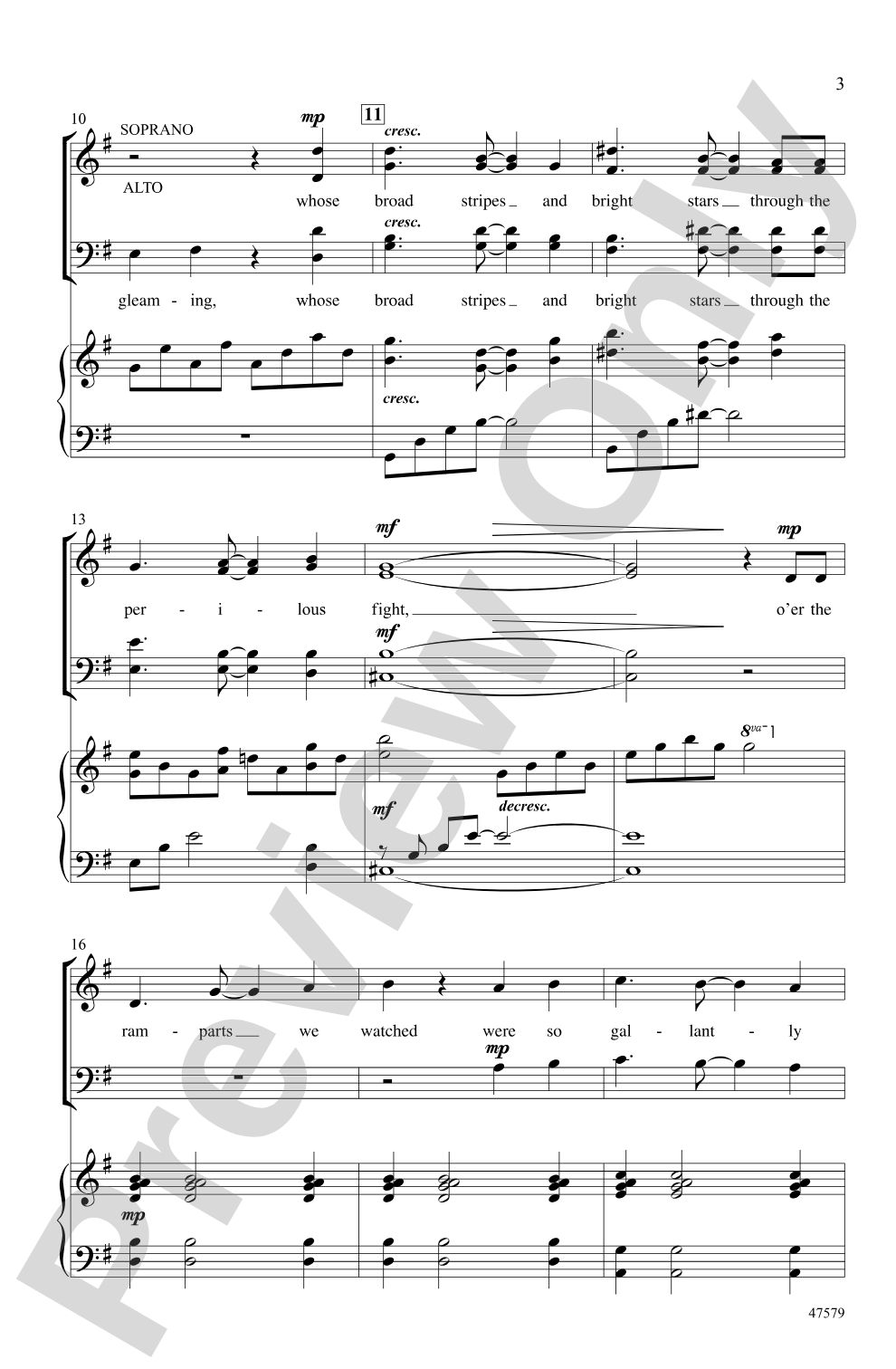

O Say, Can You See: SATB Choral Octavo
Words by Francis Scott Key, music by Ruth Morris Gray
Item: 00-PO-0005941
$2.05
Minimum order quantity: 20 copies
Pickup currently not available
Related Items
O Say, Can You See: SoundTrax Digital Audio Download |
$27.99
|
View | |
O Say, Can You See: SAB Choral Octavo |
$2.05
|
View | |
O Say, Can You See: TTB Choral Octavo |
$2.05
|
View | |
O Say, Can You See: SATB Choral Octavo |
$2.05
|
View | |
O Say, Can You See: SAB Choral Octavo |
$2.05
|
View | |
O Say, Can You See: TTB Choral Octavo |
$2.05
|
View | |
O Say, Can You See: Choral Octavo SoundTrax CD |
$27.99
|
View |
Description
Program this moving patriotic piece to celebrate our country at any time of year. An all-new original melody and a shimmering accompaniment beautifully highlight Francis Scott Key's words from “The Star-Spangled Banner.” Toward the end, a lush musical quote from the national anthem blossoms into a final glorious refrain, a soaring penultimate cadence, and one last introspective accolade for “the brave!”


O Say, Can You See: SATB Choral Octavo isn't in MakeMusic Cloud just yet...but it could be. Let us know you'd like to see it, and you'll help shape what comes next. In the meantime, start a free trial and dive into thousands of interactive titles your students can play along with today.
Request This Title
Tell us you want it.
Start Your Free Trial
Explore everything that's ready to play right now.
Sample Audio
1
Audio File
--:--
0:00
0:00
Sample Video
Additional Details
Series:
Alfred Choral Designs
Publisher:
Alfred Music
Page Count:
12
SKU:
00-PO-0005941
More about this title
About the Composer: Ruth Morris Gray

Ruth Morris Gray directs choirs at Rosemead High School in Rosemead, California, where she has shaped the vocal program since 2004. She also teaches piano and has composed over 100 choral works performed across the country. Her training spans piano performance and composition from Biola University, advanced composition study at UC Santa Barbara, and California's Single Subject Music Credential from Cal State Northridge.
Beyond the rehearsal room, Gray balances her work in composition, teaching, and performance with travel, swimming, reading, and cycling. Her dual expertise in keyboard skills and compositional craft deeply informs the accessibility and musicality of her choral writing.
Why we love this
Ruth Morris Gray crafts an entirely original melodic setting that honors Francis Scott Key's text without relying on the familiar national anthem tune, giving your singers something fresh and vocally satisfying to perform. The orchestration strategy is smart: the shimmering accompaniment creates musical space for the choir to shine, and the strategic arrival of the actual anthem melody near the end becomes a moment of genuine power rather than an expected routine. This piece respects both the solemnity of the text and the intelligence of your singers.
What to expect
The piece unfolds with quiet dignity, its original melody and glistening accompaniment creating an intimate setting for Key's words before the national anthem melody arrives like sunlight breaking through clouds. The final passage soars with hard-won sincerity, neither bombastic nor sentimental, leaving singers and listeners in a reflective space.
Who it's for
This octavo works for mixed choirs of intermediate to advanced ability who want to program patriotic music with substance. It suits singers who can handle a fresh compositional voice while connecting emotionally to text about national pride and sacrifice.
How to get the most out of it
- Balance the shimmer of the accompaniment with clear text projection; the choral line should always drive the phrase, not blend into the instrumental wash.
- Shape the musical quote from the national anthem as a watershed moment. Let the tension build in the measures leading to it, then allow the familiar melody to bloom with renewed meaning.
- Mark the "soaring penultimate cadence" in rehearsal as a landmark. Assign this spot early and build toward it with graduated dynamics and breath support throughout the piece.
- The final accolade on "the brave" benefits from precise tuning and a unified vowel shape. Take this moment slowly in rehearsal to lock in the sonority.
How to use it
Reserve this for concerts where you want to offer a patriotic moment that feels considered rather than obligatory; it works equally well for Independence Day observances, Veterans Day tributes, or any concert with a theme of American identity. The 12-page format and available recorded accompaniment make it accessible for groups planning hybrid or virtual performances. Pair it with other secular choral works to avoid an overly ceremonial program arc.
Skills your students will build
- singing original melody with confidence and clear diction
- balancing homophonic and more complex harmonic textures
- sustaining intensity through long phrases and building toward a climactic moment
- responding to dynamic and textural shifts that highlight text meaning
- ensemble blend across four-part SATB writing