
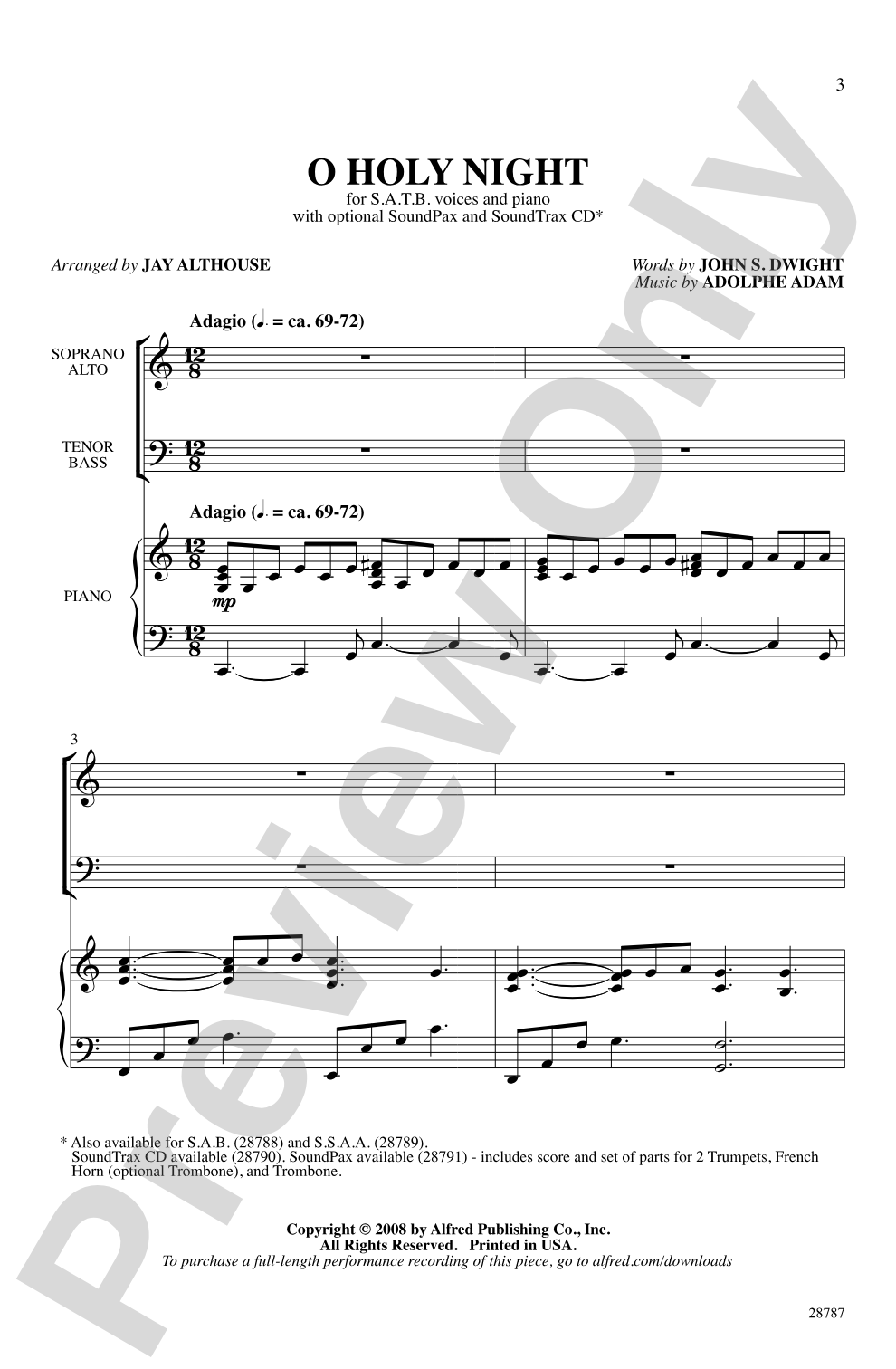
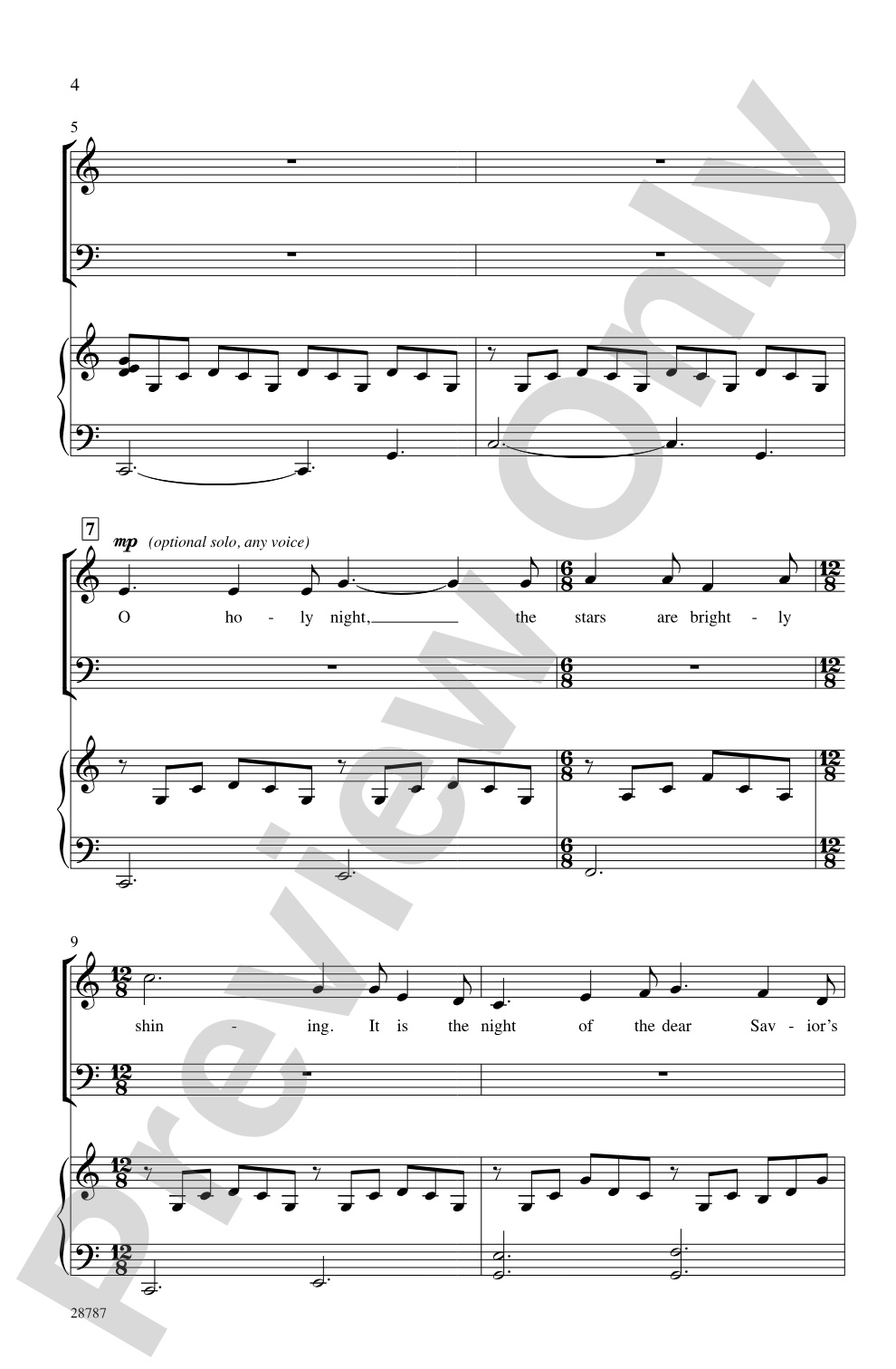

O Holy Night: SATB Choral Octavo
French Carol
Words by John S. Dwight, music by Adolphe Adam / arr. Jay Althouse
Item: 00-PO-0000577
$2.05
Minimum order quantity: 20 copies
Pickup currently not available
Related Items
O Holy Night: SoundTrax Digital Audio Download |
$27.99
|
View | |
O Holy Night: SAB Choral Octavo |
$2.25
|
View | |
O Holy Night: SSAA Choral Octavo |
$1.75
|
View | |
O Holy Night: Choral SoundPax |
$25.00
|
View | |
O Holy Night: SATB Choral Octavo |
$2.05
|
View | |
O Holy Night: SAB Choral Octavo |
$2.25
|
View | |
O Holy Night: SSAA Choral Octavo |
$1.75
|
View | |
O Holy Night: Choral Octavo SoundTrax CD |
$27.99
|
View | |
O Holy Night: Choral SoundPax |
$25.00
|
View |
Description
One of the best-loved Christmas works comes alive in this fresh new arrangement with optional brass. The parts are singable and the unique harmonies are powerful. This arrangement will make your school or church choir sound great.


O Holy Night: SATB Choral Octavo isn't in MakeMusic Cloud just yet...but it could be. Let us know you'd like to see it, and you'll help shape what comes next. In the meantime, start a free trial and dive into thousands of interactive titles your students can play along with today.
Request This Title
Tell us you want it.
Start Your Free Trial
Explore everything that's ready to play right now.
Sample Audio
1
Audio File
--:--
0:00
0:00
Sample Video
No sample videos found.
Additional Details
Series:
Alfred Choral Designs
Publisher:
Alfred Music
Page Count:
12
SKU:
00-PO-0000577
More about this title
About the Composer: Adolphe Charles Adam
Adolphe Charles Adam (1803-1856) was a French composer whose gift for melody and dramatic structure made him one of the most performed composers of his era. While he created symphonies, cantatas, and other large-scale works, Adam's legacy in music education rests largely on his ballet scores and vocal compositions, which remain staples of concert and choral repertoires worldwide. His most enduring creation, "O Holy Night" (originally "Cantique de Noël"), emerged from a request for a simple Christmas song and became one of the most beloved sacred melodies in Western music.
For choral directors, Adam's work represents an invaluable bridge between accessibility and artistry. His melodic gift means that even straightforward arrangements reward singers and audiences alike, making his compositions ideal for building both student confidence and musical literacy.
Why we love this
Jay Althouse's arrangement respects the hymn-like beauty of the original while modernizing the harmonic language in ways that engage contemporary choirs. The optional brass parts give you flexibility to program this with or without instrumental support, and the singable vocal lines mean your singers can focus on the emotional delivery rather than navigating technical hurdles. Few carols carry this much weight and warmth at a realistic skill level for mixed choirs.
What to expect
There is a quiet reverence here that builds gradually into something luminous. The harmonies create warmth and depth without overwhelming the melody, and the overall effect is contemplative yet celebratory, allowing singers to inhabit both the intimacy of the tune and its universal appeal.
Who it's for
This arrangement serves school and church choirs with singers at intermediate skill levels who want a carol with real substance. Directors seeking a familiar work that avoids oversimplification will find this particularly valuable, as will those looking to add a dignified centerpiece to their holiday program without requiring soloists or specialized vocal ranges.
How to get the most out of it
- Balance the soprano line carefully in the opening phrases; it's exposed and sets the emotional tone for the entire piece.
- If using the brass parts, use rehearsal time early to lock the harmonic foundation with your ensemble before layering instrumental color.
- Shape the dynamics gradually across longer phrases rather than hitting sudden changes; this carol breathes better when each section feels connected.
- Let the accompaniment recording guide initial rehearsals, then gradually shift toward independence so your choir's phrasing can mature.
How to use it
This is ideally positioned as an anchor piece in a holiday concert, capable of standing alone as a moment of musical reflection or threading into a longer Christmas sequence. The optional brass arrangement also makes it flexible for festive community performances or church services where instrumental support may vary.
Skills your students will build
- Sustained phrasing across longer melodic lines
- Blend and balance in four-part harmony
- Interpretation of dynamic nuance in sacred music
- Reading and performing from a recorded accompaniment
- Awareness of harmonic function in traditional and contemporary arrangements