
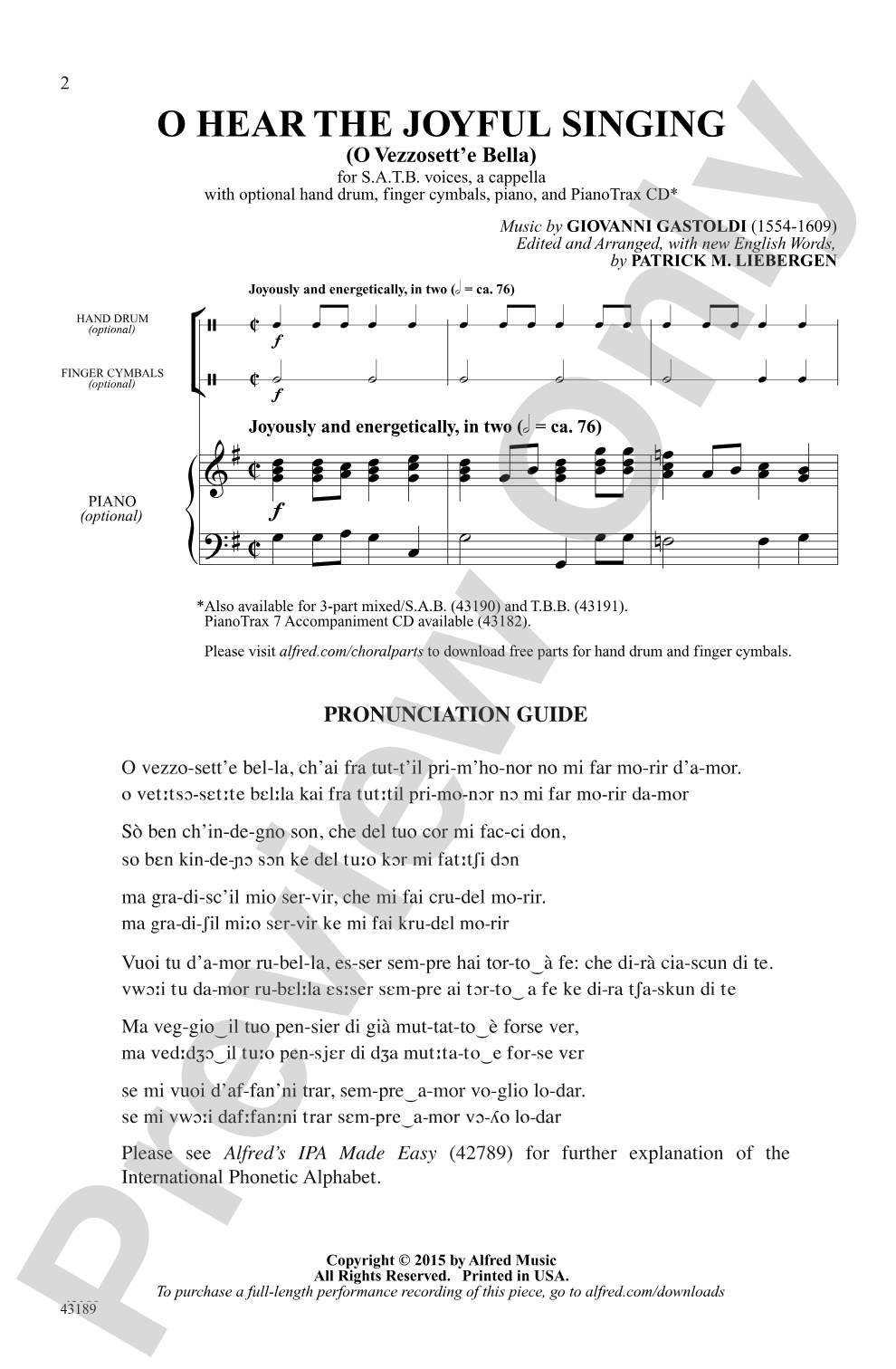
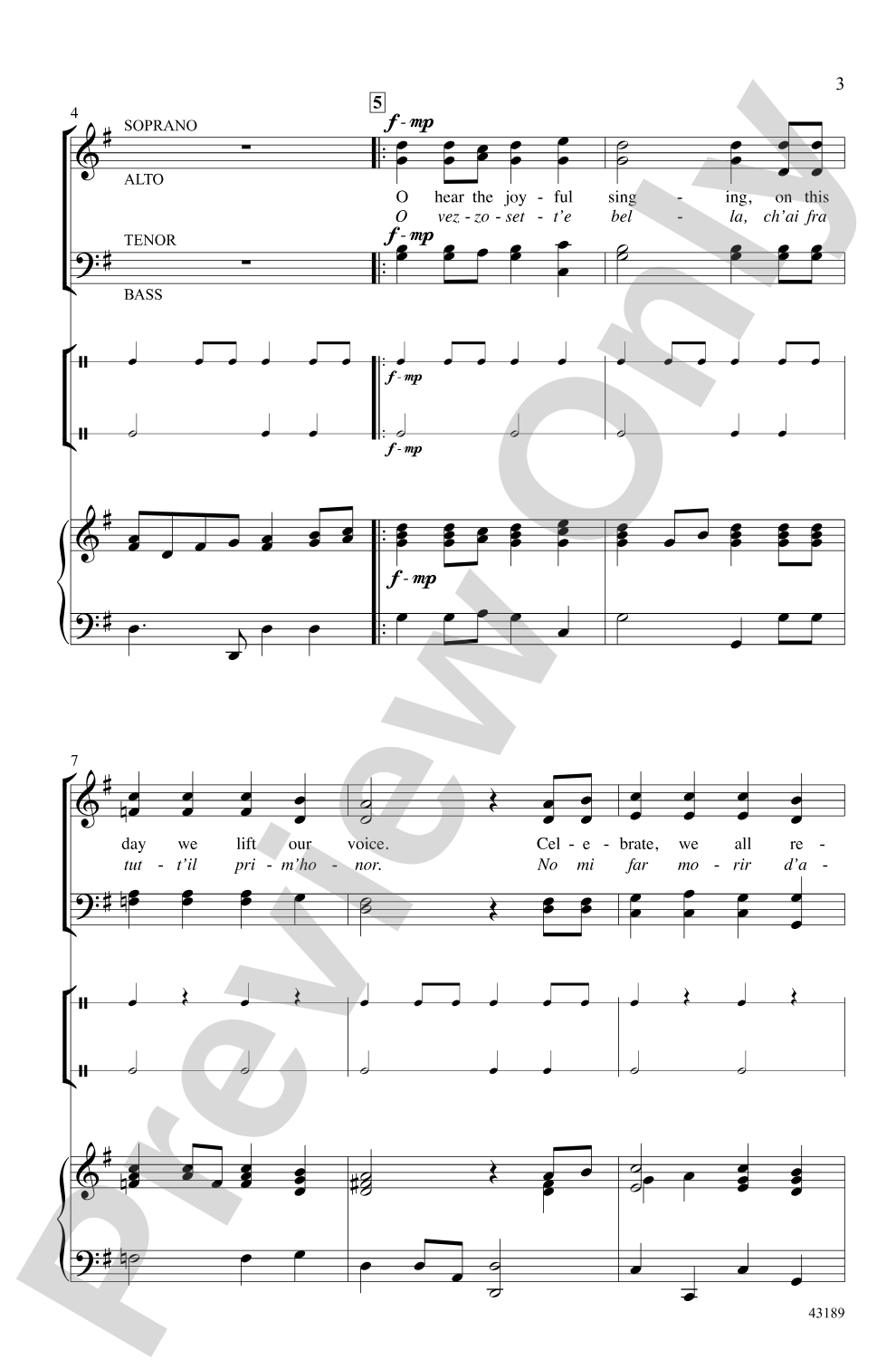

O Hear the Joyful Singing: SATB, a cappella Choral Octavo
(O Vezzosett'e Bella)
Music by Giovanni Gastoldi / ed. and arr., with new English words, by Patrick M. Liebergen
Item: 00-PO-0003189
$1.90
Minimum order quantity: 20 copies
Pickup currently not available
Related Items
O Hear the Joyful Singing: PianoTrax Digital Download |
$9.99
|
View | |
O Hear the Joyful Singing: 3-Part Mixed / SAB, a cappella Choral Octavo |
$1.90
|
View | |
O Hear the Joyful Singing: TBB, a cappella Choral Octavo |
$1.90
|
View | |
O Hear the Joyful Singing: SATB, a cappella Choral Octavo |
$1.90
|
View | |
O Hear the Joyful Singing: 3-Part Mixed / SAB, a cappella Choral Octavo |
$1.90
|
View | |
O Hear the Joyful Singing: TBB, a cappella Choral Octavo |
$1.90
|
View |
Description
Perform this buoyant Italian madrigal a cappella or accompanied by the optional piano, hand drum, and finger cymbals. The Baroque harmonies are easy to read and tune, and the 3-part mixed/SAB voicing includes several alternate notes to accommodate the vocal ranges of young men. May be sung in English, Italian, or a combination of both.


O Hear the Joyful Singing: SATB, a cappella Choral Octavo isn't in MakeMusic Cloud just yet...but it could be. Let us know you'd like to see it, and you'll help shape what comes next. In the meantime, start a free trial and dive into thousands of interactive titles your students can play along with today.
Request This Title
Tell us you want it.
Start Your Free Trial
Explore everything that's ready to play right now.
Sample Audio
1
Audio File
--:--
0:00
0:00
Sample Video
No sample videos found.
Additional Details
Series:
Alfred Choral Designs
Publisher:
Alfred Music
Page Count:
8
SKU:
00-PO-0003189
Instrumentation:
Opt. Piano, Hand Drum & Finger Cymbals
More about this title
About the Composer: Giovanni Gastoldi
Giovanni Gastoldi (1554-1609) was an Italian Renaissance composer and maestro di cappella at the court of Mantua. He specialized in vocal music, particularly the balletto, a lighter secular form that emphasized rhythmic vitality and text-driven melodic clarity. His works circulated widely across Europe and influenced the development of choral writing well into the Baroque period.
Why we love this
Gastoldi's madrigals sparkle with singable melody and rhythmic buoyancy that keeps singers engaged from the first rehearsal. The Baroque harmonies remain accessible without sacrificing sophistication, and Patrick Liebergen's arrangement thoughtfully accommodates varied vocal maturity through alternate notes for young male singers. It works equally well a cappella or with subtle instrumental color, giving directors real flexibility in how they shape the performance.
What to expect
The piece radiates lightness and joy without sacrificing musicality. Baroque harmonies create moments of gentle harmonic color while the text setting keeps momentum constant, building an almost dance-like quality that feels fresh even at the madrigal's close. The optional hand drum and finger cymbals can enhance this buoyant character, evoking the festive context in which madrigals were originally performed.
Who it's for
This octavo suits choirs ranging from strong middle school ensembles through adult groups seeking repertoire that balances approachability with musical substance. Directors will appreciate that the alternate voicing options make it viable for groups with limited male voices or uneven range distribution. It also serves singers preparing to tackle more complex Renaissance and Baroque literature.
How to get the most out of it
- Bring out the text rhythm over harmonic perfection in the opening phrases; Gastoldi's genius lies in how the words drive the melodic contour. Let that energy propel the ensemble forward.
- If using optional percussion, position the hand drum and finger cymbals where they enhance rather than overpower the voices. These instruments anchor the pulse without stepping into the foreground.
- Balance the upper voices clearly while keeping the bass line warm and supported. The alto and soprano lines carry the primary material, but the lower voices provide harmonic grounding that prevents muddiness.
- Work through both English and Italian versions separately before attempting a combination. Each language sits differently on the melodic line, and singers need secure footing in one before layering the two.
How to use it
Program this as a contrast piece in a concert pairing it with contemporary choral works or as part of a Baroque-focused set. Its brevity and accessibility also make it excellent for spring or early fall concerts when rehearsal time is limited. Young male singers particularly benefit from the vocal range flexibility, so it works well in programs introducing tenor and bass voices to choral literature.
Skills your students will build
- Reading simple Baroque harmonic progressions and identifying functional harmony
- Singing in mixed voicing with alternate notes for range accommodation
- Maintaining forward rhythmic momentum across phrase lines
- Managing optional instrumental accompaniment and percussion parts with vocal lines
- Code-switching between English and Italian text with accurate phonetic placement