
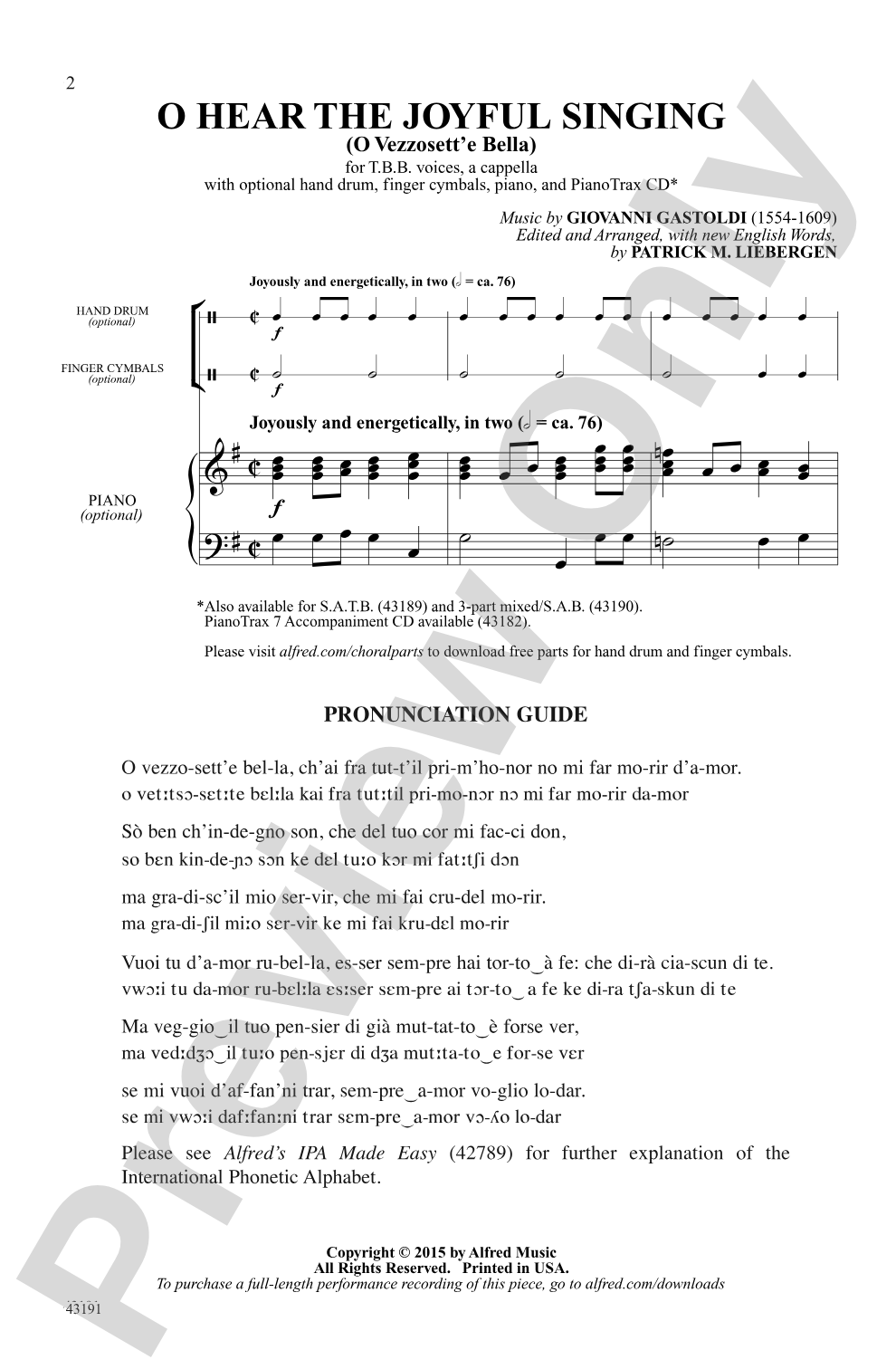
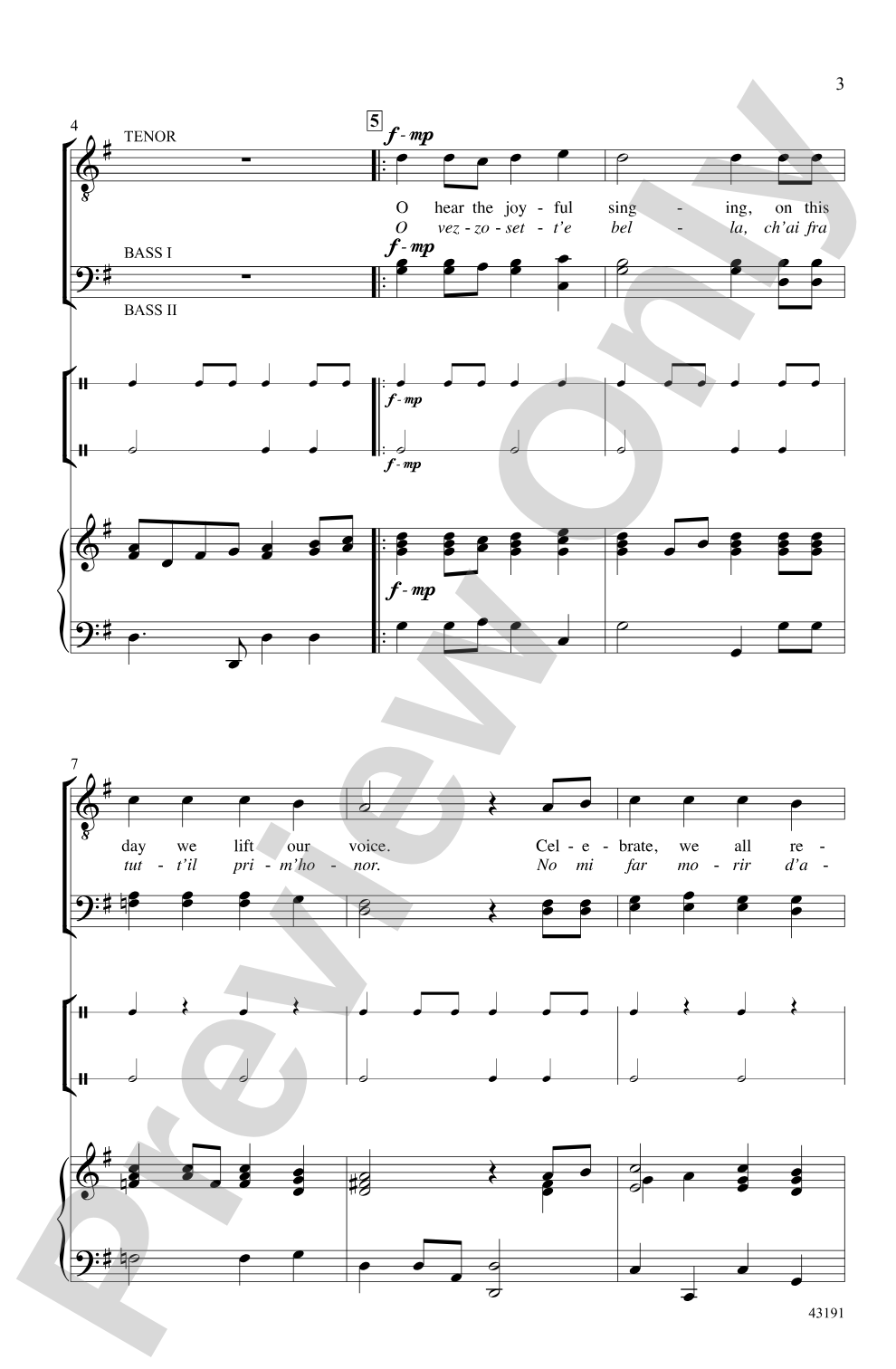

O Hear the Joyful Singing: TBB, a cappella Choral Octavo
(O Vezzosett'e Bella)
Music by Giovanni Gastoldi / ed. and arr., with new English words, by Patrick M. Liebergen
Item: 00-PO-0003191
$1.90
Minimum order quantity: 20 copies
Pickup currently not available
Related Items
O Hear the Joyful Singing: PianoTrax Digital Download |
$9.99
|
View | |
O Hear the Joyful Singing: SATB, a cappella Choral Octavo |
$1.90
|
View | |
O Hear the Joyful Singing: 3-Part Mixed / SAB, a cappella Choral Octavo |
$1.90
|
View | |
O Hear the Joyful Singing: SATB, a cappella Choral Octavo |
$1.90
|
View | |
O Hear the Joyful Singing: 3-Part Mixed / SAB, a cappella Choral Octavo |
$1.90
|
View | |
O Hear the Joyful Singing: TBB, a cappella Choral Octavo |
$1.90
|
View |
Description
Perform this buoyant Italian madrigal a cappella or accompanied by the optional piano, hand drum, and finger cymbals. The Baroque harmonies are easy to read and tune, and the 3-part mixed/SAB voicing includes several alternate notes to accommodate the vocal ranges of young men. May be sung in English, Italian, or a combination of both.


O Hear the Joyful Singing: TBB, a cappella Choral Octavo isn't in MakeMusic Cloud just yet...but it could be. Let us know you'd like to see it, and you'll help shape what comes next. In the meantime, start a free trial and dive into thousands of interactive titles your students can play along with today.
Request This Title
Tell us you want it.
Start Your Free Trial
Explore everything that's ready to play right now.
Sample Audio
1
Audio File
--:--
0:00
0:00
Sample Video
No sample videos found.
Additional Details
Series:
Alfred Choral Designs
Publisher:
Alfred Music
Page Count:
8
SKU:
00-PO-0003191
Instrumentation:
Opt. Piano, Hand Drum & Finger Cymbals
More about this title
About the Composer: Giovanni Gastoldi
Giovanni Gastoldi (c. 1554-1609) was an Italian composer and maestro di cappella whose gift for melodic invention and rhythmic vitality made him one of the most performed composers of the late Renaissance and early Baroque. His ballettos and madrigals, characterized by homophonic texture and infectious dance-like energy, were widely published across Europe and influenced the development of secular vocal music in the 17th century.
Gastoldi's works remain central to choral education because they demonstrate how sophisticated musical ideas can be expressed through accessible part-writing. His balance of harmonic clarity with expressive warmth makes his music particularly rewarding for developing ensembles learning to navigate Baroque style.
Why we love this
Patrick Liebergen's arrangement captures the essential character of Gastoldi's original while opening it to a wider range of voices through flexible TBB voicing and alternate note options. Directors will appreciate how the optional percussion and piano accompaniment choices let you shape the performance to match your ensemble's needs and comfort level, from intimate a cappella singing to more rhythmically driven versions. The bilingual text options (English, Italian, or mixed) give you programming flexibility without requiring specialized language coaching.
What to expect
Buoyant and celebratory, with the kind of rhythmic bounce that invites physical response. The homophonic texture creates transparency, allowing lyrics to carry easily and harmonies to settle naturally into the ear. There's joy in the simplicity here: Gastoldi writes music that feels inevitable once sung, combining harmonic warmth with melodic directness.
Who it's for
This arrangement suits treble-heavy programs (concert choirs, chamber choirs, community ensembles) with developing male voices or limited tenor-bass depth. Young singers in mixed ensembles benefit from the straightforward part-writing and the freedom to find their optimal range through alternate notes. Directors seeking repertoire that balances musical substance with accessibility to less experienced singers will find this piece rewarding.
How to get the most out of it
- Establish a secure sense of pulse before adding the optional hand drum and finger cymbals. These percussion parts should enhance the madrigal's dance-like character, not rush the ensemble.
- Use the provided alternate notes strategically during rehearsal to map out ranges for each section. This upfront planning prevents confusion and allows tenors and basses to lock in their parts confidently.
- If performing with piano accompaniment, balance the voices so the harmonic motion remains audible. The Baroque progressions are one of the piece's greatest strengths; let them breathe.
- Commit to a single language version (English, Italian, or a planned mix) well before performance. Text switching requires precision in ensemble singing and deserves rehearsal time equal to the music itself.
How to use it
Program this as a concert opener or closer to establish an uplifting mood. It pairs beautifully alongside other Renaissance and early Baroque madrigals or contrasts effectively with modern secular choral works. The piece works equally well in spring concerts, holiday programs, or any context calling for accessible yet musically substantial repertoire that showcases ensemble blend and tuning.
Skills your students will build
- Reading and performing Baroque harmonic progressions
- Achieving blend and intonation in a cappella singing
- Flexible vocal range navigation using alternate note options
- Text expression across multiple languages (English and Italian)
- Ensemble rhythmic precision with optional percussion parts
- Performing homophonic texture with lyrical clarity