
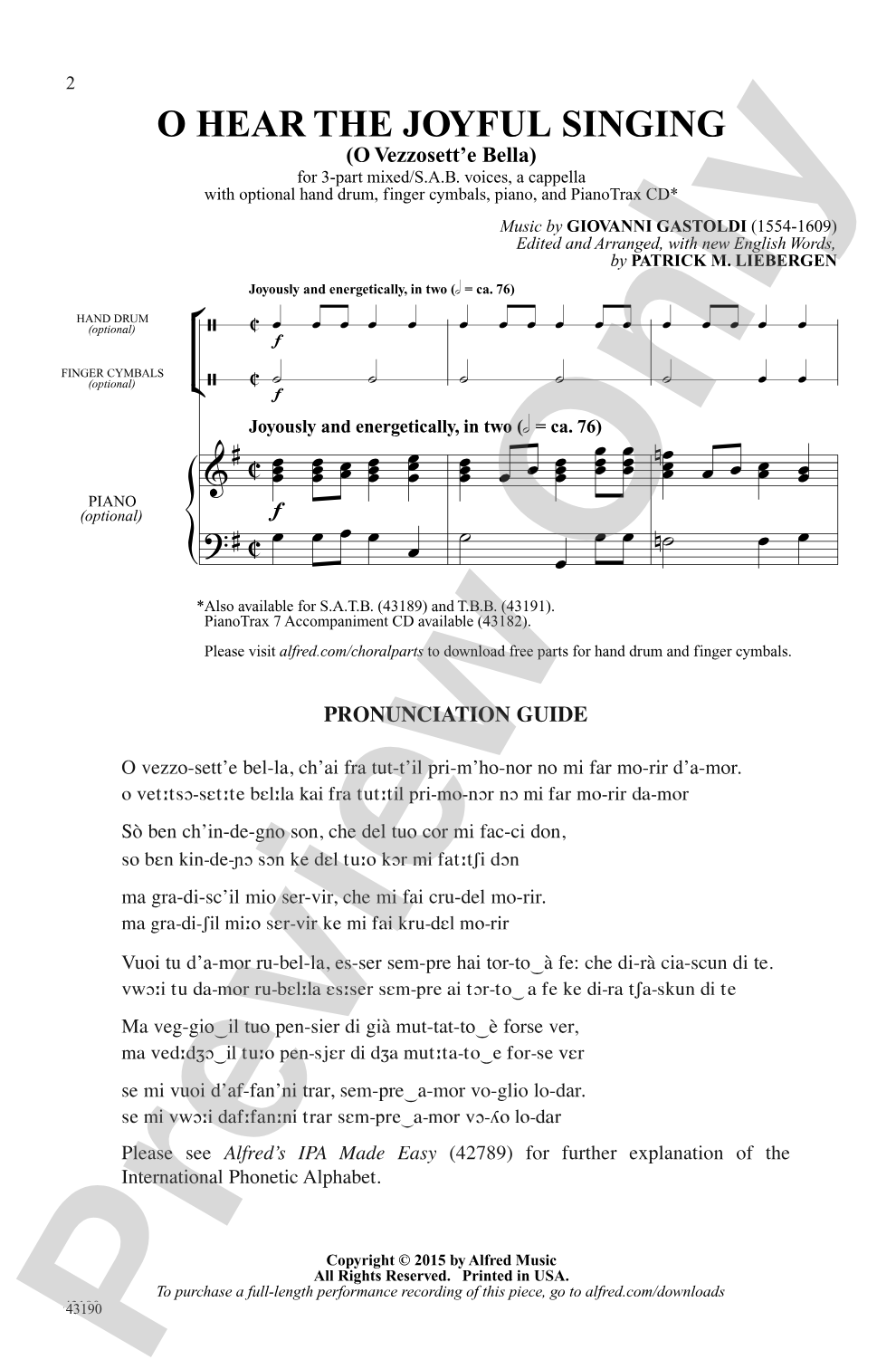
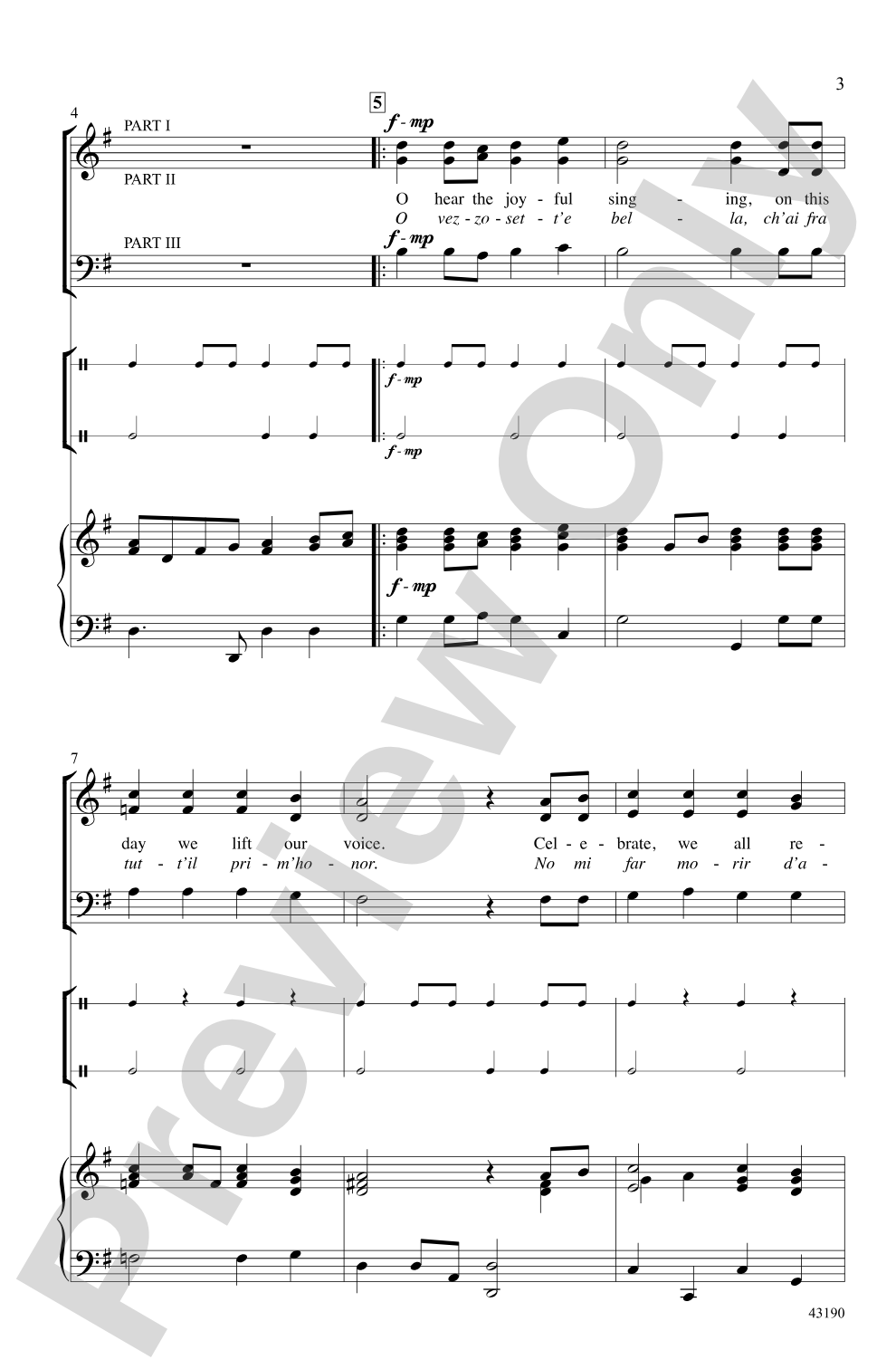

O Hear the Joyful Singing: 3-Part Mixed / SAB, a cappella Choral Octavo
(O Vezzosett'e Bella)
Music by Giovanni Gastoldi / ed. and arr., with new English words, by Patrick M. Liebergen
Item: 00-PO-0003190
$1.90
Minimum order quantity: 20 copies
Pickup currently not available
Related Items
O Hear the Joyful Singing: PianoTrax Digital Download |
$9.99
|
View | |
O Hear the Joyful Singing: SATB, a cappella Choral Octavo |
$1.90
|
View | |
O Hear the Joyful Singing: TBB, a cappella Choral Octavo |
$1.90
|
View | |
O Hear the Joyful Singing: SATB, a cappella Choral Octavo |
$1.90
|
View | |
O Hear the Joyful Singing: 3-Part Mixed / SAB, a cappella Choral Octavo |
$1.90
|
View | |
O Hear the Joyful Singing: TBB, a cappella Choral Octavo |
$1.90
|
View |
Description
Perform this buoyant Italian madrigal a cappella or accompanied by the optional piano, hand drum, and finger cymbals. The Baroque harmonies are easy to read and tune, and the 3-part mixed/SAB voicing includes several alternate notes to accommodate the vocal ranges of young men. May be sung in English, Italian, or a combination of both.


O Hear the Joyful Singing: 3-Part Mixed / SAB, a cappella Choral Octavo isn't in MakeMusic Cloud just yet...but it could be. Let us know you'd like to see it, and you'll help shape what comes next. In the meantime, start a free trial and dive into thousands of interactive titles your students can play along with today.
Request This Title
Tell us you want it.
Start Your Free Trial
Explore everything that's ready to play right now.
Sample Audio
1
Audio File
--:--
0:00
0:00
Sample Video
No sample videos found.
Additional Details
Series:
Alfred Choral Designs
Publisher:
Alfred Music
Page Count:
8
SKU:
00-PO-0003190
Instrumentation:
Opt. Piano, Hand Drum & Finger Cymbals
More about this title
About the Composer: Giovanni Gastoldi
Giovanni Gastoldi (c. 1554-1609) was a prolific Italian composer and maestro di cappella whose output shaped the sound of late Renaissance choral music. His gift for crafting melodies that sit naturally in the voice and his instinct for harmonic clarity made his works accessible to amateur singers while remaining musically sophisticated. Gastoldi's secular madrigals and balletti circulated widely throughout Europe, influencing both performers and composers in the centuries that followed.
Gastoldi spent much of his career in Mantua, one of Italy's most important musical centers. His secular works, particularly the balletti (a lighter cousin of the madrigal), earned him lasting recognition in choral pedagogy. The combination of memorable melody, transparent harmony, and singable vocal lines ensures that his music remains a staple for developing choirs learning how to balance part independence with ensemble blend.
Why we love this
Gastoldi's madrigal style delivers authentic Baroque flavor without the vocal gymnastics that can bog down young singers. Patrick Liebergen's arrangement preserves the elegant simplicity of the original while the optional accompaniments let you scale from pure a cappella to a fully supported performance, giving you genuine flexibility mid-season or across different ensemble levels.
What to expect
Bright and lilting, with an irresistible forward momentum that feels celebratory rather than heavy. The Baroque harmonies are warm and transparent, letting you hear every voice without strain, while the text about joyful singing gives the whole piece an infectious, almost communal spirit.
Who it's for
This arrangement serves developing choirs that are building confidence with part-singing and harmonic awareness. It works equally well for community choirs, school ensembles, and youth groups looking for repertoire that sounds polished without requiring advanced vocal technique.
How to get the most out of it
- Sing the text in Italian first to connect with the madrigal's rhythmic character and historical idiom, then add the English translation once the parts are solid. The language switch clarifies phrasing in ways that benefit both interpretation and tuning.
- Balance the optional percussion thoughtfully. Hand drum and finger cymbals should enhance the dance-like quality without overwhelming the voices; keep them light and rhythmically precise rather than steady.
- Shape phrases through subtle dynamics within each line rather than sudden changes. The Baroque harmonies stay in tune better when voices maintain consistent tone and let the harmony breathe naturally.
- Check the alternate notes provided for young men's voices and use them if needed. A singer who can access the line comfortably will always produce better sound than one stretched beyond their range.
How to use it
Program this alongside other Renaissance or Baroque vocal music for a focused thematic concert, or pair it with a more substantial choral work as an energizing opener or closer. The optional accompaniments make it flexible enough for a spring concert, holiday program, or informal chamber performance.
Skills your students will build
- Reading and performing in SAB voicing
- Tuning within transparent four-part Baroque harmony
- Sustaining independent vocal lines while maintaining ensemble blend
- Interpreting period-appropriate diction and phrasing in Italian and English
- Singing with consistent tone across comfortable and extended range (using provided alternate notes)