
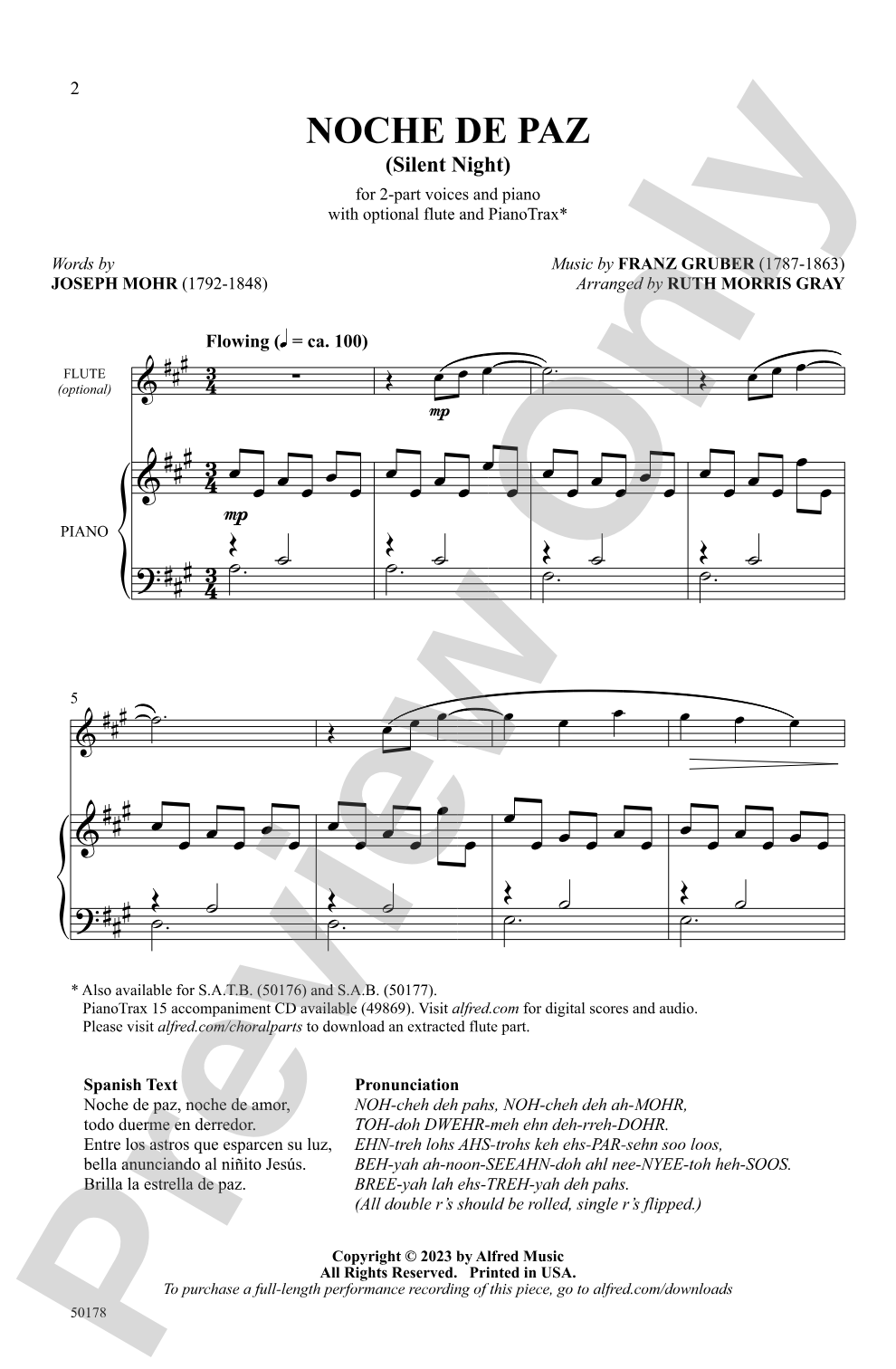
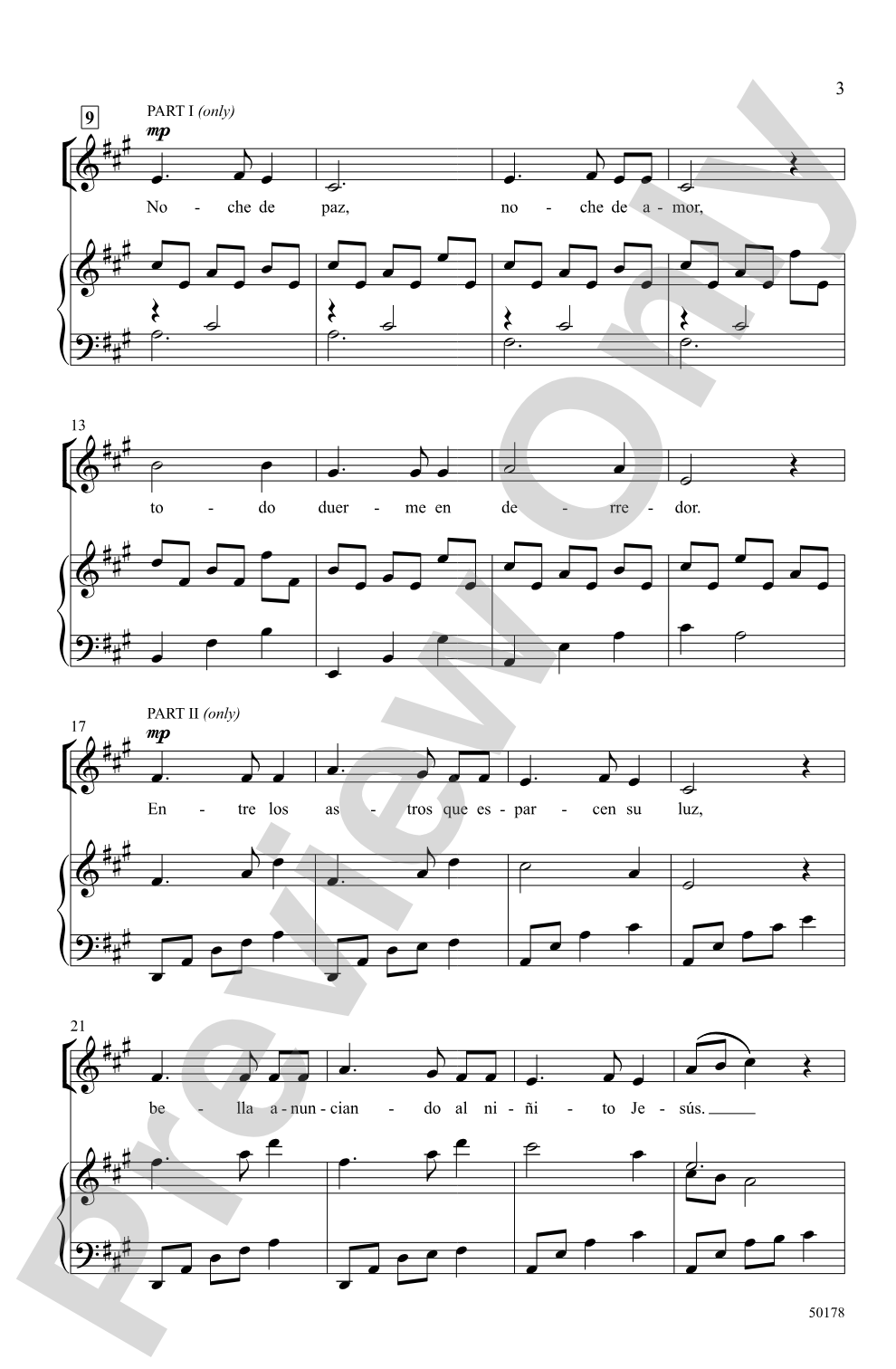

Noche de Paz: 2-Part Choral Octavo
(Silent Night)
Words by Joseph Mohr, music by Franz Gruber / arr. Ruth Morris Gray
Item: 00-PO-0007039
$2.05
Minimum order quantity: 20 copies
Pickup currently not available
Description
This bilingual arrangement of "Silent Night" alternates between Spanish and English verses. Ruth pays careful attention to expressive phrasing, voice leading, and tessitura, making it easy for school, community, and church choirs to prepare and perform. The flowing piano part and an optional flute obbligato bring a peaceful sense of reverence. Teach it this year and sing it for years to come.


Noche de Paz: 2-Part Choral Octavo isn't in MakeMusic Cloud just yet...but it could be. Let us know you'd like to see it, and you'll help shape what comes next. In the meantime, start a free trial and dive into thousands of interactive titles your students can play along with today.
Request This Title
Tell us you want it.
Start Your Free Trial
Explore everything that's ready to play right now.
Sample Audio
1
Audio File
--:--
0:00
0:00
Sample Video
Additional Details
Series:
Alfred Choral Designs
Publisher:
Alfred Music
Page Count:
12
SKU:
00-PO-0007039
More about this title
About the Composer: Franz Gruber
Franz Gruber (1787-1863) was an Austrian organist and composer whose modest output belies his lasting influence on sacred music. Though trained as a schoolmaster, Gruber's gifts as a musician led him to compose for church services and community gatherings in his native Tyrol. His most enduring contribution came in 1818 when, as organist at St. Nikolaus Church in Oberndorf, he composed the melody to Josef Mohr's poem "Stille Nacht" (Silent Night), creating one of the world's most beloved hymn tunes.
Why we love this
Ruth Morris Gray's arrangement respects Gruber's iconic melody while making it genuinely singable for mixed-ability choirs. The bilingual structure gives you natural programming flexibility for diverse communities, and the care taken with voice leading means your singers will experience the beauty of the arrangement, not struggle through it. You get a piece that sounds reverent without requiring advanced vocal technique.
What to expect
Peaceful and introspective, with warmth that comes from familiarity rather than sentimentality. The alternation between Spanish and English invites singers and listeners into a shared moment of quiet reflection, while the flowing piano accompaniment and optional flute create a luminous backdrop for the simple, powerful melody.
Who it's for
This works for school choirs in grades 5-12, community ensembles, and church musicians seeking accessible yet musically mature holiday literature. Whether your singers are reading music for the first time or performing with confidence, the thoughtful voicing and modest range make it genuinely manageable while remaining rewarding to prepare.
How to get the most out of it
- Shape the phrasing across the Spanish and English sections to maintain musical continuity even as the language changes. Avoid treating each language as a separate moment.
- Let the piano part breathe; it supports rather than drives the line. This allows the singers' voices to sit forward naturally.
- If using the optional flute obbligato, balance it carefully so it enhances the melody without competing for attention.
- Encourage singers to sustain long tones with steadiness rather than vibrato, which will keep the sound unified across the two-part writing.
How to use it
Use this as a centerpiece for December concert programming, particularly in schools and communities where bilingual repertoire strengthens cultural connection. It also pairs beautifully with other sacred or seasonal music as a closing moment that leaves audiences in a contemplative mood rather than high energy.
Skills your students will build
- Singing in Spanish with accurate vowel sounds and phrasing
- Blending two-part harmony while maintaining individual line integrity
- Sustained singing with steady tone across longer phrases
- Following expressive cues from piano accompaniment
- Language switching while maintaining musical continuity