
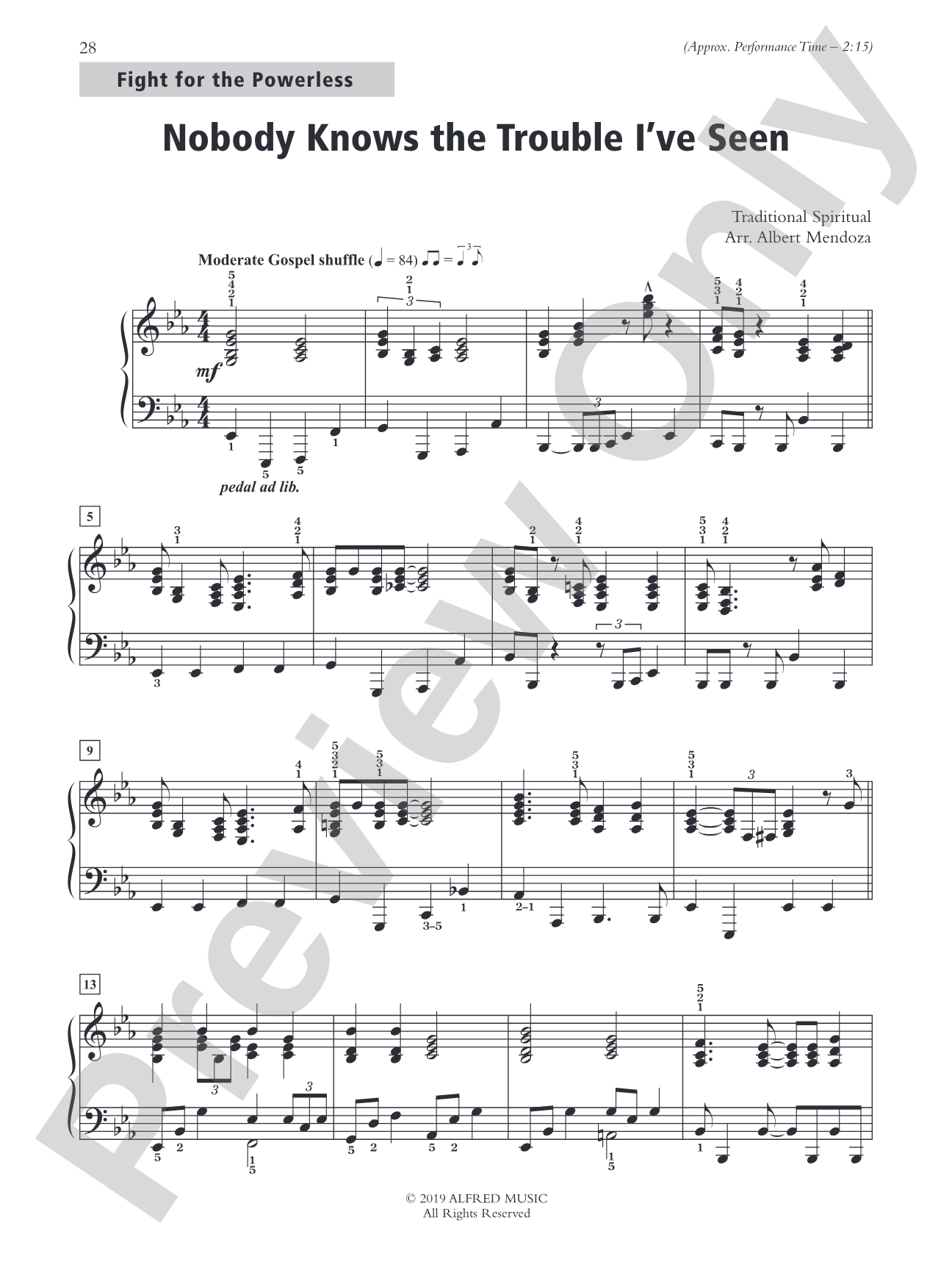

Nobody Knows the Trouble I’ve Seen - Piano Solo: Piano Solo
18 Arrangements Inspired by Universal Statements of Faith
Arranged by Albert Mendoza
Level: Early Advanced
Item: 00-PS-0017551
$4.99
Pickup currently not available
Related Items
Amazing Grace - Piano Solo: Piano Solo |
$4.99
|
View | |
Blest Be the Tie - Piano Solo: Piano Solo |
$4.99
|
View | |
Heaven and Earth, and Sea and Air - Piano Solo: Piano Solo |
$4.99
|
View | |
Lord, I Want to Be a Christian - Piano Solo: Piano Solo |
$4.99
|
View | |
Maitland - Piano Solo: Piano Solo |
$4.99
|
View | |
My Shepherd Is the Living God - Piano Solo: Piano Solo |
$4.99
|
View | |
Spirit of God, Descend Upon My Heart - Piano Solo: Piano Solo |
$4.99
|
View | |
The Lord Bless You and Keep You - Piano Solo: Piano Solo |
$4.99
|
View | |
We Gather Together (Medley) (Shall We Gather at the River / Let Us Break Bread Together / We Gather Together) - Piano Solo: Piano Solo |
$4.99
|
View | |
We Shall Overcome - Piano Solo: Piano Solo |
$4.99
|
View | |
Be the Church: Piano Book |
$14.99
|
View |
Description
These beautiful early advanced piano arrangements of beloved hymns and spirituals were inspired by universal statements of faith: protect the environment; care for the poor; forgive often; reject racism; fight for the powerless; share earthly and spiritual resources; embrace diversity; love God; and enjoy this life. Titles: Amazing Grace * Blest Be the Tie * Heaven and Earth, and Sea and Air * Here I Am, Lord * In the Bulb There Is a Flower * The Lord Bless You and Keep You * Lord, I Want to Be a Christian * Maitland * My Faith, It Is an Oaken Staff * My Shepherd Is the Living God * Nobody Knows the Trouble I've Seen * Spirit of God, Descend Upon My Heart * Stars and Planets Flung in Orbit * They'll Know We Are Christians by Our Love * Touch the Earth Lightly * We Gather Together (Medley) (Shall We Gather at the River / Let Us Break Bread Together / We Gather Together) * We Shall Overcome * Where Charity and Love Prevail. A Federation Festivals 2024-2028 selection.


Nobody Knows the Trouble I’ve Seen - Piano Solo: Piano Solo isn't in MakeMusic Cloud just yet...but it could be. Let us know you'd like to see it, and you'll help shape what comes next. In the meantime, start a free trial and dive into thousands of interactive titles your students can play along with today.
Request This Title
Tell us you want it.
Start Your Free Trial
Explore everything that's ready to play right now.
Sample Audio
1
1a Stars and Planets Flung in Orbit
--:--
2
1b Heaven and Earth and Sea and Air
--:--
3
2a Where Charity and Love Prevail
--:--
4
2b The Lord Bless You and Keep You
--:--
5
3a Lord I Want to Be a Christian
--:--
6
3b Spirit of God Descend Upon My Heart
--:--
7
4a Maitland
--:--
8
4b We Shall Overcome
--:--
9
5a Nobody Knows the Trouble I've Seen
--:--
10
5b My Faith It Is an Oaken Staff
--:--
11
6a We Gather Together (Medley)
--:--
12
6b Touch the Earth Lightly
--:--
13
7a They'll Know We Are Christians
--:--
14
7b Blest Be the Tie
--:--
15
8a Here I Am Lord
--:--
16
8b My Shepherd Is the Living God
--:--
17
9a Amazing Grace
--:--
18
9b In the Bulb There Is a Flower
--:--
1a Stars and Planets Flung in Orbit
0:00
0:00
Sample Video
No sample videos found.
Additional Details
Series:
Sacred Performer Collections
Publisher:
Alfred Music
Page Count:
60
SKU:
00-PS-0017551
More about this title
Why we love this
Mendoza's arrangements honor the spiritual and social weight of these texts without resorting to sentimentality. Each piece sits comfortably in the early advanced range, which means your students engage with real harmonic thinking and textural variety without drowning in technical demands. The thematic cohesion across the collection makes programming natural; you can pull individual pieces for specific liturgical moments or string several together for a recital that speaks clearly about faith and justice.
What to expect
Grounded and reflective. The writing respects the dignity of each melody while adding layers of harmonic color and pianistic texture that invite contemplation rather than virtuosic display. You'll find moments of brightness and moments of quiet introspection, with the overall arc suggesting both personal faith and communal purpose.
Who it's for
Advanced intermediate pianists preparing for festival competitions or church services, and instructors seeking repertoire that deepens students' connection between musical interpretation and textual meaning. This collection also works for pianists who want to expand their understanding of American spiritual and hymn traditions through arrangement.
How to get the most out of it
- Shape the hymn melodies with subtle dynamic contours; these arrangements trust the tune to carry meaning, so let it breathe rather than overstate it.
- Attend closely to the harmonic progressions in the left hand. Mendoza's voice leading often creates the emotional arc, particularly in pieces like "Lord, I Want to Be a Christian" and "Spirit of God, Descend Upon My Heart."
- Balance transparency with expression in the medley. The multiple tunes deserve space to emerge individually before the texture thickens.
- Practice the pedal changes deliberately. Sacred music of this kind benefits from clarity in the harmonic foundation.
How to use it
Frame this as a thematic program around faith and social witness. Pull two or three pieces to anchor a church service or recital, or use individual selections as interludes between spoken text about stewardship, inclusion, or peace. The medley works particularly well as a closing statement, drawing multiple traditions together.
Skills your students will build
- Harmonic analysis and voice leading in jazz-influenced and contemporary hymn contexts
- Pedal technique and timing to support sustained harmonic color
- Interpretive nuance in melody-driven arrangements with varied accompaniment textures
- Sight-reading of left-hand figuration with independent melodic fragments