
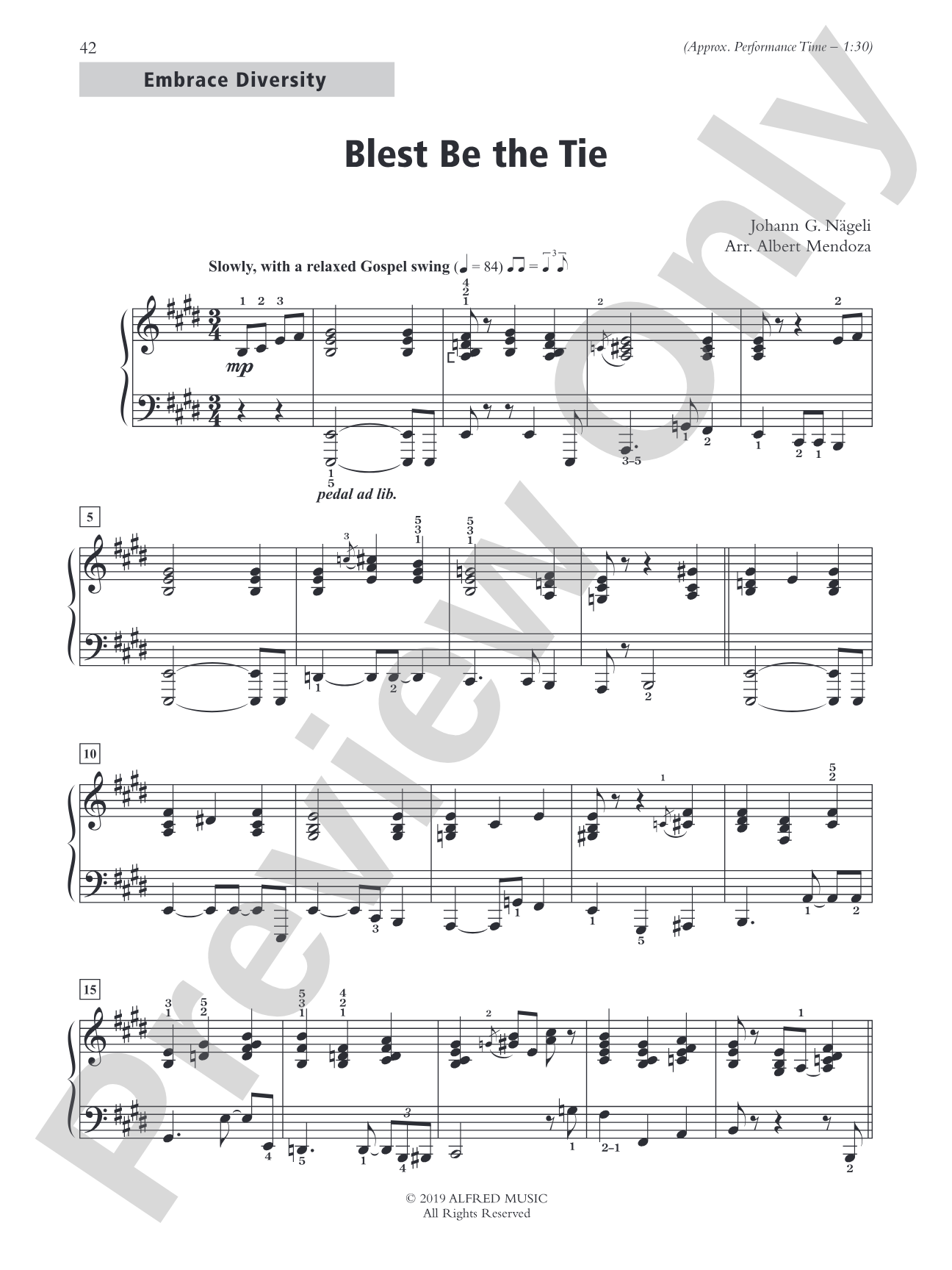

Blest Be the Tie - Piano Solo: Piano Solo
18 Arrangements Inspired by Universal Statements of Faith
Arranged by Albert Mendoza
Level: Early Advanced
Item: 00-PS-0017546
$4.99
Pickup currently not available
Related Items
Amazing Grace - Piano Solo: Piano Solo |
$4.99
|
View | |
Heaven and Earth, and Sea and Air - Piano Solo: Piano Solo |
$4.99
|
View | |
Lord, I Want to Be a Christian - Piano Solo: Piano Solo |
$4.99
|
View | |
Maitland - Piano Solo: Piano Solo |
$4.99
|
View | |
My Shepherd Is the Living God - Piano Solo: Piano Solo |
$4.99
|
View | |
Nobody Knows the Trouble I’ve Seen - Piano Solo: Piano Solo |
$4.99
|
View | |
Spirit of God, Descend Upon My Heart - Piano Solo: Piano Solo |
$4.99
|
View | |
The Lord Bless You and Keep You - Piano Solo: Piano Solo |
$4.99
|
View | |
We Gather Together (Medley) (Shall We Gather at the River / Let Us Break Bread Together / We Gather Together) - Piano Solo: Piano Solo |
$4.99
|
View | |
We Shall Overcome - Piano Solo: Piano Solo |
$4.99
|
View | |
Be the Church: Piano Book |
$14.99
|
View |
Description
These beautiful early advanced piano arrangements of beloved hymns and spirituals were inspired by universal statements of faith: protect the environment; care for the poor; forgive often; reject racism; fight for the powerless; share earthly and spiritual resources; embrace diversity; love God; and enjoy this life. Titles: Amazing Grace * Blest Be the Tie * Heaven and Earth, and Sea and Air * Here I Am, Lord * In the Bulb There Is a Flower * The Lord Bless You and Keep You * Lord, I Want to Be a Christian * Maitland * My Faith, It Is an Oaken Staff * My Shepherd Is the Living God * Nobody Knows the Trouble I've Seen * Spirit of God, Descend Upon My Heart * Stars and Planets Flung in Orbit * They'll Know We Are Christians by Our Love * Touch the Earth Lightly * We Gather Together (Medley) (Shall We Gather at the River / Let Us Break Bread Together / We Gather Together) * We Shall Overcome * Where Charity and Love Prevail. A Federation Festivals 2024-2028 selection.


Blest Be the Tie - Piano Solo: Piano Solo isn't in MakeMusic Cloud just yet...but it could be. Let us know you'd like to see it, and you'll help shape what comes next. In the meantime, start a free trial and dive into thousands of interactive titles your students can play along with today.
Request This Title
Tell us you want it.
Start Your Free Trial
Explore everything that's ready to play right now.
Sample Audio
1
1a Stars and Planets Flung in Orbit
--:--
2
1b Heaven and Earth and Sea and Air
--:--
3
2a Where Charity and Love Prevail
--:--
4
2b The Lord Bless You and Keep You
--:--
5
3a Lord I Want to Be a Christian
--:--
6
3b Spirit of God Descend Upon My Heart
--:--
7
4a Maitland
--:--
8
4b We Shall Overcome
--:--
9
5a Nobody Knows the Trouble I've Seen
--:--
10
5b My Faith It Is an Oaken Staff
--:--
11
6a We Gather Together (Medley)
--:--
12
6b Touch the Earth Lightly
--:--
13
7a They'll Know We Are Christians
--:--
14
7b Blest Be the Tie
--:--
15
8a Here I Am Lord
--:--
16
8b My Shepherd Is the Living God
--:--
17
9a Amazing Grace
--:--
18
9b In the Bulb There Is a Flower
--:--
1a Stars and Planets Flung in Orbit
0:00
0:00
Sample Video
No sample videos found.
Additional Details
Series:
Sacred Performer Collections
Publisher:
Alfred Music
Page Count:
60
SKU:
00-PS-0017546
More about this title
About the Composer: Johann G. Nägeli
Johann Georg Nägeli (1773, 1836) was a Swiss composer, music educator, and publisher whose work bridged the Classical and early Romantic periods. He championed music education for the general public and composed extensively in sacred genres, earning recognition for hymns and devotional music that combined accessibility with genuine artistic merit. His influence on congregational music remains substantial, particularly in Protestant traditions across Europe and North America.
Why we love this
Albert Mendoza's arrangements transform these hymns and spirituals into sophisticated solo vehicles without losing their spiritual core. The collection's thematic coherence around justice, stewardship, and human dignity gives recitals genuine substance, and the early advanced level makes these pieces achievable for serious students ready to interpret rather than simply read notation.
What to expect
Reverent without being heavy, accessible yet sophisticated. The writing honors the simplicity at the heart of each melody while opening its harmonic and textural possibilities, creating arrangements that feel both familiar and freshly discovered.
Who it's for
Advanced high school pianists and college-level students seeking repertoire with genuine musical substance and social meaning. Music teachers building recital programs that reflect values of justice, community, and faith will find these arrangements substantive enough to stand alongside secular repertoire.
How to get the most out of it
- Establish the hymn's congregational character first, then layer interpretive detail. These melodies carry deep communal meaning, so honor their directness before adding harmonic color.
- Study the harmonic language closely. Mendoza's arrangements likely expand Nägeli's original accompaniments; understanding where the arrangement moves beyond traditional harmony helps you shape those moments with intention.
- Balance legato phrasing against clear articulation of structural points. Spiritual and hymn texts have natural cadences and breathing points that should guide your pedaling decisions.
How to use it
Build a thematic recital around Mendoza's curated hymns and spirituals, pairing them with sacred music from other traditions or other early advanced repertoire that explores similar questions of justice and community. These 60 pages offer enough variety to anchor an entire concert or serve as a meaningful closing section within a larger program.
Skills your students will build
- Interpreting harmony beyond the lead line
- Sustaining legato texture across a full keyboard span
- Managing harmonic rhythm in slower-moving arrangements
- Connecting technical execution to textual meaning
- Stylistic awareness of sacred and spiritual music traditions