
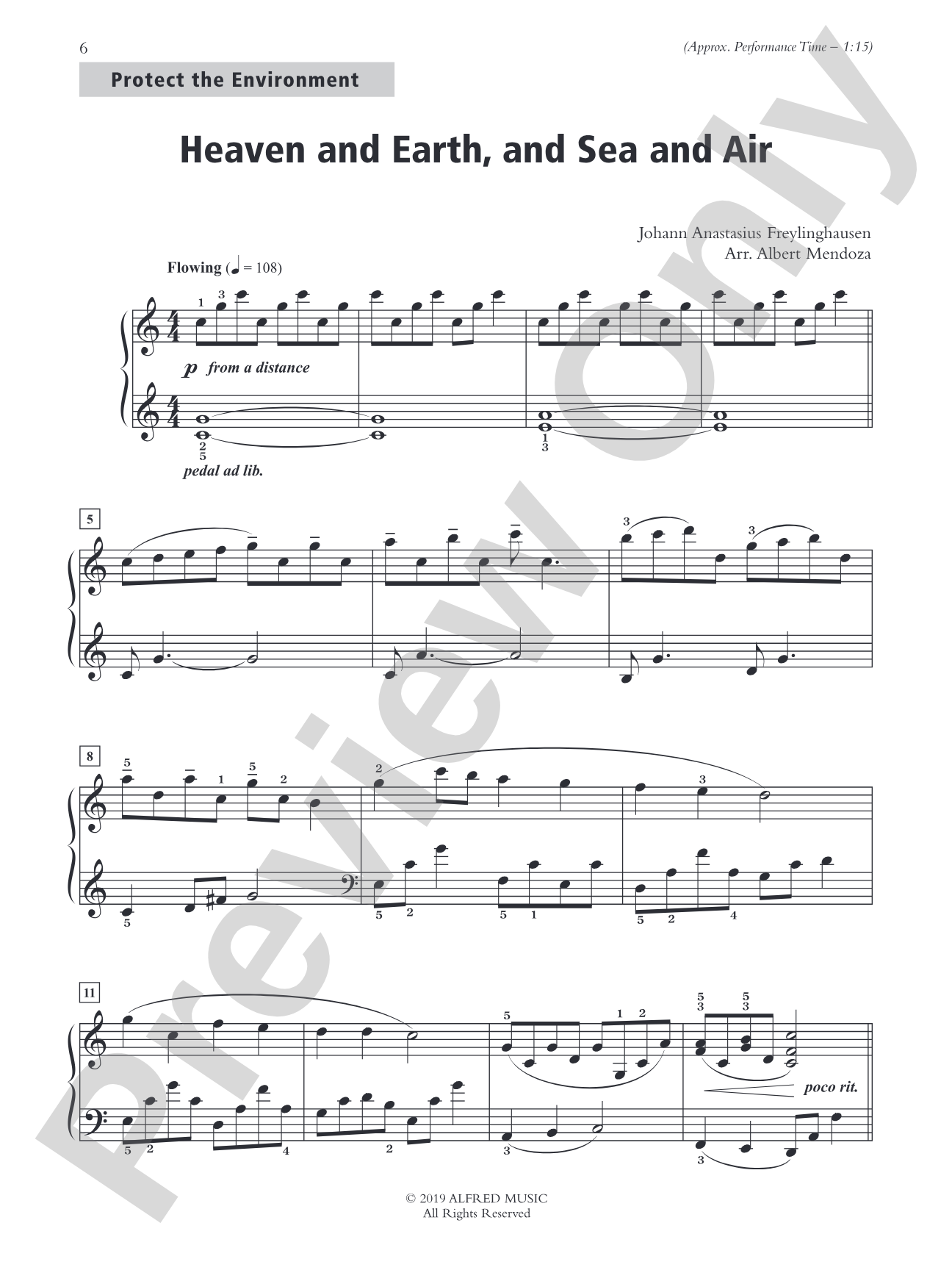

Heaven and Earth, and Sea and Air - Piano Solo: Piano Solo
18 Arrangements Inspired by Universal Statements of Faith
Arranged by Albert Mendoza
Level: Early Advanced
Item: 00-PS-0017547
$4.99
Pickup currently not available
Related Items
Amazing Grace - Piano Solo: Piano Solo |
$4.99
|
View | |
Blest Be the Tie - Piano Solo: Piano Solo |
$4.99
|
View | |
Lord, I Want to Be a Christian - Piano Solo: Piano Solo |
$4.99
|
View | |
Maitland - Piano Solo: Piano Solo |
$4.99
|
View | |
My Shepherd Is the Living God - Piano Solo: Piano Solo |
$4.99
|
View | |
Nobody Knows the Trouble I’ve Seen - Piano Solo: Piano Solo |
$4.99
|
View | |
Spirit of God, Descend Upon My Heart - Piano Solo: Piano Solo |
$4.99
|
View | |
The Lord Bless You and Keep You - Piano Solo: Piano Solo |
$4.99
|
View | |
We Gather Together (Medley) (Shall We Gather at the River / Let Us Break Bread Together / We Gather Together) - Piano Solo: Piano Solo |
$4.99
|
View | |
We Shall Overcome - Piano Solo: Piano Solo |
$4.99
|
View | |
Be the Church: Piano Book |
$14.99
|
View |
Description
These beautiful early advanced piano arrangements of beloved hymns and spirituals were inspired by universal statements of faith: protect the environment; care for the poor; forgive often; reject racism; fight for the powerless; share earthly and spiritual resources; embrace diversity; love God; and enjoy this life. Titles: Amazing Grace * Blest Be the Tie * Heaven and Earth, and Sea and Air * Here I Am, Lord * In the Bulb There Is a Flower * The Lord Bless You and Keep You * Lord, I Want to Be a Christian * Maitland * My Faith, It Is an Oaken Staff * My Shepherd Is the Living God * Nobody Knows the Trouble I've Seen * Spirit of God, Descend Upon My Heart * Stars and Planets Flung in Orbit * They'll Know We Are Christians by Our Love * Touch the Earth Lightly * We Gather Together (Medley) (Shall We Gather at the River / Let Us Break Bread Together / We Gather Together) * We Shall Overcome * Where Charity and Love Prevail. A Federation Festivals 2024-2028 selection.


Heaven and Earth, and Sea and Air - Piano Solo: Piano Solo isn't in MakeMusic Cloud just yet...but it could be. Let us know you'd like to see it, and you'll help shape what comes next. In the meantime, start a free trial and dive into thousands of interactive titles your students can play along with today.
Request This Title
Tell us you want it.
Start Your Free Trial
Explore everything that's ready to play right now.
Sample Audio
1
1a Stars and Planets Flung in Orbit
--:--
2
1b Heaven and Earth and Sea and Air
--:--
3
2a Where Charity and Love Prevail
--:--
4
2b The Lord Bless You and Keep You
--:--
5
3a Lord I Want to Be a Christian
--:--
6
3b Spirit of God Descend Upon My Heart
--:--
7
4a Maitland
--:--
8
4b We Shall Overcome
--:--
9
5a Nobody Knows the Trouble I've Seen
--:--
10
5b My Faith It Is an Oaken Staff
--:--
11
6a We Gather Together (Medley)
--:--
12
6b Touch the Earth Lightly
--:--
13
7a They'll Know We Are Christians
--:--
14
7b Blest Be the Tie
--:--
15
8a Here I Am Lord
--:--
16
8b My Shepherd Is the Living God
--:--
17
9a Amazing Grace
--:--
18
9b In the Bulb There Is a Flower
--:--
1a Stars and Planets Flung in Orbit
0:00
0:00
Sample Video
No sample videos found.
Additional Details
Series:
Sacred Performer Collections
Publisher:
Alfred Music
Page Count:
60
SKU:
00-PS-0017547
More about this title
About the Composer: Johann Anastasius Freylinghausen
Johann Anastasius Freylinghausen (1660-1739) was a German Reformed theologian and hymn writer whose vast collection of sacred texts shaped Protestant worship across Europe. His prolific output of nearly 1,400 hymns reflected his deep commitment to making faith accessible and singable for ordinary congregations, prioritizing clarity and emotional directness over complexity.
Freylinghausen's hymns endured for centuries because they paired theological substance with memorable melodies. Many have been translated, harmonized, and arranged countless times, making his work foundational to sacred music pedagogy and repertoire.
Why we love this
Albert Mendoza's arrangements honor these texts by deepening their spiritual resonance through elegant piano writing that never overshadows the hymns themselves. Each piece unfolds with restraint and purpose, allowing the sacred message to remain central while offering pianists substantive musical material that rewards careful listening and thoughtful interpretation. For programs exploring faith, justice, and community, this collection speaks directly to what you're trying to say.
What to expect
Contemplative and grounded. These arrangements create space for reflection rather than demonstrating virtuosity. You'll encounter thoughtful harmonic movement, gentle figuration, and moments of unexpected tenderness that invite the listener into genuine spiritual terrain.
Who it's for
Pianists at the early advanced level preparing for recitals, festivals, or church services where sacred music speaks to contemporary values. This collection also serves teachers looking for repertoire that combines technical growth with meaningful musical substance and spiritual depth.
How to get the most out of it
- Approach the harmonic language with deliberation. These arrangements often sit in extended harmonies that can sound precious if rushed; give each chord room to breathe.
- Let the text underlying each hymn inform your phrasing, even though you're playing piano solo. The natural speech patterns of the lyrics shape where you'll breathe and where tension builds.
- Balance transparency with depth. The early advanced level permits rubato and interpretive freedom, but avoid obscuring the hymn tune itself with excessive pedal or flourish.
- Study the original hymn versions before diving into these arrangements. Understanding the congregational context will deepen your choices about tempo, dynamic shape, and emotional arc.
How to use it
String these pieces together for a complete recital devoted to faith, justice, and environmental stewardship. The variety of moods and texts makes them natural for thematic programming; pair them with spoken readings addressing the concerns named in the collection's subtitle, or include them in a service addressing peace and community care.
Skills your students will build
- Interpreting text-informed musical phrasing without singing
- Managing rubato within hymn-based structures
- Voicing extended harmonies with clarity and sensitivity
- Sustaining slow tempos without losing momentum
- Understanding the relationship between sacred text and musical form