
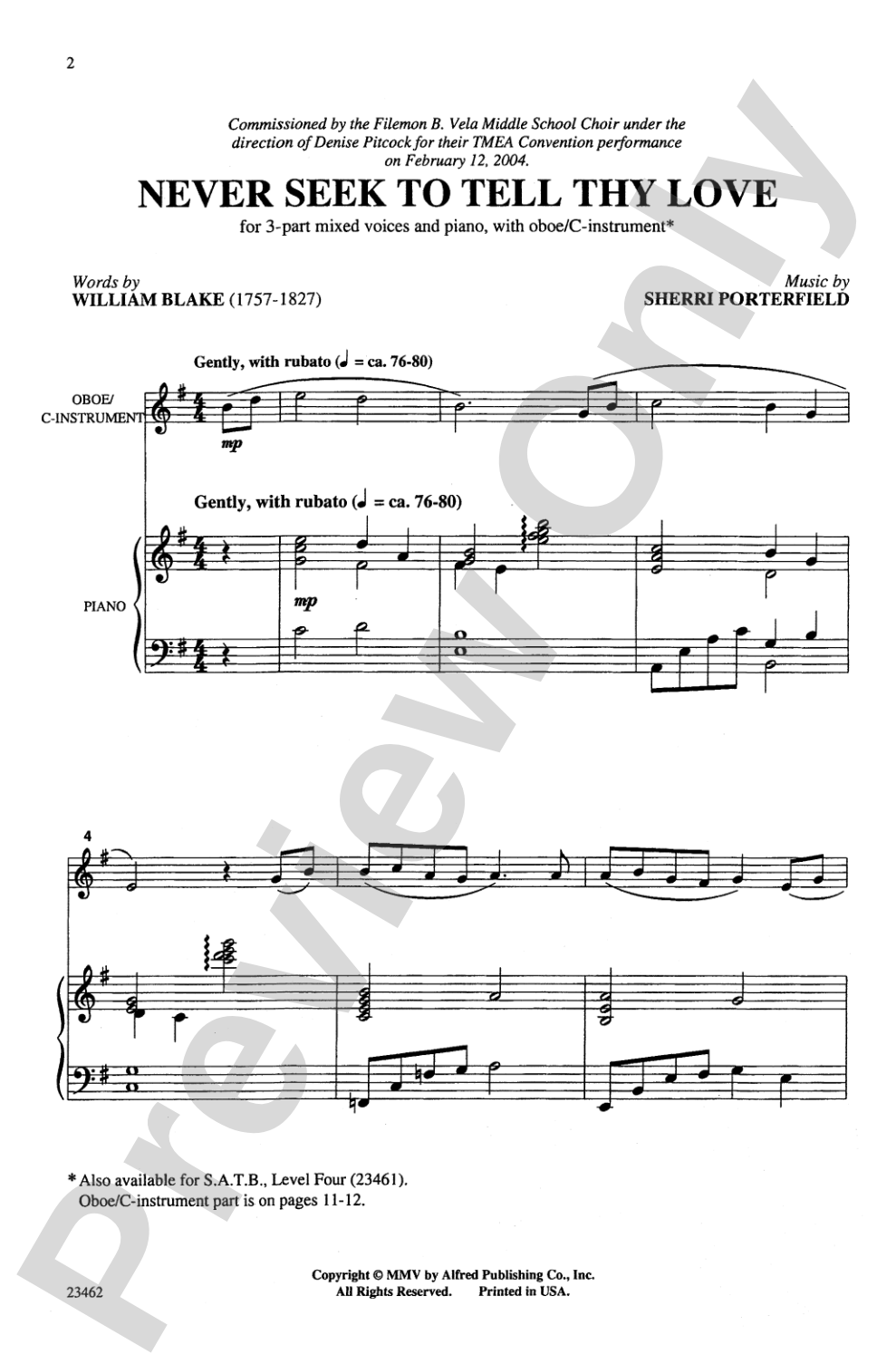
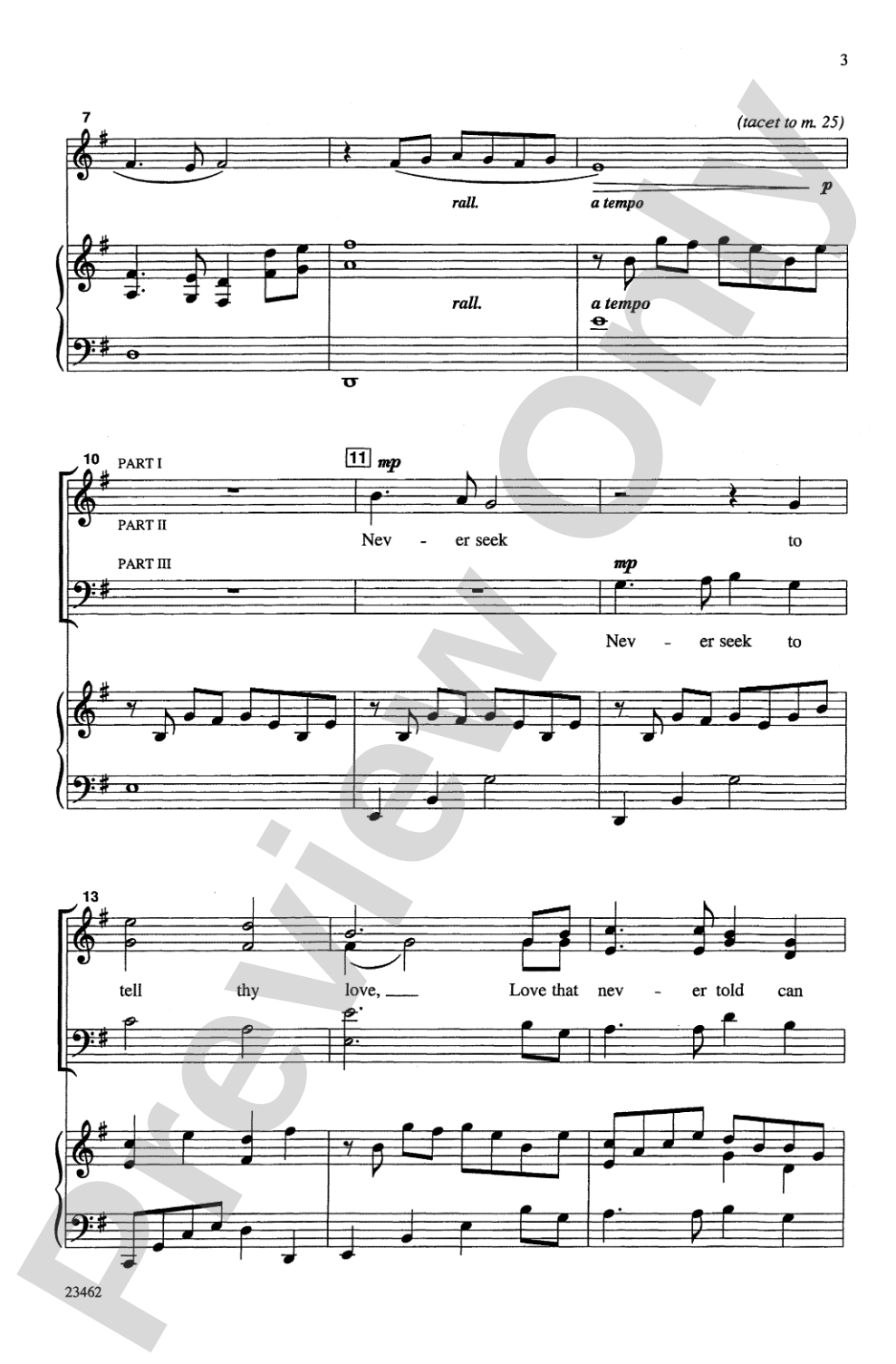
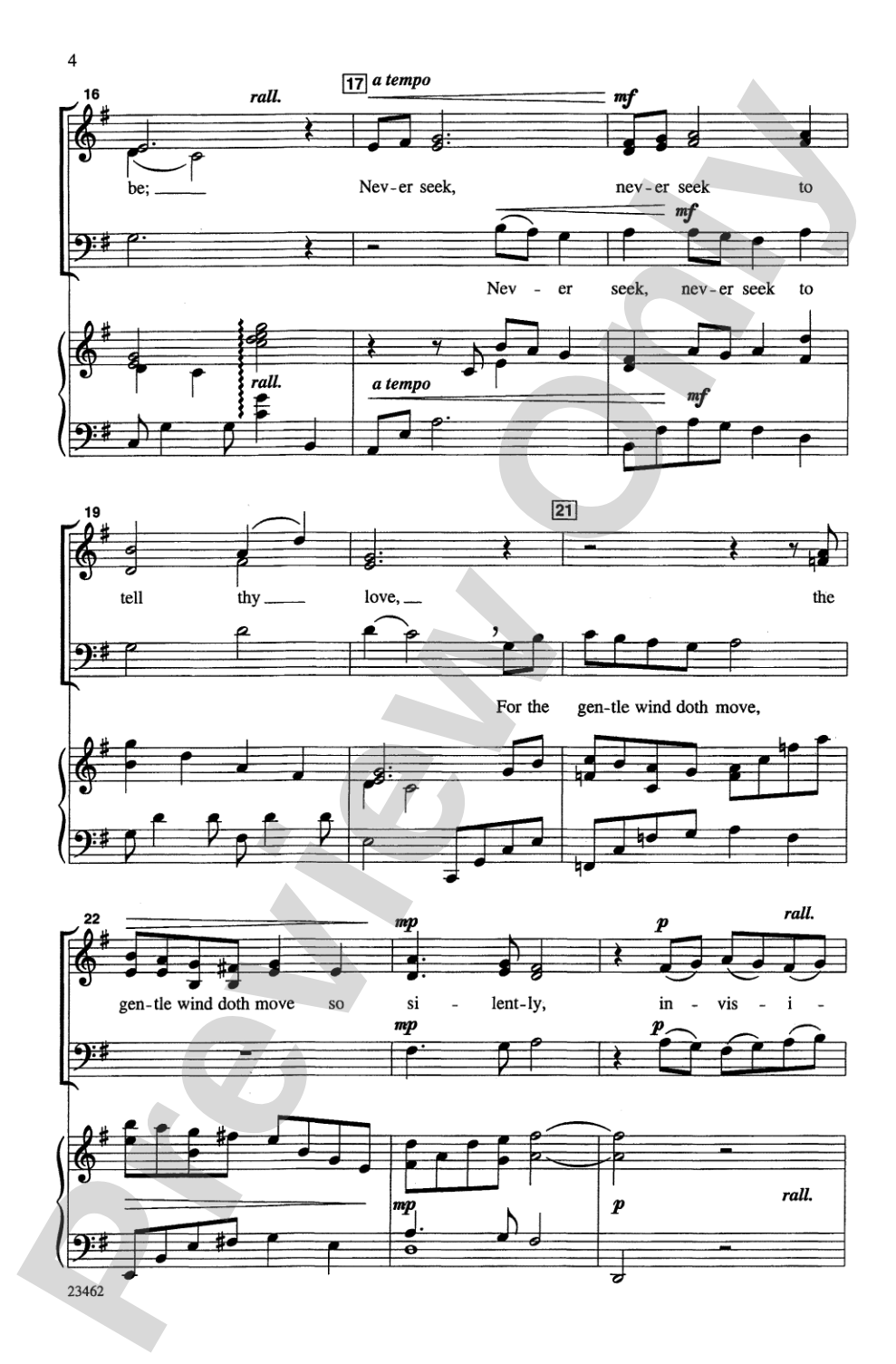

Never Seek to Tell Thy Love: 3-Part Mixed Choral Octavo
Music by Sherri Porterfield
Item: 00-PO-0002908
$2.25
Minimum order quantity: 20 copies
Pickup currently not available
Description
The heartfelt poetry of William Blake is artfully transformed into a stunning choral work with expressive rubato, breathtaking suspensions, and colorful text painting. Effective for adjudication and memorable in concert. Features a sublime oboe/C-instrument part that brilliantly compliments the mature choral phrases and fluid piano accompaniment.


Never Seek to Tell Thy Love: 3-Part Mixed Choral Octavo isn't in MakeMusic Cloud just yet...but it could be. Let us know you'd like to see it, and you'll help shape what comes next. In the meantime, start a free trial and dive into thousands of interactive titles your students can play along with today.
Request This Title
Tell us you want it.
Start Your Free Trial
Explore everything that's ready to play right now.
Sample Audio
1
Audio File
--:--
0:00
0:00
Sample Video
No sample videos found.
Additional Details
Series:
Alfred Archive Edition: Alfred Choral Designs
Publisher:
Alfred Music
Page Count:
12
SKU:
00-PO-0002908
Instrumentation:
Opt. Oboe/C-Instrument
More about this title
About the Composer: Sherri Porterfield
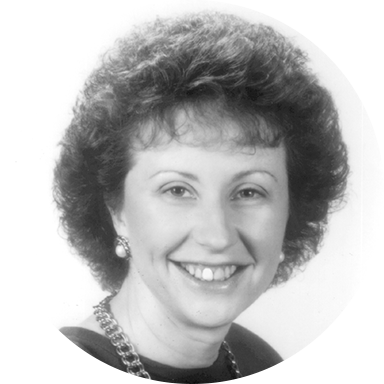
Sherri Porterfield directs choirs at Cedar Park Middle School in Cedar Park, Texas, and has shaped competitive programs across Missouri and Kansas, earning sweepstakes awards and state convention appearances. She has taught as an adjunct assistant professor of music education at the University of Missouri-Kansas City Conservatory and worked as a clinician and guest conductor with honor choirs throughout the United States.
With over 175 published choral compositions, Porterfield has received annual ASCAP awards for her writing since 1997 and is represented by Alfred Music Publishing and other major publishers. She holds a B.S.E. in music education from the University of Memphis and a Master of Music in choral conducting from the University of Missouri-Kansas City, and has been recognized multiple times in Who's Who honors and as Teacher of the Year.
Why we love this
The suspension-laden harmonic language and rubato phrasing elevate Blake's text without overwhelming a three-part mixed ensemble, creating something that sounds mature without demanding advanced voices. This is one of those pieces that stands out in adjudication because it balances poetic sensitivity with genuine choral writing—the optional oboe part adds sophistication without becoming a distraction from the singers' work.
What to expect
Intimate and introspective, with a lyrical quality that invites listeners into Blake's emotional landscape. The suspensions and harmonic color create moments of beautiful tension and release, while the flowing piano accompaniment and optional oboe line suggest depth and refinement.
Who it's for
Three-part mixed choirs ready to move beyond simple arrangements into more sophisticated harmonic territory. Directors seeking repertoire for contest and concert that displays vocal maturity and musicality without requiring soloistic performers.
How to get the most out of it
- Honor the expressive rubato written into the score by allowing the chorus to breathe through Blake's language; resist the urge to lock into strict time.
- Balance the oboe or C-instrument part carefully during full passages so it enriches rather than overwhelms the three vocal lines.
- Shape the suspensions deliberately; let them land with intention so the resolutions feel earned and not rushed.
- Explore the text painting moments to help singers understand how the music reinforces Blake's imagery and emotion.
How to use it
Pair this with contrasting lighter fare to let its expressive character shine, or program it early in a concert to establish sophistication and set an artistic tone. Its twelve pages and medium length make it ideal for February or spring concerts when directors want substantial work without overextending rehearsal time.
Skills your students will build
- Singing through suspensions and harmonic tension
- Interpreting and executing expressive rubato in ensemble
- Blending three-part mixed voicing with dynamic and textural control
- Coordinating with optional instrumental part while maintaining vocal independence
- Text painting and connecting poetic language to musical gesture