
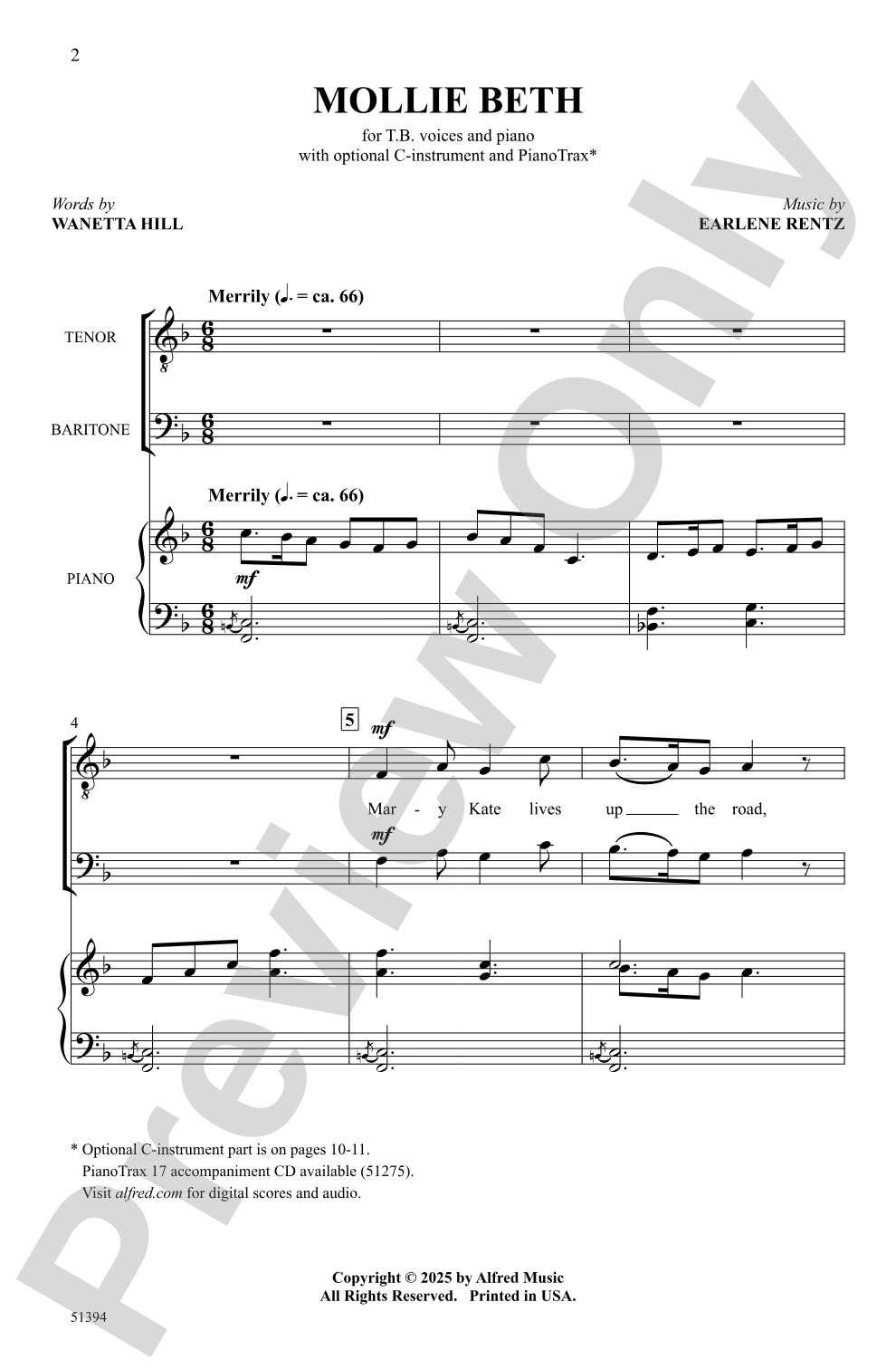
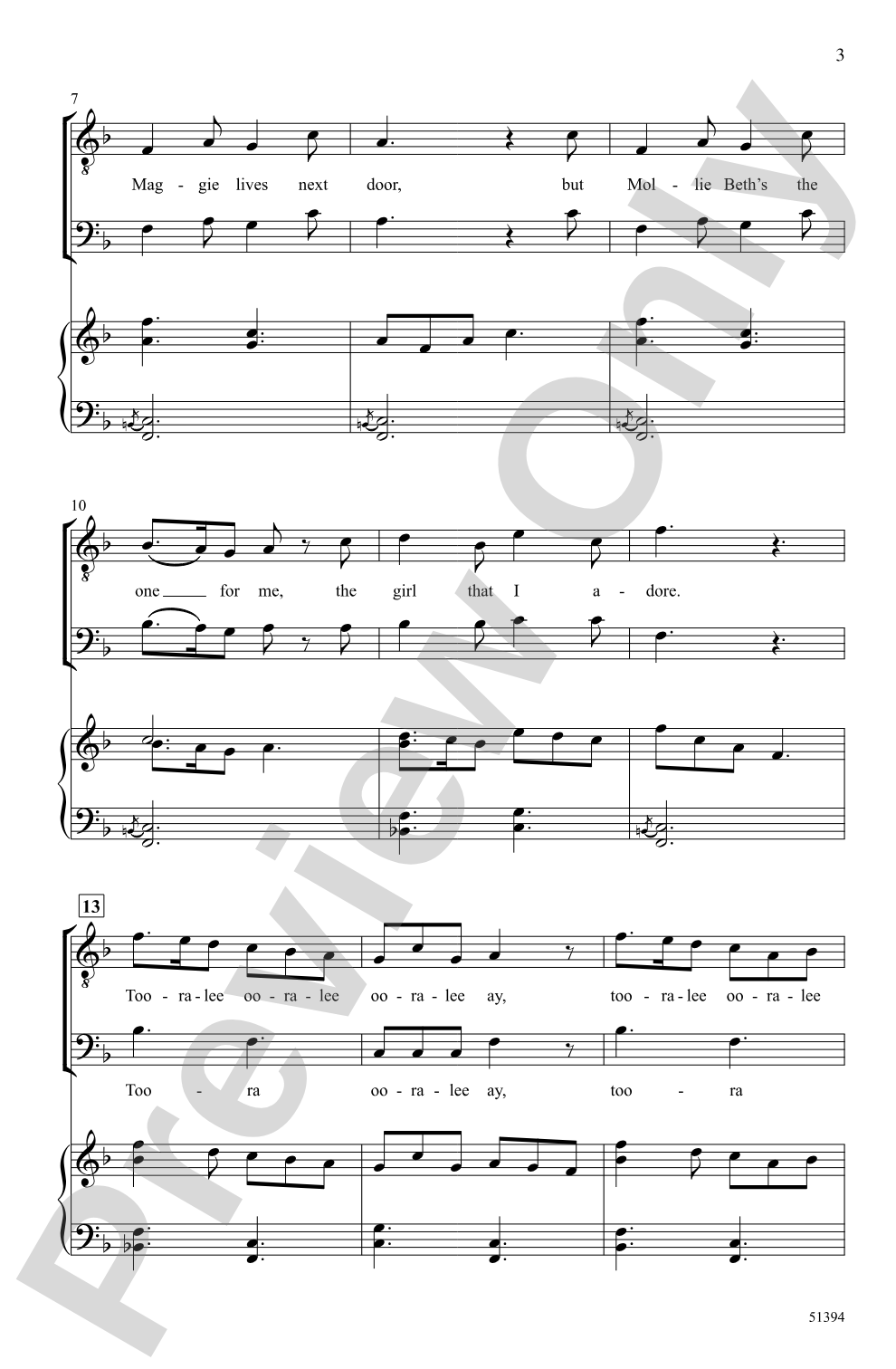

Mollie Beth: TB Choral Octavo
Words by Wanetta Hill, music by Earlene Rentz
Item: 00-PO-0007423
$2.30
Minimum order quantity: 20 copies
Pickup currently not available
Description
Here's a Celtic-style original crafted with developing tenor-bass choirs in mind! Conservative ranges, a lilting 6/8 time signature, a catchy "too-ra-lee-ay" refrain, and just the right amount of repetition make this fun for changing and changed voices. Invite a student to play the optional C-instrument which heightens the British Isles appeal.


Mollie Beth: TB Choral Octavo isn't in MakeMusic Cloud just yet...but it could be. Let us know you'd like to see it, and you'll help shape what comes next. In the meantime, start a free trial and dive into thousands of interactive titles your students can play along with today.
Request This Title
Tell us you want it.
Start Your Free Trial
Explore everything that's ready to play right now.
Sample Audio
1
Audio File
--:--
0:00
0:00
Sample Video
Additional Details
Series:
Alfred Choral Designs
Publisher:
Alfred Music
Page Count:
12
SKU:
00-PO-0007423
Instrumentation:
C-instrument
More about this title
About the Composer: Earlene Rentz
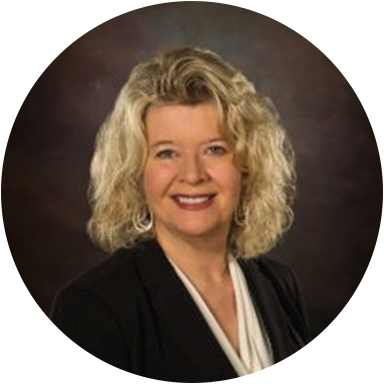
Earlene Rentz has spent her career bridging the gap between pedagogy and composition. She taught choral music across all levels in public schools for seven years, then moved into higher education where she taught choral music education courses for twelve years. Her deep familiarity with how singers actually develop informs every piece she writes.
Rentz has conducted All-State Choirs throughout the Southeast, bringing her expertise to Georgia, Florida, Kentucky, and Alabama. She has published over 700 choral compositions across 17 different publishers, establishing herself as a prolific voice in accessible choral writing.
Why we love this
Rentz understands developing tenor-bass choirs in a way that shows in every choice here: conservative ranges, natural phrasing, and a rhythm in 6/8 that feels lilting without demanding complex articulation. The "too-ra-lee-ay" refrain is genuinely catchy and gives your singers something memorable to hold onto. Adding a C-instrument part gives your program an authentic Celtic color and pulls in any instrumentalists sitting in your rehearsal.
What to expect
Imagine standing at a crossroads in the Irish countryside, where a folk melody drifts from a nearby cottage. The rhythm is unhurried and warm, carrying that distinctive Celtic character without feeling precious or overly arranged. Your singers will hear themselves singing something genuinely lyrical, not just reciting notes.
Who it's for
This works beautifully for developing tenor-bass choirs with singers whose voices are still settling. The conservative ranges and straightforward vocal writing let singers focus on blend and tuning rather than struggling with extremes. It's equally at home in a school program with freshman boys, a community choir, or any mixed ensemble with a strong lower voice section.
How to get the most out of it
- Let the 6/8 meter breathe. The piece moves in two rather than six, so shape phrases to emphasize the gentle lilt without rushing the pulse.
- Build the refrain energy gradually. Early repetitions can sit back; let enthusiasm build toward the final statements so the piece doesn't wear thin by the end.
- If you have a C-instrument player, give them prominence during the refrain. That whistle or recorder line is the piece's signature sound and deserves to sit slightly forward in the mix.
How to use it
Program this as a standalone feature that showcases your developing singers without apology. It pairs well alongside more traditional choral repertoire since its folk identity gives your concert program geographic and stylistic variety. The optional C-instrument also makes it a natural pairing with any concert that celebrates folk music or cultural traditions.
Skills your students will build
- Singing in compound meter (6/8) with proper phrasing and lilt
- Blending and balancing in lower voice ranges
- Sustaining pitch and intonation with conservative vocal demands
- Ensemble unity through repetition and catchy melodic material
- Collaborating with optional instrumental doubling