
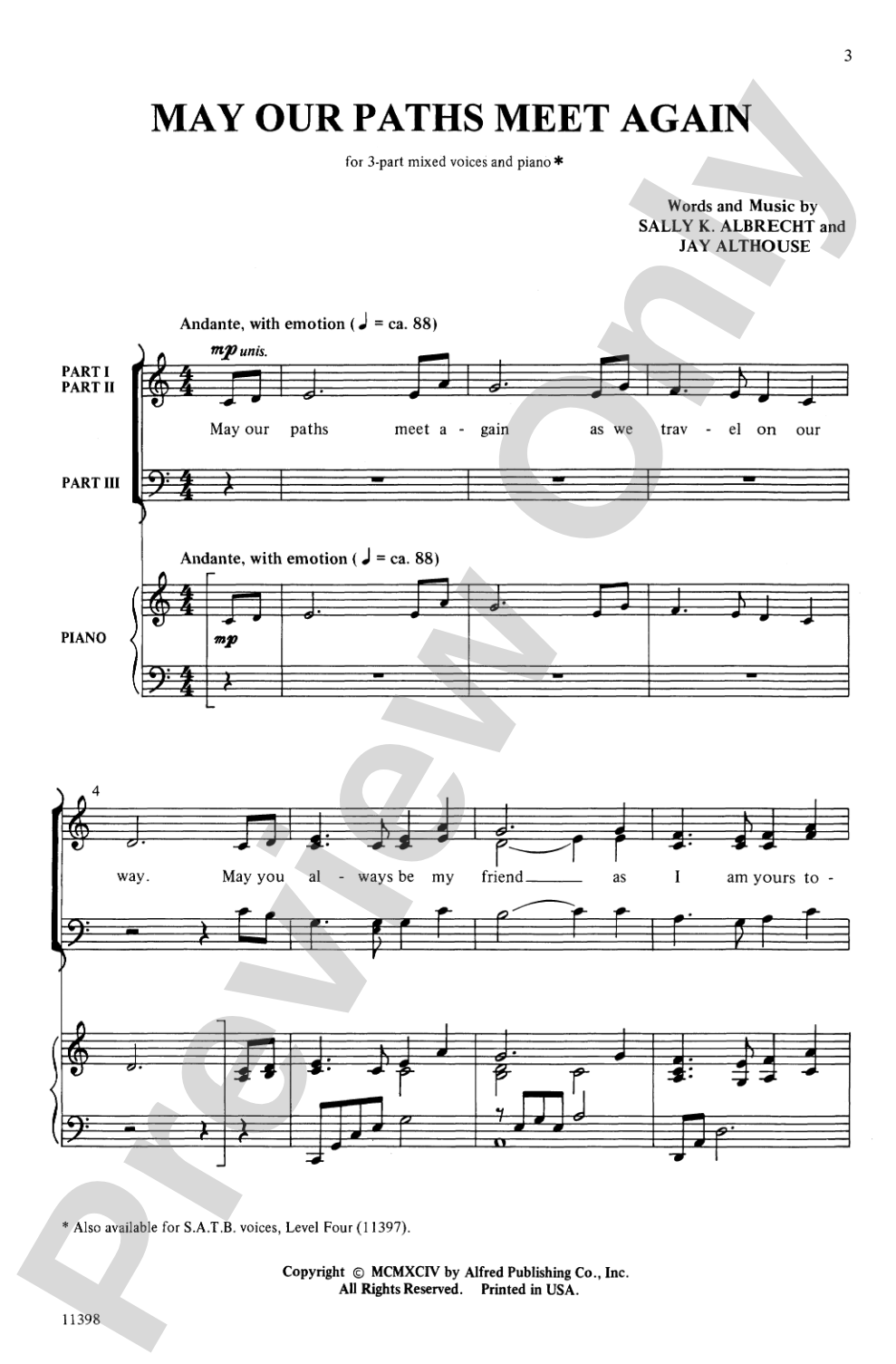

May Our Paths Meet Again: 3-Part Mixed Choral Octavo
Music by Sally K. Albrecht and Jay Althouse
Item: 00-PO-0003813
$2.25
Minimum order quantity: 20 copies
Pickup currently not available
Description
A simple four-measure a cappella opening develops slowly and meaningfully into a gorgeous ballad of farewell. "I know you must travel your road as I must travel mine, but may our paths meet again sometime." Of course, it's an obvious choice for graduation, baccalaureate or end-of-year concerts, but we also recommend it as a closer for any concert. It just might become your choir's traditional encore.


May Our Paths Meet Again: 3-Part Mixed Choral Octavo isn't in MakeMusic Cloud just yet...but it could be. Let us know you'd like to see it, and you'll help shape what comes next. In the meantime, start a free trial and dive into thousands of interactive titles your students can play along with today.
Request This Title
Tell us you want it.
Start Your Free Trial
Explore everything that's ready to play right now.
Sample Audio
No sample audio found.
Sample Video
No sample videos found.
Additional Details
Series:
Alfred Archive Edition: Alfred Choral Designs
Publisher:
Alfred Music
Page Count:
8
SKU:
00-PO-0003813
More about this title
About the Composer: Sally K. Albrecht
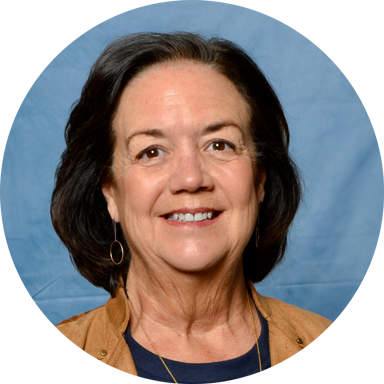
Sally K. Albrecht has shaped American choral music for decades as a composer, conductor, and clinician with a particular gift for integrating movement into choral performance. Since 1987, she has received the ASCAP Special Music Award annually, and her catalog now includes more than 600 choral publications alongside 75 full-length musicals and songbooks. Her conducting experience spans prestigious venues including Lincoln Center, Carnegie Hall, and The Kennedy Center, where she has led honor choirs and festivals across the country.
For over 30 years, Albrecht directed school choral and vocal publications for major educational music publishers, including Alfred Music, bringing her pedagogical expertise directly to teachers and students. She earned her B.A. from Rollins College in Music and Theater, then completed both an M.A. in Drama and an M.M. in Accompanying at the University of Miami. In 2021, she received the Distinguished Alumna Award from both institutions. She currently resides in Wake Forest, North Carolina, with her husband, composer and arranger Jay Althouse.
Why we love this
Albrecht and Althouse craft a piece with genuine emotional weight that doesn't rely on complexity to move singers and audiences. The journey from spare, intimate four-measure opening to full-voiced ballad creates a natural arc that feels earned rather than manipulative, making it equally powerful in a graduation ceremony or as an unexpected concert finale.
What to expect
The opening feels like the moment just before saying goodbye, spare and vulnerable. As the piece unfolds into fuller harmony, it settles into the quiet dignity of an accepted parting, with a melody that carries both sadness and hope.
Who it's for
This piece suits any mixed-voice choir with a cappella confidence and the maturity to hold emotional silence. Directors seeking a meaningful closer that works equally well for graduation ceremonies, spring concerts, or end-of-year celebrations will find exactly the right balance of accessibility and depth.
How to get the most out of it
- Shape the opening four measures with restraint; the simplicity is the strength. Let each voice entry feel like a quiet conversation rather than a formal entrance.
- Balance the three parts evenly during the transition so no single voice dominates the gradual development. This registers as organic growth rather than text-book modulation.
- Sustain the text with genuine legit tone through the ballad section; avoid oversinging or adding unnecessary vibrato that clouds the farewell message.
- Consider the final cadence as a moment of release rather than arrival. Let the voices settle into stillness so the last sound lingers in the room.
How to use it
Position this as your final selection of any spring or year-end concert; its emotional landscape makes it feel both celebratory and reflective. The piece also serves concert programming well when paired with more energetic material earlier in the set, as it provides genuine closure without sentimentality.
Skills your students will build
- Sustaining long phrases without accompaniment support
- Balancing three-part SAB voicing with equal voice blend
- Interpreting text with emotional authenticity rather than technical display
- Building harmonic awareness through gradual chord development
- Managing silence and pacing to allow meaning to land