
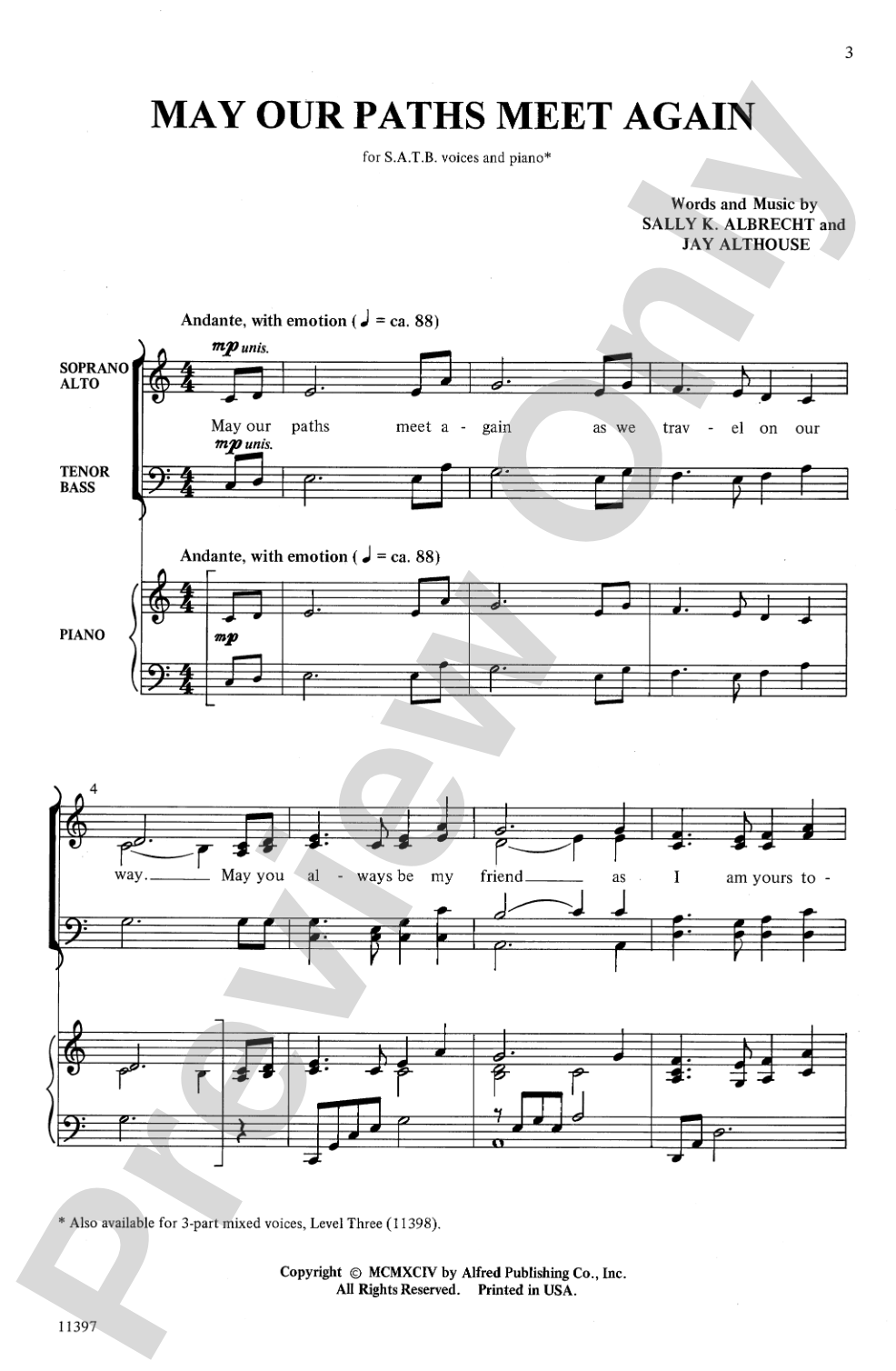

May Our Paths Meet Again: SATB Choral Octavo
Music by Sally K. Albrecht and Jay Althouse
Item: 00-PO-0003812
$2.25
Minimum order quantity: 20 copies
Pickup currently not available
Description
A simple four-measure a cappella opening develops slowly and meaningfully into a gorgeous ballad of farewell. "I know you must travel your road as I must travel mine, but may our paths meet again sometime." Of course, it's an obvious choice for graduation, baccalaureate or end-of-year concerts, but we also recommend it as a closer for any concert. It just might become your choir's traditional encore.


May Our Paths Meet Again: SATB Choral Octavo isn't in MakeMusic Cloud just yet...but it could be. Let us know you'd like to see it, and you'll help shape what comes next. In the meantime, start a free trial and dive into thousands of interactive titles your students can play along with today.
Request This Title
Tell us you want it.
Start Your Free Trial
Explore everything that's ready to play right now.
Sample Audio
No sample audio found.
Sample Video
No sample videos found.
Additional Details
Series:
Alfred Archive Edition: Alfred Choral Designs
Publisher:
Alfred Music
Page Count:
8
SKU:
00-PO-0003812
More about this title
About the Composer: Sally K. Albrecht
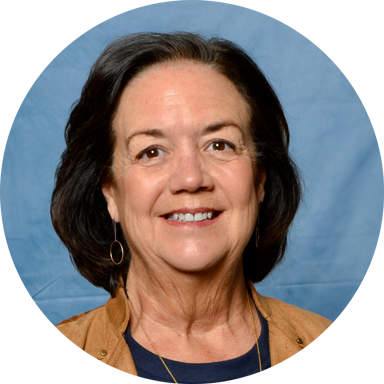
Sally K. Albrecht has shaped American choral music for over three decades as both a composer and advocate for meaningful vocal literature. Since 1987, she has received the ASCAP Special Music Award annually, and her catalog includes more than 600 choral publications alongside 75 songbooks and musicals. Her work with school and community choirs led to conducting appointments at prestigious venues including Lincoln Center, Carnegie Hall, and The Kennedy Center. She served as Director of School Choral, Vocal, and Elementary Publications for major educational publishers, most recently Alfred Music, where her influence on accessible, artistically rich repertoire shaped generations of choir programs.
Albrecht holds degrees from Rollins College (B.A. in Music and Theater, 1976), the University of Miami (M.A. in Drama, 1977; M.M. in Accompanying, 1979), and has taught at Oakland University, Jersey City State College, and Meredith College. A native of Cleveland, Ohio, she collaborated with composer and arranger Jay Althouse, her husband, on numerous works. Her leadership extended beyond composition to roles including Chair of the Board of Trustees for the Omicron Delta Kappa National Leadership Honor Society. In 2021, she received the Distinguished Alumna Award from both the University of Miami Frost School of Music and Rollins College.
Why we love this
This piece moves with genuine emotional weight without requiring complex harmonic or rhythmic demands from your singers. The text captures a universal moment of transition with dignity and warmth, giving every choir member meaningful music to voice. It earned its reputation as an encore staple because it speaks to any ensemble's experience of change, change that deserves more than sentiment—it deserves this kind of honest, beautiful closure.
What to expect
The opening a cappella gestures feel intimate and grounded, almost conversational, before the piece unfolds into a warm, gently expansive ballad. There's a quality of acceptance in the harmonic movement and melodic contour—neither yearning nor sad, but rather peaceful and grounded. Singers experience the architecture of emotional maturity, moving from restraint into something fuller without ever losing grace.
Who it's for
This octavo serves directors seeking meaningful choral repertoire for graduation ceremonies, baccalaureate services, and concert closings. Choirs at intermediate to advanced levels will find the SATB voicing straightforward enough to prepare efficiently while maintaining musical integrity.
How to get the most out of it
- Shape the opening a cappella measures with care. The simplicity of those first four measures sets the emotional foundation for everything that follows; slight dynamic shaping and phrase breathing will ensure clarity without overwrought expression.
- Balance the SATB texture so that no single voice dominates the melodic line. The piece's strength lies in the collective sound rather than featured voices, particularly as the ballad develops.
- Allow the piece to breathe at structural moments. Strategic pauses and gentle releases between phrases will deepen the contemplative mood and prevent the music from rushing emotionally.
- Connect the text to genuine farewell experience. Whether performed for graduates or as a concert closer, singers who understand the weight of the message will deliver performances that resonate authentically with listeners.
How to use it
Program this as the final piece of any concert where transition, change, or ending feels thematically appropriate. Its length and simplicity make it ideal as an encore that leaves audiences in thoughtful silence rather than immediate applause. For graduation concerts, it serves as the perfect bridge between celebration and reflection, honoring both the joy of accomplishment and the bittersweet reality of moving forward.
Skills your students will build
- Shaping phrase contours with minimal accompaniment (a cappella singing)
- Blending SATB texture while maintaining line clarity
- Sustaining emotional authenticity and connection to text meaning
- Balancing restraint and expression across a gradual musical arc