
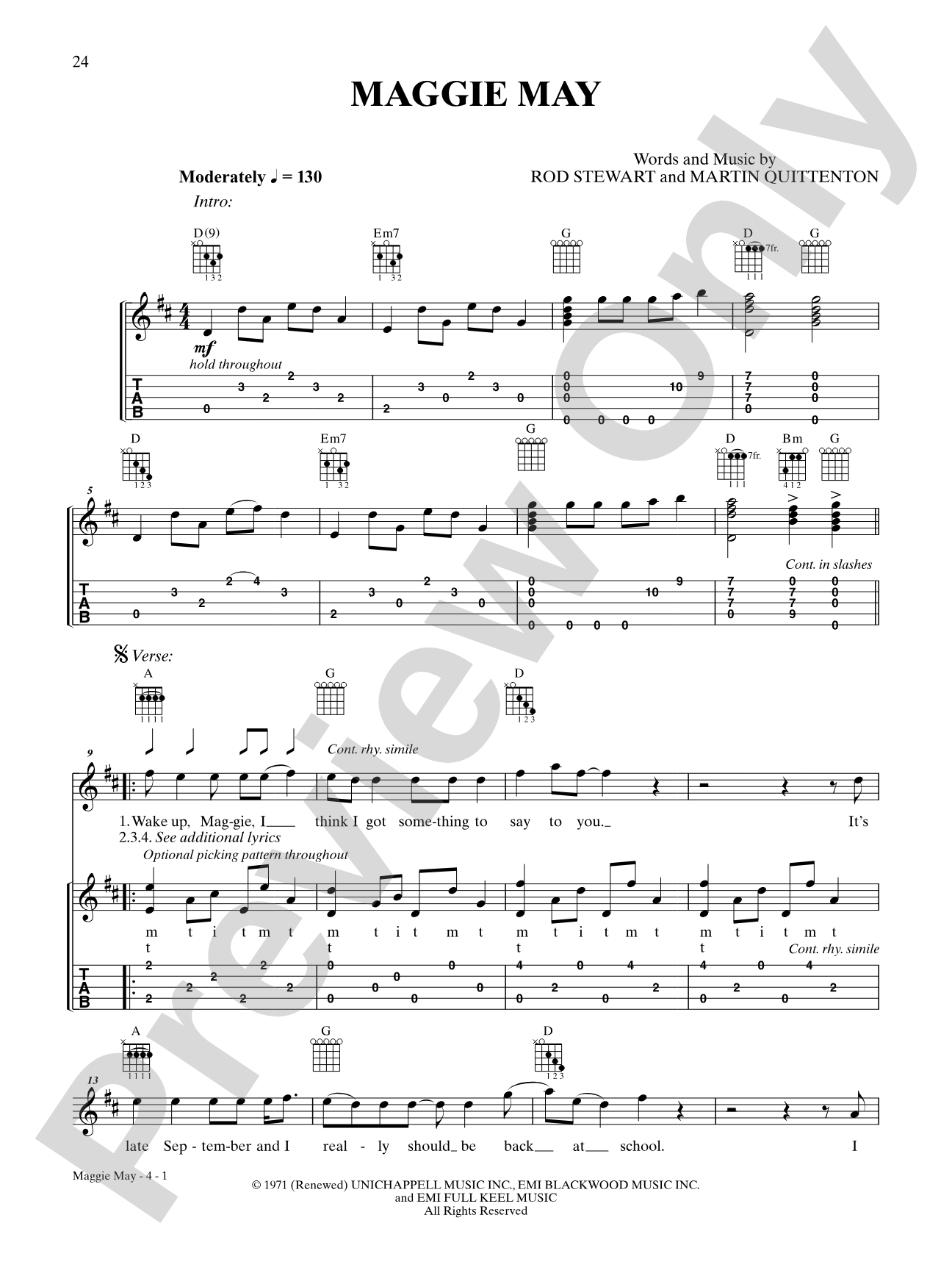

Maggie May: Banjo TAB
12 Great Songs of the '60s, '70s & '80s
Item: 00-PS-0011946
$4.99
One moment…
Related Items
Paint It, Black: Banjo TAB |
$4.99
|
View | |
It's All Over Now: Banjo TAB |
$4.99
|
View | |
Long Train Runnin': Banjo TAB |
$4.99
|
View | |
The Night They Drove Old Dixie Down: Banjo TAB |
$4.99
|
View | |
Stairway to Heaven: Banjo TAB |
$5.99
|
View | |
After Midnight: Banjo TAB |
$4.99
|
View | |
Sunshine of Your Love: Banjo TAB |
$4.99
|
View |
Description
Classic Rock Banjo is designed for your total enjoyment. Each song uses the original guitar parts arranged for the banjo. Also, we've added some suggested roll and picking patterns to add to the fun. Titles: After Midnight (Eric Clapton) * Go Your Own Way (Fleetwood Mac) * Hotel California (Eagles) * It's All Over Now (The Rolling Stones) * Jump (Van Halen) * Long Train Runnin' (The Doobie Brothers) * Maggie May (Rod Stewart) * The Night They Drove Old Dixie Down (The Band) * Paint It, Black (The Rolling Stones) * Stairway to Heaven (Led Zeppelin) * Sunshine of Your Love (Cream) * Truckin' (Grateful Dead).


Maggie May: Banjo TAB isn't in MakeMusic Cloud just yet...but it could be. Let us know you'd like to see it, and you'll help shape what comes next. In the meantime, start a free trial and dive into thousands of interactive titles your students can play along with today.
Request This Title
Tell us you want it.
Start Your Free Trial
Explore everything that's ready to play right now.
Sample Audio
No sample audio found.
Sample Video
No sample videos found.
Additional Details
Series:
Just for Fun
Publisher:
Alfred Music
Page Count:
64
SKU:
00-PS-0011946
More about this title
About the Composer: Rod Stewart
Rod Stewart became one of rock's most distinctive voices during the 1970s, blending blues-influenced vocals with folk and rock sensibilities. His songwriting often drew from personal experience and storytelling, creating songs that resonated across generations of listeners. Martin Quittenton, who co-wrote "Maggie May" with Stewart, was a guitarist and songwriter whose contributions helped shape some of Stewart's most enduring work during this era.
Why we love this
This folio captures genuine classic rock hits that banjo players actually want to learn, arranged directly from the original guitar parts rather than retrofitted from vocal melodies. The inclusion of suggested roll and picking patterns gives students concrete techniques to explore while working through recognizable songs that make practice feel like playing music, not completing exercises.
What to expect
Hearing these iconic rock songs adapted for banjo creates an unexpected collision between instrument and genre that feels both irreverent and musically authentic. The arrangements honor the original guitar parts while revealing the banjo's capacity for the rhythmic drive, sustain, and tonal color that made these records unforgettable.
Who it's for
Banjo players who want to move beyond traditional bluegrass and folk idioms into classic rock repertoire, including intermediate to advanced students looking for recognizable material that builds chops and expands musical vocabulary. This collection works equally well for solo practice and as a foundation for arranging with other instrumentalists.
How to get the most out of it
- Study the suggested picking and roll patterns provided for each song; these patterns unlock the rhythmic feel of the original arrangements and give you options for interpreting the parts.
- Pay attention to dynamics across the full 64-page collection, since these songs span different eras and styles. Some require driving, energetic picking while others call for more subtle phrasing.
- Track tempo carefully, especially on longer pieces like "Stairway to Heaven" and "Hotel California," where maintaining steady time through extended sections is essential for group performance.
How to use it
Use individual pieces from this collection in student recitals or informal jam sessions where banjo players can shine outside traditional contexts. The variety of tempos and styles makes it suitable for pairing with students at different levels within a single performance, or for introducing banjo to audiences more familiar with rock than roots music.
Skills your students will build
- Arranging and adapting guitar-centered compositions for banjo tuning and technique
- Reading and applying varied roll patterns (forward roll, backward roll, alternating rolls) in musical context
- Maintaining rhythmic precision in standard and syncopated picking patterns across multiple tempos
- Navigating genre conventions outside traditional banjo literature