
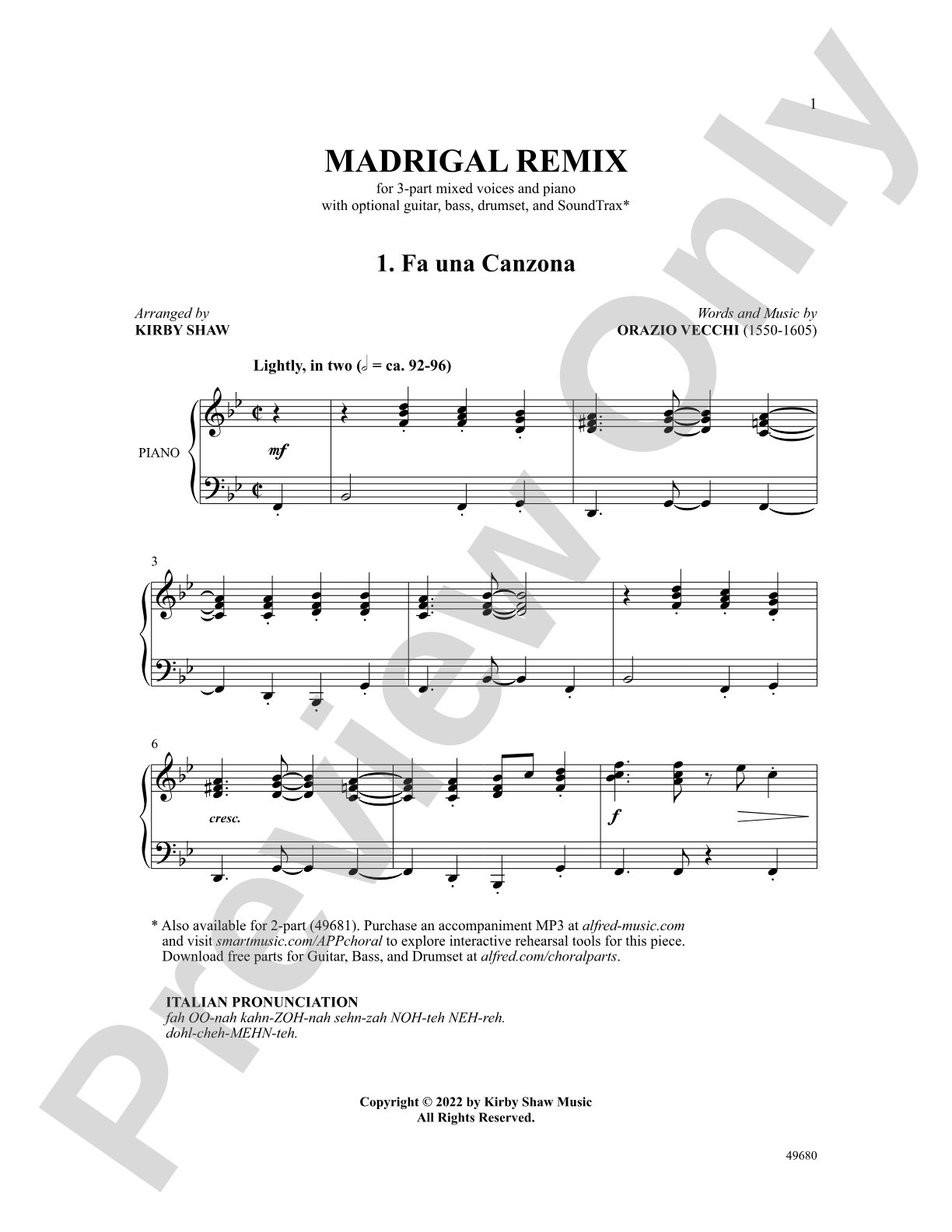
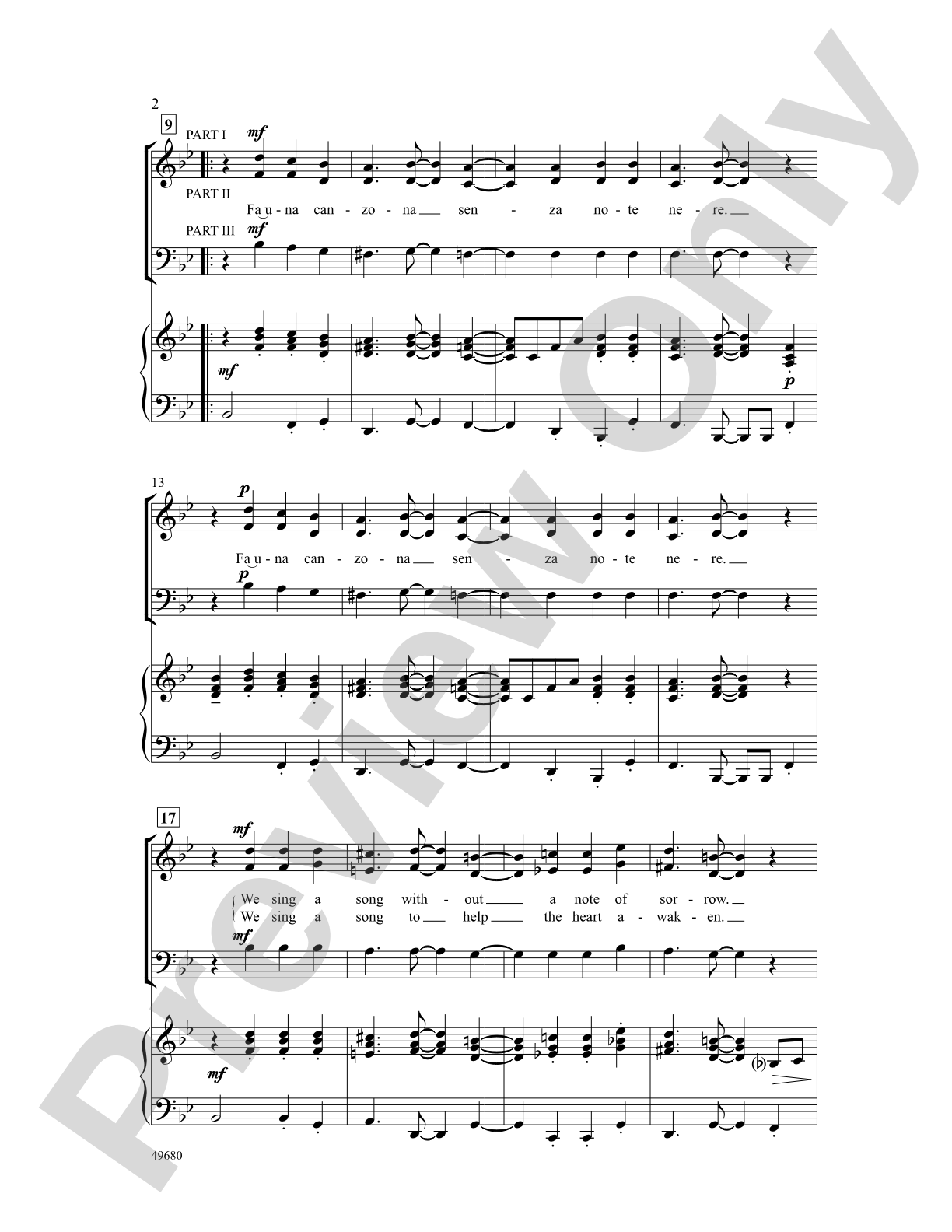

Madrigal Remix: 3-Part Mixed Choral Octavo
1. Fa una Canzona 2. Sing We and Chant It
Arr. Kirby Shaw
Item: 00-PO-0006978
$2.20
Minimum order quantity: 20 copies
Pickup currently not available
Description
What a fresh take on standard repertoire! Two brief mainstream madrigals are reimagined with syncopated rhythms and a supportive piano, bass, and drums accompaniment.
TAs part of the PerformancePlus+ series, this title is in the MakeMusic Cloud interactive library. Subscribers can access additional resources, including assessment and recording tools, part-predominant and accompaniment tracks, PDF rehearsal guides, and more.


TAs part of the PerformancePlus+ series, this title is in the MakeMusic Cloud interactive library. Subscribers can access additional resources, including assessment and recording tools, part-predominant and accompaniment tracks, PDF rehearsal guides, and more.
Madrigal Remix: 3-Part Mixed Choral Octavo isn't in MakeMusic Cloud just yet...but it could be. Let us know you'd like to see it, and you'll help shape what comes next. In the meantime, start a free trial and dive into thousands of interactive titles your students can play along with today.
Request This Title
Tell us you want it.
Start Your Free Trial
Explore everything that's ready to play right now.
Sample Audio
1
1 Fa una Canzona
--:--
2
2 Sing We and Chant It
--:--
1 Fa una Canzona
0:00
0:00
Sample Video
Additional Details
Series:
Alfred Choral Designs
Publisher:
Alfred Music
Page Count:
8
SKU:
00-PO-0006978
More about this title
About the Arranger: Kirby Shaw
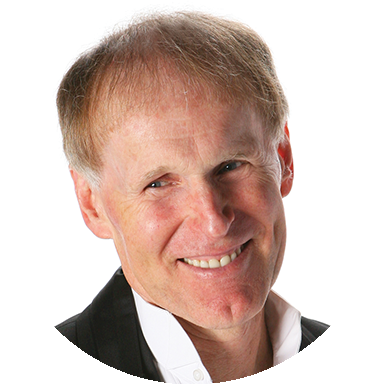
Kirby Shaw's influence on choral music education spans decades and continents. With formal training in music education, choral composition, and choral conducting from San Jose State University and the University of Washington, Shaw has brought his distinctive blend of musicality and humor to ensembles across North America, Europe, and beyond. He founded and directed acclaimed vocal jazz programs at the College of the Siskiyous, Colorado State University, and the University of Missouri at Kansas City, and currently directs the Jefferson State Choral Coalition at Southern Oregon University.
Shaw's prolific output as a composer and arranger is staggering: over 2,500 choral works in print, nearly 20 million copies sold worldwide, and multiple ASCAP awards to his name. His arrangements have shaped choral repertoire for generations, and his work carries the mark of someone who understands both the mechanics of good voice writing and the joy that comes from singing it. Beyond sheet music, Shaw co-authored an original musical adaptation of A Christmas Carol with his wife Markita, and has served as a mentor to countless musicians through workshops and direct collaboration.
Why we love this
Shaw takes two canonical madrigals and strips away the dusty reverence that often surrounds them, replacing it with syncopated energy and a modern rhythm section. The result feels both playful and serious—a genuine reexamination of how these centuries-old forms can speak to contemporary singers. The piano, bass, and drums accompaniment do the heavy lifting, freeing your singers to focus on precision and joy rather than sustaining through thick vocal textures.
What to expect
Fresh and propulsive, with the intellectual bones of madrigal writing wrapped in contemporary rhythmic language. The syncopated figures feel natural rather than forced, and the rhythm section gives the whole piece a buoyant quality that makes even tightly-voiced moments sparkle. There's humor in the arrangement without being silly—a genuine respect for both the source material and the singers performing it.
Who it's for
Three-part mixed ensembles looking for repertoire that honors choral tradition while speaking to modern audiences. This arrangement works well for high school and college choirs with solid rhythmic foundation and the flexibility to embrace contemporary accompaniment textures. Directors seeking approachable madrigal literature that doesn't require soloistic singers or elaborate historical context will find an ideal fit here.
How to get the most out of it
- Lock the rhythm section entrance with your singers from the first rehearsal; the syncopation works only when everyone trusts the groove.
- Use the recorded accompaniment tracks to establish tempo and feel before independent rehearsals become counterproductive.
- Encourage singers to listen past their own part to the bass line; it will anchor the syncopated moments that might otherwise feel unstable.
- Balance the madrigal's textural clarity against the modern rhythmic drive; neither should overwhelm the other.
How to use it
These two madrigals pair well with other Shaw arrangements or contemporary choral works in a concert exploring how classical forms evolve. They also make excellent bridges between traditional madrigal literature and more modern secular repertoire, useful in concerts where you're building a narrative about genre and style. The eight-page length makes them efficient programming choices for variety without overshadowing a concert's longer anchor works.
Skills your students will build
- Reading and executing syncopated rhythms against steady accompaniment
- Balancing independence and interdependence in three-part voicing
- Responding to rhythm section cues and modern accompaniment textures
- Ensemble tuning in close-voiced harmonic writing
- Performing madrigals with contemporary stylistic flexibility