
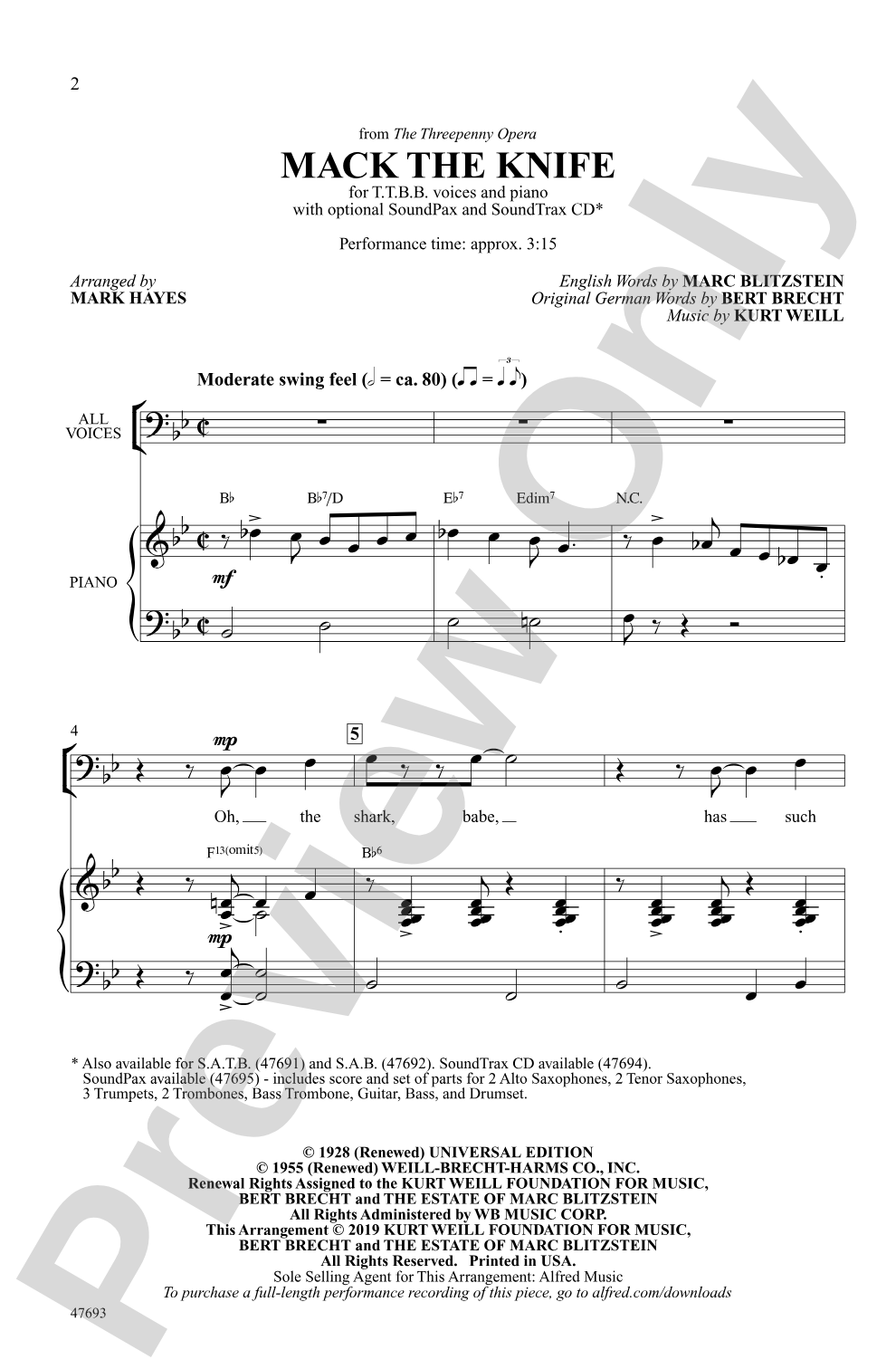

Mack the Knife: TTBB Choral Octavo
from The Threepenny Opera
English words by Marc Blitzstein, original German words by Bert Brecht, music by Kurt Weill / arr. Mark Hayes
Item: 00-PO-0006069
$2.25
Minimum order quantity: 20 copies
One moment…
Related Items
Mack the Knife: SoundTrax Digital Audio Download |
$29.99
|
View | |
Mack the Knife: SATB Choral Octavo |
$2.25
|
View | |
Mack the Knife: SAB Choral Octavo |
$2.25
|
View | |
Mack the Knife: SATB Choral Octavo |
$2.25
|
View | |
Mack the Knife: SAB Choral Octavo |
$2.25
|
View | |
Mack the Knife: TTBB Choral Octavo |
$2.25
|
View | |
Mack the Knife: Choral SoundTrax CD |
$29.99
|
View |
Description
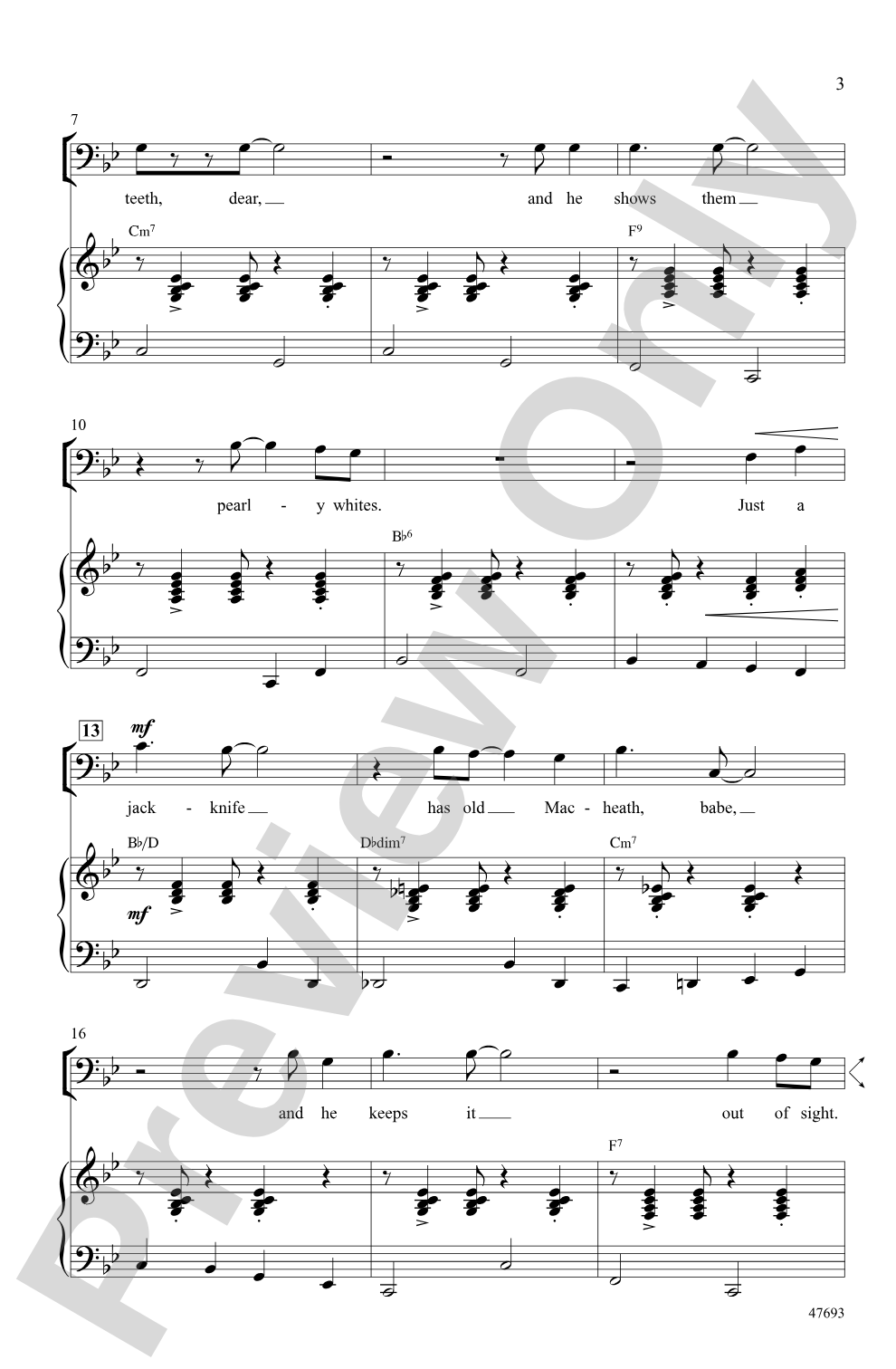
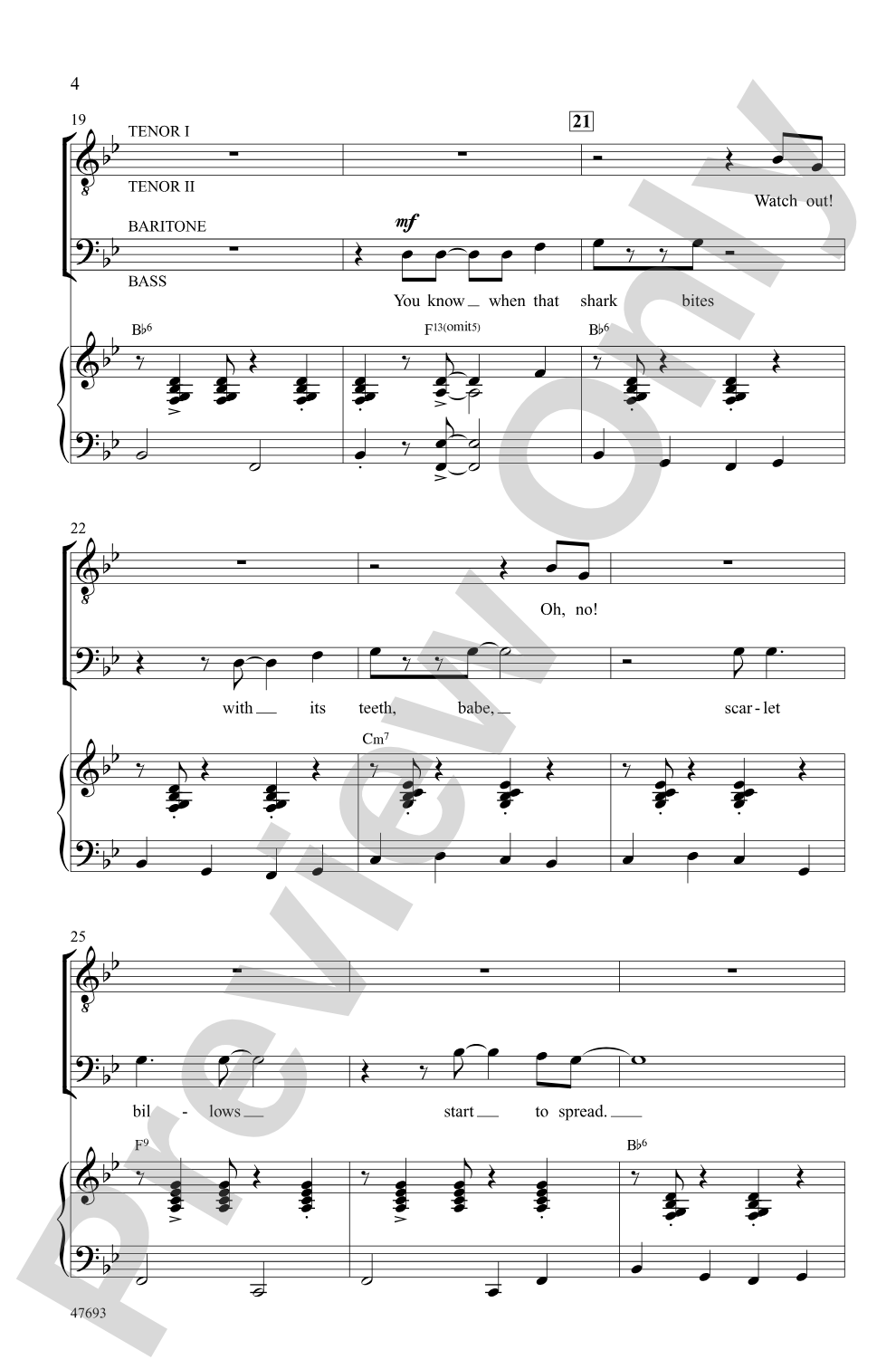
Originally written for The Threepenny Opera and famously covered by the likes of Louis Armstrong, Bobby Darin, and Frank Sinatra, this song has become one of the best-known jazz standards of the twentieth century. Mark's arrangement captures all the style of Kurt Weill's original score, building in excitement right to the very end. Perform with the swingin' piano accompaniment, add live horns and rhythm with the optional SoundPax, or check out our hip live-instrument SoundTrax CD.


Mack the Knife: TTBB Choral Octavo isn't in MakeMusic Cloud just yet...but it could be. Let us know you'd like to see it, and you'll help shape what comes next. In the meantime, start a free trial and dive into thousands of interactive titles your students can play along with today.
Request This Title
Tell us you want it.
Start Your Free Trial
Explore everything that's ready to play right now.
Sample Audio
1
Audio File
--:--
0:00
0:00
Sample Video
Additional Details
Series:
Alfred Pop Choral Series
Publisher:
Alfred Music
Page Count:
16
SKU:
00-PO-0006069
More about this title
About the Composer: Kurt Weill
Kurt Weill (1900-1950) was a German-American composer who bridged classical training and popular music with startling originality. His work with librettist Bertolt Brecht on The Threepenny Opera (1928) created some of the twentieth century's most enduring songs, blending operatic craft with the raw energy of jazz and cabaret. Weill's gift was making sophisticated harmonies and social commentary feel immediate and singable; his melodies lodged in listeners' ears while his harmonic language kept musicians intellectually engaged.
Weill immigrated to America in 1935 and continued writing for Broadway and film, proving that popular music and artistic integrity were not mutually exclusive. For choral directors, his work offers a rare opportunity: scores that respect singers' musicality while remaining genuinely accessible to audiences. His arrangements and compositions demand clarity, style awareness, and ensemble precision, making them ideal vehicles for teaching both technique and interpretation.
Why we love this
Mark Hayes's arrangement strips away nothing essential from Weill's original while tailoring it perfectly for male voices. The harmonic sophistication stays intact, the swing feel is unmistakable, and the buildup genuinely lands. You get a song that works equally well as a concert closer or a high-energy moment in a pops program, and your singers will love the swagger of it.
What to expect
Urbane, slightly dangerous, and impossibly cool. The melody carries dark humor; the accompaniment swings with a smoky confidence. This is a song about a morally compromised character, but the arrangement lets you enjoy the style of it without ever winking at the audience.
Who it's for
TTBB choirs looking for a showstopper with legitimate musical substance. This works for college groups, community choruses, and advanced high school men's ensembles who are comfortable with jazz phrasing and can handle the harmonic language Weill wrote.
How to get the most out of it
- Let the piano accompaniment breathe on the intro and during the verse; the arrangement relies on space to establish the jazz feel before the voices enter.
- Shape the dynamic curve toward the final chorus. Hayes has written this to escalate, so track your energy arch across the whole piece and make sure each section feels like it's building.
- Nail the rhythmic precision in the swing sections. Weill's melodies are memorable, but they only lock when the harmonic support underneath is locked. Your bass section carries this responsibility.
- If you add SoundPax or horns, keep your balance clinical in rehearsal first. Once you know the core arrangement, the added instruments elevate it rather than bury it.
How to use it
Pair this with other Great American Songbook standards for a focused set, or use it as the jaw-dropping moment in a mixed pops concert. It also sits naturally alongside other Weill works if you're building a theatrical music program. The 16-page score gives you room to take your time with rehearsal and performance.
Skills your students will build
- Swing phrasing and jazz articulation in a classical choral context
- Reading complex harmonic progressions written for male voices
- Dynamic shaping and ensemble balance within a fixed-tempo style piece
- Interpreting lyrics with character and intention in a secular vocal line