
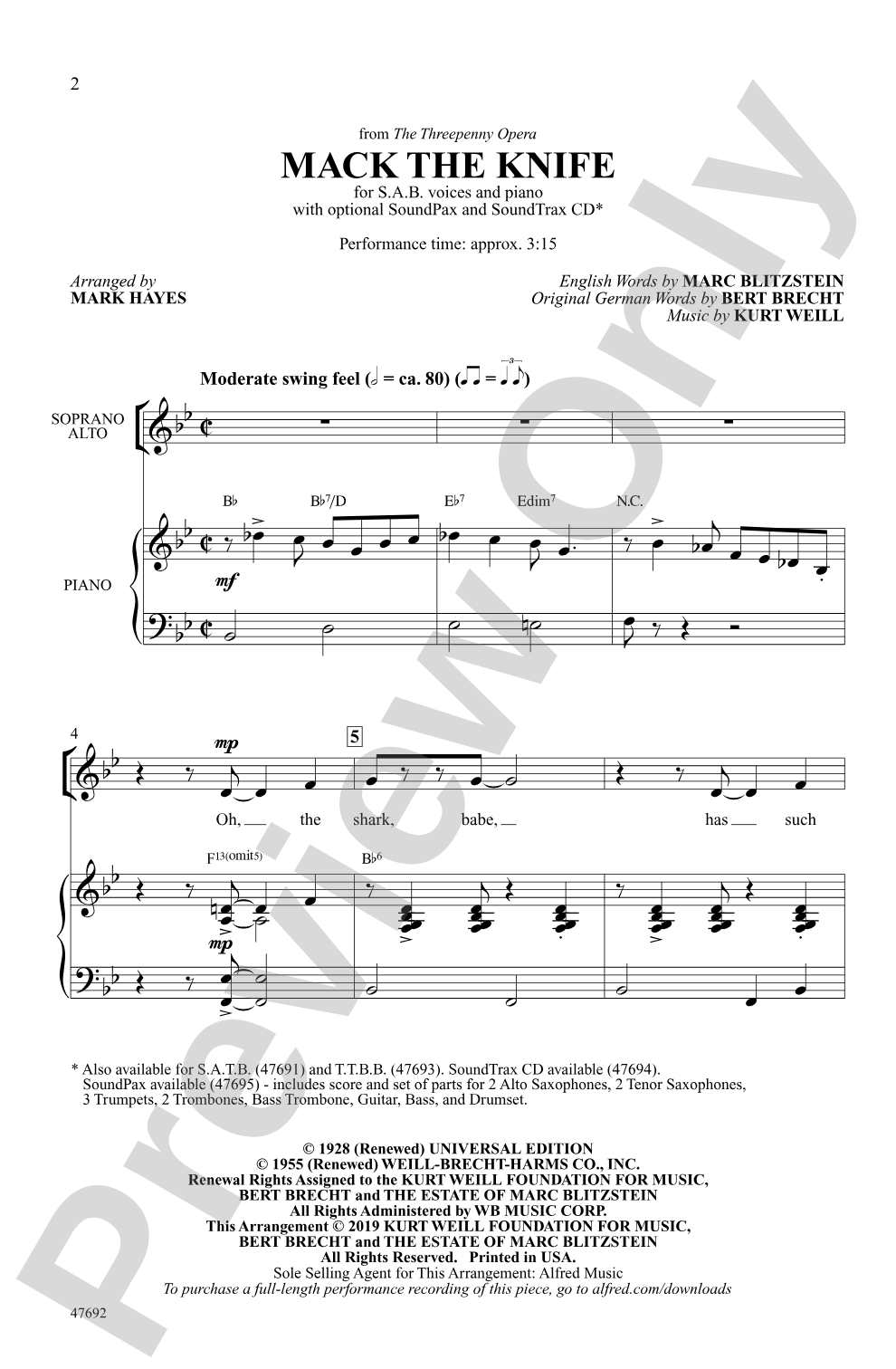

Mack the Knife: SAB Choral Octavo
from The Threepenny Opera
English words by Marc Blitzstein, original German words by Bert Brecht, music by Kurt Weill / arr. Mark Hayes
Item: 00-PO-0006068
$2.25
Minimum order quantity: 20 copies
One moment…
Related Items
Mack the Knife: SoundTrax Digital Audio Download |
$29.99
|
View | |
Mack the Knife: SATB Choral Octavo |
$2.25
|
View | |
Mack the Knife: TTBB Choral Octavo |
$2.25
|
View | |
Mack the Knife: SATB Choral Octavo |
$2.25
|
View | |
Mack the Knife: SAB Choral Octavo |
$2.25
|
View | |
Mack the Knife: TTBB Choral Octavo |
$2.25
|
View | |
Mack the Knife: Choral SoundTrax CD |
$29.99
|
View |
Description
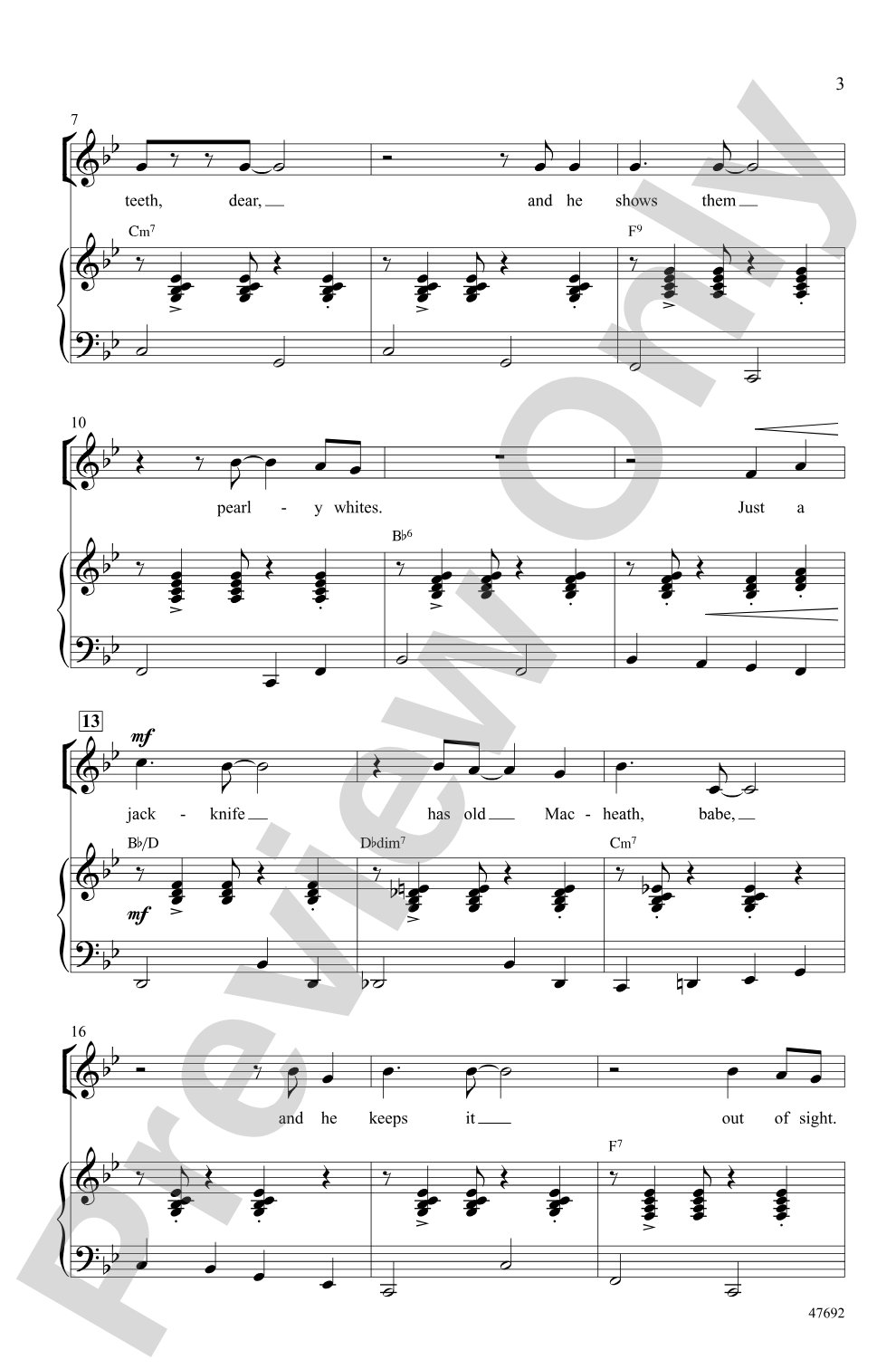
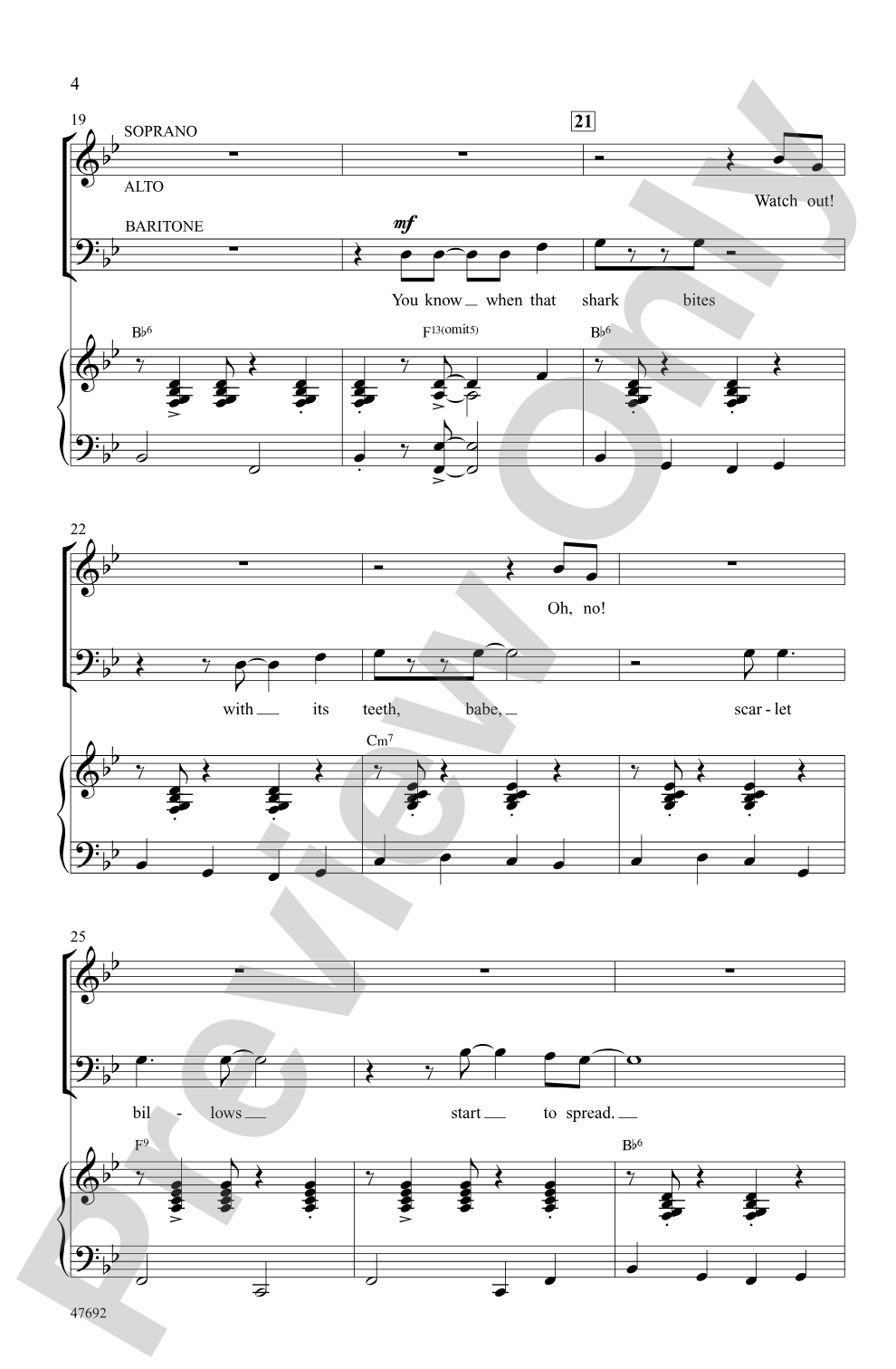
Originally written for The Threepenny Opera and famously covered by the likes of Louis Armstrong, Bobby Darin, and Frank Sinatra, this song has become one of the best-known jazz standards of the twentieth century. Mark's arrangement captures all the style of Kurt Weill's original score, building in excitement right to the very end. Perform with the swingin' piano accompaniment, add live horns and rhythm with the optional SoundPax, or check out our hip live-instrument SoundTrax CD.


Mack the Knife: SAB Choral Octavo isn't in MakeMusic Cloud just yet...but it could be. Let us know you'd like to see it, and you'll help shape what comes next. In the meantime, start a free trial and dive into thousands of interactive titles your students can play along with today.
Request This Title
Tell us you want it.
Start Your Free Trial
Explore everything that's ready to play right now.
Sample Audio
1
Audio File
--:--
0:00
0:00
Sample Video
Additional Details
Series:
Alfred Pop Choral Series
Publisher:
Alfred Music
Page Count:
16
SKU:
00-PO-0006068
More about this title
About the Composer: Kurt Weill
Kurt Weill (1900, 1950) was a German-American composer who revolutionized musical theater by fusing classical training with popular idioms, jazz inflections, and biting social commentary. His collaboration with playwright Bertolt Brecht on The Threepenny Opera produced some of the most enduring songs of the twentieth century, including "Mack the Knife," which proved that songs written for the stage could achieve independent life as standards.
Weill's genius lay in his ability to write music that felt both sophisticated and immediately accessible. His melodies were memorable without being simple, and his harmonic language, informed by German Expressionism but always grounded in singable lines, made his work a bridge between concert music and popular song. For educators, Weill's output offers a window into how theatrical music shapes culture and how compositional craft serves storytelling.
Why we love this
Mark Hayes captures the swagger and menace of Weill's original without getting bogged down in period pastiche. The arrangement builds momentum intelligently, letting the text do its work before the music amplifies the final payoff. For SAB ensembles, this hits that sweet spot where the voicing feels natural and idiomatic to the style rather than merely adapted.
What to expect
Slick and dark, like watching a street hustler work a crowded marketplace. The music has the polish of a Broadway stage number but with an undercurrent of danger; it swings without winking, making you complicit in Mack's schemes even as you're horrified by them.
Who it's for
Intermediate to advanced high school and college choirs, community groups, and adult singers who want to perform a twentieth-century standard with historical credibility. Directors seeking a crowd-pleasing arrangement that doesn't sacrifice musical substance will find this invaluable for concert programming.
How to get the most out of it
- Commit to the swing feel from measure one. Even in the verses, the rhythm section should sit slightly behind the beat rather than dead center; this creates the groove that makes the song distinctive.
- Shape the dynamic arc carefully across the form. Resist the urge to jump to full volume too early; the arrangement's effectiveness depends on having room to grow toward the climax.
- If using the optional SoundPax or live horns, bring them in during rehearsal before the final week so singers adjust to sharing space rather than carrying the full texture themselves.
- Emphasize clear diction on the text, particularly consonants in the upper voices. The story matters here, and audiences need to hear what Mack is up to.
How to use it
This works beautifully in a program exploring the Great American Songbook or in a concert built around theatrical music from the twentieth century. Pair it with other Weill numbers, American jazz standards, or Brecht-inspired works for historical context. It also serves as an accessible gateway to more challenging modern repertoire for groups still building confidence with contemporary idioms.
Skills your students will build
- Singing with a swing feel and controlling the rhythmic placement relative to the beat
- Balancing homophonic and contrapuntal textures within a single arrangement
- Interpreting text with attitude and dramatic intention rather than literal sentimentality
- Managing blend when optional instrumental parts are added to the core vocal arrangement
- Understanding the relationship between theatrical context and how a song is shaped musically